





 Portuguese
  English
  Spanish
  8 min of reading
  0 comments


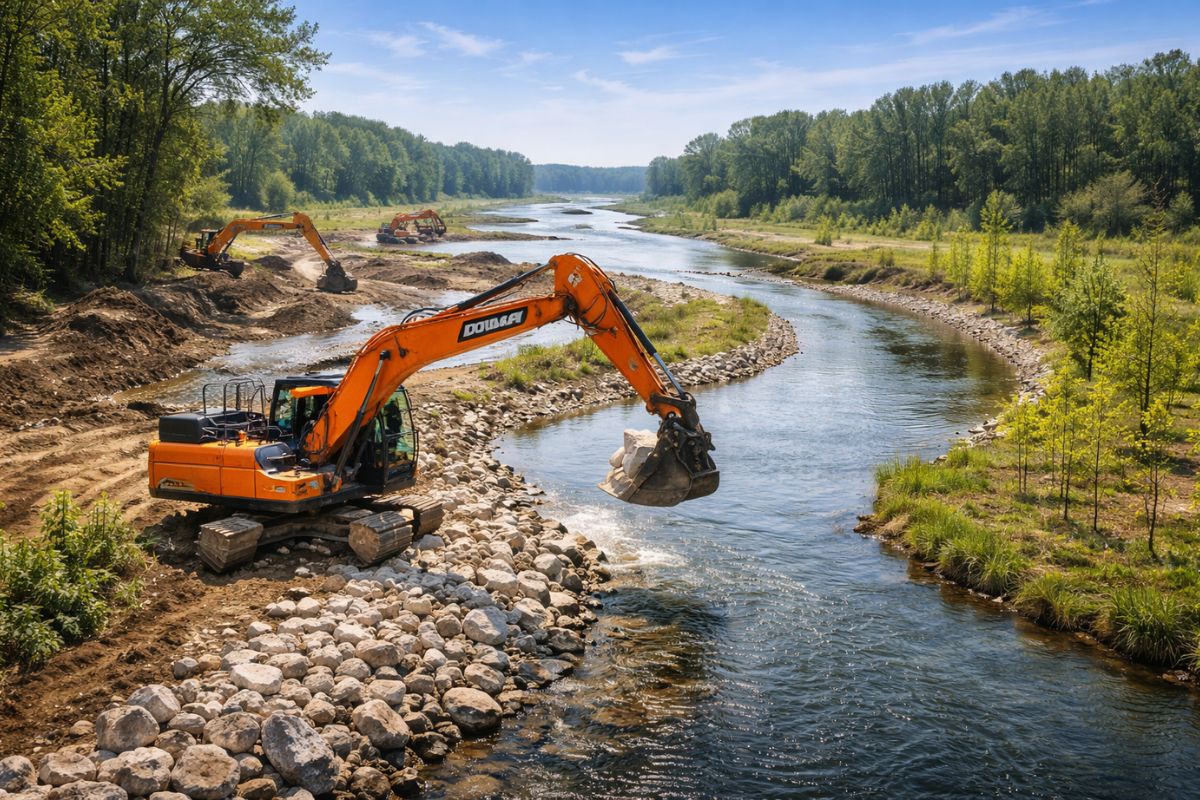
Renaturalization of the Po River, Executed by AIPo with Funding from the PNRR Next Generation EU, Brings Together Interventions on River Morphology, Renaturalization, and Control of Exotic Plants, as Well as Bank Works. The Goal is to Restore Habitats, Reduce Hydrogeological Problems, and Complete 37 Km by March 31, 2026 in the Territory.
Machines and excavators advance over 37 km of the Po River to undo artificial interventions accumulated over time, reopen water arms, reactivate floodable areas, and restore natural banks with riverside reforestation. The objective is direct and measurable: reconstruct habitats, increase biodiversity, and reduce risks associated with flooding and hydrogeological instability, returning part of its original ecological dynamics to the longest river in Italy.
The global goal is to complete the renaturalization of this stretch by March 2026, with highlighted areas in the Cremona region, covering Motta Baluffi, Stagno Lombardo, San Daniele Po, and Torricella del Pizzo. The operational execution is being carried out by AIPo, under the investment of the PNRR, in an arrangement that integrates central government, basin authority, and regions, aligned with the public timeline presented at a meeting held in Mantua.
An Ecological Corridor Under Reconstruction in the Po River

The investment called “Renaturalization of the Po River Area” focuses on restoring the ecological corridor formed by the riverbed and its riparian zones.
-
Something is happening around the Earth: Inside the huge explosion of fireballs in 2026

-
A hot air bubble coming from Argentina expands over Brazil, causing thermometers to exceed 38 degrees with a thermal sensation of 40 degrees in late March, affecting 6 states at once.

-
The radish leaf that almost everyone throws away has more polyphenols, flavonoids, and fiber than the consumed root, and a 2025 study showed that the leaf contains compounds that protect the intestine, combat inflammation, and may inhibit the growth of cancer cells.

-
A planet that seemed to defy the laws of physics has intrigued scientists for decades, until the James Webb revealed what is really affecting Saturn’s rotation.


This means acting on the system as a whole, treating water, sediments, banks, and vegetation as interconnected parts, with expected gains in natural habitats, biodiversity, and requalification of portions of the basin.

Within this design, actions such as reactivating lakes and river arms appear.
In practice, the logic is to bring the Po River closer to a more functional configuration from an ecological point of view, in which the river converses again with its floodplain and its lateral elements, creating conditions for more varied and stable habitats.
Who Executes and Who Coordinates the Investment

The execution is assigned to AIPo, the Inter-regional Agency of the Po River, defined as the executing entity of the investment financed by PNRR Next Generation EU funds, under measure M2C4.3, Investment 3.3.
The intervention plan involves the Ministry of the Environment and Energy Security, the Po River Basin Authority, the Regions of Piedmont, Emilia-Romagna, Lombardy, and Veneto, in addition to AIPo itself.
This institutional arrangement is important because it provides scale and governance to the project. This is not an isolated work, but a set of interventions with physical deliveries, contractual milestones, environmental targets, and closed deadlines, which need to be aligned with the economic activities of the territory, especially agriculture, the wood supply chain, navigation, and tourism.
The Timeline Presented in Mantua and the Public Accountability
The central message of the meeting held in Mantua was that implementation is progressing according to the established schedule. The “Renaturalization of the Po River Area – Status of Implementation of the Investment Funded by the PNRR – Next Generation EU” meeting was organized by AIPo at Casa del Mantegna and represented the second public event in the region, following an earlier event in Parma on October 2.
At the opening, local authorities were present, such as the president of the province of Mantua, Carlo Bottani, and the environmental and territorial planning advisor of the municipality of Mantua, Andrea Murari. Among the cited participants were names directly linked to the design and management of the investment, including the regional councilor of Lombardy for Territory and Green Systems, Gianluca Comazzi, the general secretary of the Po River Basin Authority, Alessandro Bratti, the director of AIPo, Gianluca Zanichelli, and the responsible manager within AIPo, Mirella Vergnani, linked to ecological transition and soft mobility.
The Goal of the PNRR: Reduce the Artificiality of the Po Riverbed by 37 Km

The goal established by the investment is explicit: “reduction of the artificiality of the Po River bed” over 37 km by March 2026.
This segment of 37 km is the physical target of the renaturalization work, which combines interventions in the design and dynamics of the bed with actions for recovering banks and vegetation.
Additionally, there are targets related to reforestation and control of non-native plants. At this point, the project has already recorded a milestone achieved: 337 hectares of area related to reforestation actions and control of non-native plant species.
Line M: Interventions on the River Morphology and Sections Already Delivered

The interventions of line M are described as actions on the river’s morphology. Within the so-called “priority stretch,” the first five interventions have a total value of € 72,100,000, making up the first block of greater visibility and monitoring.
In this set, two interventions are reported as effectively completed:
Section No. 6, involving Camino, Morano sul Po, Pontestura, and Coniolo, in the province indicated as AL
Section No. 8, in Bassignana, also in the reference AL
Two others appear to be practically finalized, with 90% completion:
Section No. 27, including Roccabianca, in reference PR, and Motta Baluffi and Torricella del Pizzo, in reference CR
Section No. 32, involving Sorbolo-Mezzani, in reference PR, and Viadana, in reference MN
These percentages are an important operational signal because they indicate that, in the execution design of the Po River, delivery does not depend on a single worksite, but on multiple fronts with different stages, requiring management of contracts, construction logistics, and environmental monitoring in parallel.
Section No. 33: Interruption Due to Explosive Artifact and New Forecast
Section No. 33, which involves Viadana in reference MN and Brescello and Boretto in reference RE, had a forced suspension after the discovery of an explosive artifact in December.
The resumption comes with a new forecast for closure: completion by summer.
This detail, in addition to explaining a specific delay, shows how works on the Po River can handle unforeseen risks during execution, requiring pauses for safety and reprogramming of the timetable, without abandoning the overall final goal of March 2026.
Line R: Renaturalization, Combatting Exotic Vegetation, and Maintenance for Five Years
Line R is described as renaturalization and combat against exotic vegetation. On this front, the works on stretch 6 have been completed, while the other stretches are expected to be finished by the end of March 2025.
A significant component in this front is long-term maintenance: the intervention plan for line R includes five years of care for the culture after the intervention.
This expands the reach of investment in the Po River, because it is not enough to plant, control, or restore. The design allows time to consolidate the result, reducing the risk of reversal due to failures in vegetation establishment or reoccupation by non-native species.
Second Phase 2A: € 82,500,000 and Hiring in Spring for Works in Summer 2025
The second phase of priority works, called 2A, totals € 82,500,000. In this stage, the executive projects are in finalization, with the prospect of hiring the interventions from lines M and R in spring, paving the way for the start of works in summer 2025.
The watersheds and affected areas listed include combinations of municipalities and territorial references, such as Stagno Lombardo in reference CR, Villanova d’Arda in reference PC, Polesine Zibello and Roccabianca in reference PR, in addition to San Daniele Po and Motta Baluffi in reference CR, and nuclei like Boretto and Gualtieri in reference RE. Also listed are Gualtieri in reference RE and Dosolo in reference MN, along with Suzzara and Viadana in reference MN.
The detail of mapping by watersheds and sections reinforces that, in the Po River, execution is planned in technical segments, allowing river morphology, renaturalization, and control of exotic vegetation to advance in an organized manner, with bidding and works distributed across regions.
Line PT: Protection of Banks, Hydraulic Safety, and € 50,600,000 in Projects
In addition to renaturalization and control of vegetation, there is a front dedicated to bank protection focused on hydraulic safety, called line PT.
The estimated value for four projects is € 50,600,000, and all are in the final project phase, with bidding expected in spring 2025.
The projects are planned for areas in Emilia-Romagna and Veneto and are identified by the following numbers and locations:
- Project No. 16 in Caorso, reference PC
- Project No. 49 in Corbola and Papozze, reference RO
- Project No. 52 in Porto Tolle and Porto Viro, reference RO
- Project No. 55 in Santa Giustina-Mesola, reference FE
This front is relevant because it aligns with the very justification of the investment in the Po River: improve the fluvial ecosystem while also reducing the risk associated with floods and vulnerabilities of banks, integrating environmental restoration and hydraulic safety.
What Authorities Highlighted: Water Savings, Agriculture, and Adjustments to the Project
The statements gathered at the meeting connect the Po River to a broad territorial vision.
For Mantua and its surroundings, it was emphasized that water is a fundamental environmental factor as well as economic and productive, with direct reference to agriculture, commercial and recreational navigation, and tourism.
It was also underscored that it is essential to maintain an adequate balance between the renaturalization project and the legitimate needs of the territory, starting with agriculture and the wood supply chain.
In this line, it was reported that important changes were requested and obtained regarding the initial project design, indicating adjustments to align environmental objectives with production realities.
On the technical side, it was noted that the renaturalization project of the Po River brings multiple benefits, both through positive environmental impacts in line with the European Union’s Nature Restoration Law, and by indicating a more effective management of riverbed sediments, a central element for fluvial dynamics and for system stability.
AIPo and the Final Goal: 37 Km by March 31, 2026
The director of AIPo emphasized the renaturalization of the Po River as the most important of the four PNRR projects that the agency is implementing, also citing other fronts such as reservoir plans, water security, and bike paths.
The endpoint, however, remains unequivocal: to achieve the PNRR goal of renaturalization of 37 km of the Po River by March 31, 2026.
In the presentation of plans, director and engineer Mirella Vergnani highlighted that the proposals are the result of in-depth technical and scientific analyses, and that the service conferences of the first and second phases found commitments deemed virtuous between renaturalization goals and the protection of agricultural production.
Why These Details Matter to Understand the Size of the Intervention
When the debate shifts from a generic level into numbers and phases, the picture becomes clearer.
The Po River is at the center of a package that combines physical deliveries in the field, environmental targets already accounted for, such as 337 hectares, and an execution engineering framework with multiple sections, values, and schedules.
There are completed works, works at 90%, and one work that was interrupted for safety, with an adjusted forecast.
There is a renaturalization line with a deadline until March 2025 and maintenance for five years. There is a second phase of € 82,500,000 with hiring in spring and works in summer 2025.
And there are bank projects of € 50,600,000 with bidding anticipated in spring 2025. Together, these elements show a renaturalization program with governance, deadlines, and explicit territorial scope, not just a one-off intervention.
In your opinion, will the Po River manage to balance renaturalization and agricultural protection without losing strength on either side?







-

-

-

-

-

-

78 pessoas reagiram a isso.