





 Portuguese
  English
  Spanish
  8 min of reading
  0 comments


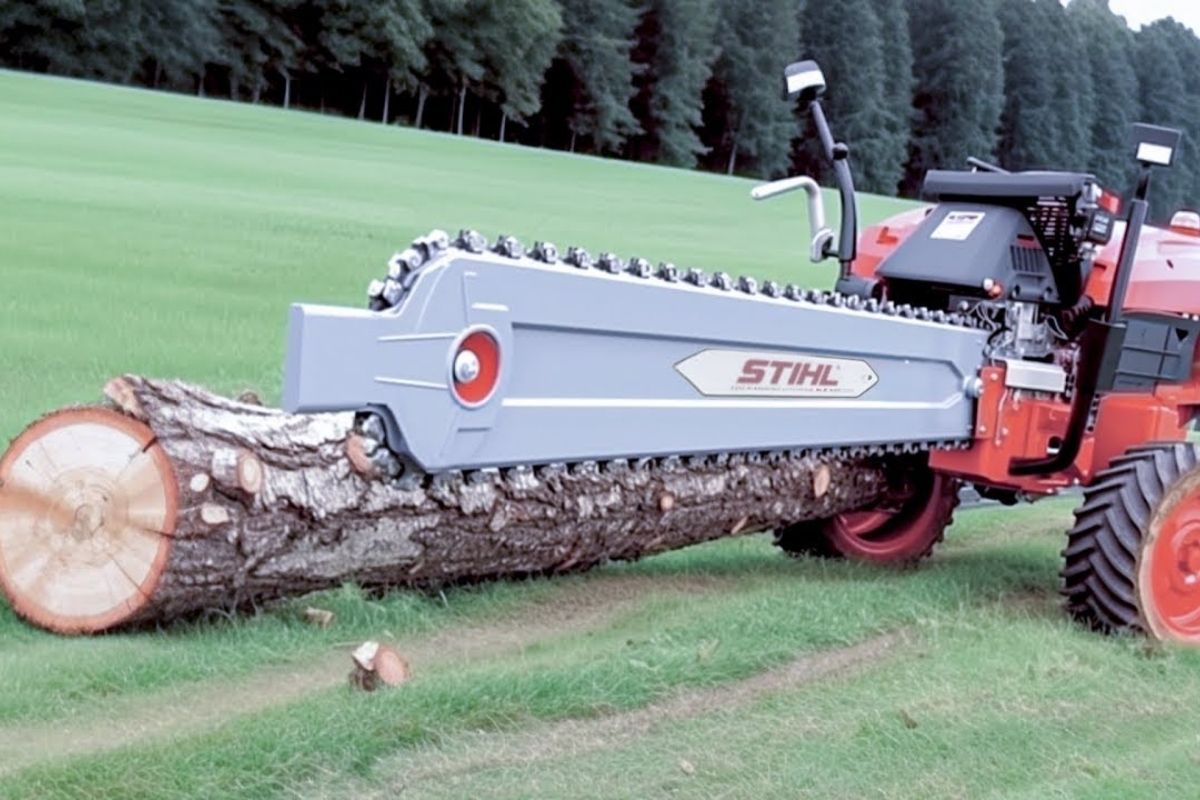
Automated Forestry Machines Transform Wood Into Finished Product Right On The Ground, Joining Quick Cutting, Continuous Feeding, Grinding And Splitting With Cabin Safety, Dual Torque And High-Power Drums To Increase Productivity And Reduce Human Effort.
In forestry operations, the scene has changed from a set of separate steps to a mobile industrial flow. Automated forestry machines now execute, in the same cycle, tasks that previously required teams, various tools, long breaks, and constant risk around heavy logs.
The change appears in the set: grabs that position and rotate, saws that quickly fell thick trees, feeding systems that push and stabilize, modules that debark and cut, grinders that swallow waste, and splitters that deliver standardized firewood. The result is a line of production that rolls on wheels or belts, with the operator protected and the wood moving until it becomes a piece, chip, or sawdust.
Quick Cutting Of Thick Trees And Immediate Gain In Efficiency

In forests with large-diameter trees, the first bottleneck has always been the cutting.
-
Few remember, but the submarine that disappeared in 1968 with 52 crew members was found after 51 years at the bottom of the sea at more than 2,000 meters, intriguing the entire world.

-
With 1,200 tons suspended, the Japan mega-structure in a grid shape with a floating sphere from Fuji TV features two 25-story towers connected by elevated walkways, titanium panels, and impresses the world with its ability to reduce wind impact.

-
The village where two rivers run side by side without mixing in Santarém and Alter do Chão reveals some of the most beautiful freshwater beaches on the planet.

-
Brazil’s nuclear submarine with a speed 5 times greater than normal advances after nearly 50 years and R$ 40 billion spent.


Automated forestry machines solve this with heads and cutting sets capable of acting quickly on thick logs, speeding up the felling and reducing repositioning time.
This quick cutting is not just blade speed.
It is stability of the set, available force, and pressure control at the right point, to cut without clogging, without “biting” unevenly, and without requiring repeated attempts.
In practice, continuous cutting shortens the most critical stage of the cycle and opens space for what comes next: processing the tree immediately.
Dual Torque And Power Maintained At The Same Speed

The logic of torque appears as a technical divider.
The system of dual torque delivers more power at the same speed, maintaining available energy to push, rotate, feed, and work in difficult conditions.
This changes two things at once.
First, the machine sustains productivity when the terrain and wood make the job more challenging.
Second, the operator does not need to force the operation with extra maneuvers to compensate for lack of power, because the torque delivery helps maintain a stable cycle from start to finish.
In forestry operations, constant force means fewer interruptions, less trial and error, less retreat, and more predictability per hour worked.
Automated forestry machines with dual torque begin to behave like factory equipment, only in the midst of the forest.
Grab With Chanfering Device And Splitting Already In The Handling Stage


The grab ceases to be merely a “arm that holds.”
With the use of a chanfering device, the grab can be rotated and used to split the wood, incorporating a function that previously depended on another piece of equipment or manual stages.
This detail alters the routine of the yard and the block.
If the grab already positions, rotates, and splits, the wood begins to exit handling with part of the processing completed.
It is the type of integration that defines automated forestry machines as a mobile industrial line: each arm, each support, each fixture does more than one thing.
Safe Cabins And Total Control Even In Poor Terrain
The productivity leap comes along with a change in risk.
Instead of people circulating near logs and cutting points, the operator acts from within a cabin.
The set highlights total control regardless of terrain conditions, with ample space, storage area, and rotating seat to facilitate access and operation.
The rotating seat is not a luxury; it is operational ergonomics.
It allows visualizing and operating rear and side areas without repeated twisting of the body, reducing fatigue, improving reaction, and maintaining precision throughout the shift.
In automated forestry machines, safety is tied to the ability to see well, control well, and operate for longer without losing standards.
Continuous Feeding And Dedicated Systems For Biomass
The industrial flow in the field depends on constant feeding. A well-resolved feeding system reduces clogging, decreases rework, and keeps the wood moving.
This is where solutions like a dedicated feeding system and drum come into play for biomass applications.
When the operation includes biomass, the waste ceases to be excess and becomes an input.
Automated forestry machines begin to treat branches, twigs, and leftovers generated by exploration as processable material, transforming waste into chips or ground cover with a defined destination.
This impacts logistics because it reduces the volume of “loose” material in the terrain and creates standardization.
What previously scattered becomes chips, becomes cover, becomes biomass for later use, all within the operational cycle.
Grinding With 50 Hp And The Removal Of Undesirable Parts From The Ground
Grinding appears as a cleaning and transformation step at the same time.
The description shows a machine with 50 horsepower grinding wood with ease, removing undesirable parts and potentially dangerous debris from the landscape.
When the grinder enters the flow, it solves two problems.
First, the operational one, by dealing with debris that hinders circulation and increases risk.
Second, the utilization one, by transforming this material into chips or ground cover. Automated forestry machines thus become equipment for production and terrain management.
Stable Sawing: Micro-Adjustable Levelers And High-Precision Blade Guides
Mobile industrialization does not solely rely on force; it needs precision. In sawing, stability and alignment are decisive for correct cutting and safety.
The described set features precision machined blade guides, hardened zinc chromate coating, and double sealed ball bearings.
The machine also includes 10 micro-adjustable leveling feet, designed for stable sawing at ground level, keeping the set steady and reducing vibration.
In operation, this means more precise cuts, less misalignment, less “pulling” of the blade, and more repeatability.
In automated forestry machines, repeatability is the technical name for productivity that does not drop. An unstable cut generates correction, waste, and delay. A stable cut becomes standard.
Firewood Processing In Short Cycle: 2.4 Seconds Per Interval
At the final point, firewood processing takes on the appearance of an automatic line.
The fully automatic firewood saw described cuts logs into round wood in intervals of 2.4 seconds, with logs sliding by gravity into a saw chute at an ergonomic height.
This detail of gravity and ergonomic chute is the type of solution that reduces human effort without needing “magic”.
The wood moves on its own in the right direction, the operator supervises, and the machine executes the cut at a fixed pace.
Automated forestry machines begin to replace the logic of brute force with flow, as in an industrial conveyor.
Robust Hydraulic Splitters For Large And Resilient Logs
For large logs, the classic bottleneck is splitting without clogging, without returning, and without exposing people to dangerous effort.
The described splitter is known for its robust hydraulic system and strong splitting force, capable of processing large and resilient logs with ease, featuring easy-to-use controls and safety features directed towards the operator.
The point here is that splitting ceases to be a “heavy phase” and becomes part of the same processing ecosystem.
Automated forestry machines not only cut and move; they also deliver ready-to-use products, with standardized splitting and rhythm.
High-Power Drum And Hourly Productivity In Grinding
The logic of the drum reappears as a measure of production. A medium-power drum with 700 millimeters in diameter is presented as capable of ensuring high efficiency, producing up to 80 cubic meters of sawdust per hour.
This type of number provides dimension to the industrial turnaround.
When the machine begins to produce dozens of cubic meters per hour, the operation changes in scale.
The logistics must keep up; transport needs to be considered, storage and material destination gain importance, and the team profile changes.
From then on, automated forestry machines stop being “large tools” and become mobile production infrastructure, with measurable, predictable, and repeatable capacity.
One Machine For Many Steps: From Soil To Planting
Mechanization appears also outside cutting.
The data from braca P11 allows performing a range of tasks, from scarification to planting, with a single machine, focusing on high-level regeneration, environmental care, and ecological aspects.
This passage indicates an important point: mobile industrialization does not end when the wood exits.
The same logic of efficiency and control tries to enter regeneration and preparation, integrating stages of the forest cycle and shortening the time between exploration, preparation, and recovery.
Damaged Wood Becomes Product And Reduces Infestation Risk
A frequent problem in operations is damaged wood that can be infested by insects.
The description indicates that this wood can be quickly converted into valuable wood, with a machine easy to operate safely, capable of debarking, cutting, sharpening, and splitting.
Here, automated forestry machines come in as a time solution.
The faster problematic material is processed, the smaller the window for loss and for risk of spreading. What previously could turn into waste or delay becomes utilized material.
Replacement Of Teams And Change In The Logic Of Forestry Work
The most visible effect of this package is the replacement of functions.
When a set cuts, feeds, debarks, grinds, saws, and splits, several stages no longer require full teams in the field.
In exchange, dependence on trained operators, maintenance, logistics, and flow planning increases.
Productivity increases because the cycle is closed.
The reduction of human effort appears because the weight, cutting, and repetition shift to the equipment.
And the operation becomes a mobile industrial line because the wood enters raw and exits processed, in rhythm, with cabin safety standards and with coupled functions.
Automated forestry machines change the center of the operation: fewer people around the risk, more control in the cabin, more available force with dual torque, more precision in guides and leveling, more waste utilization with grinding and biomass, and more speed in firewood with intervals of 2.4 seconds.
The forest has not turned into a factory in the sense of a building and fixed conveyor, but it has turned into a factory in the sense of process.
With automated forestry machines, the quick cutting of thick trees, dual torque, high-power drums, biomass processing, and safe cabins drive the wood into a continuous flow, with fewer pauses and less human effort.
In your view, does this transformation by automated forestry machines improve safety and efficiency or create a new risk of total dependence on increasingly complex machines?








-

Uma pessoa reagiu a isso.