





 Portuguese
  English
  Spanish
  14 min of reading
  0 comments


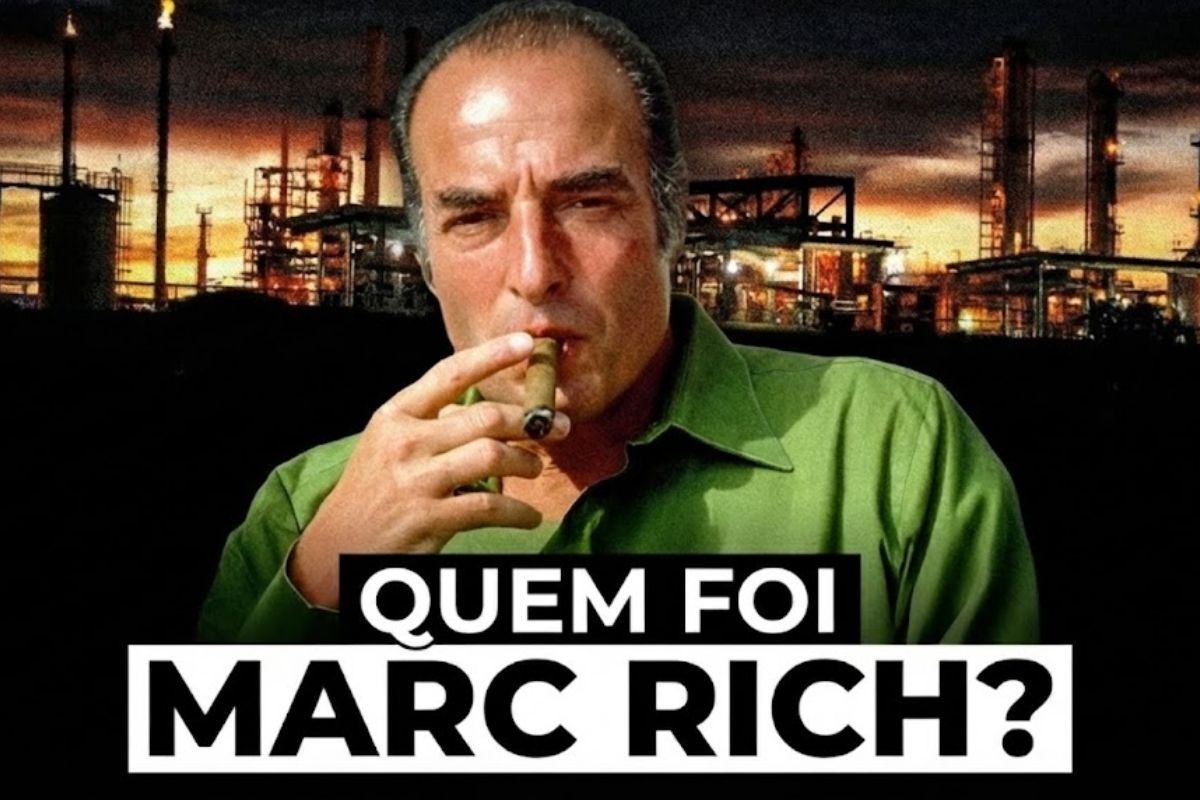
From Jewish Refugee Fleeing Europe to Apprentice at Philip Brothers, Marc Rich Became a Billionaire in Zug, Funded Prohibited Countries, Infuriated the FBI, Helped Israel with Oil, and Divided the World Between Seeing Him as a Financial Genius or a Ruthless Criminal Supported by the Mossad, by Israeli Leaders and by a Pardon.
Marc Rich left a childhood marked by fleeing Nazism in 1941 to become, between the 1970s and 80s, the man who reinvented the global oil trade. In the wake of the oil shocks of 1973 and 1979, he created the spot market, dismantled the power of the Seven Sisters, and built a billion-dollar empire from Zug, Switzerland.
But the peak of Marc Rich came with explosive accusations. Indicted in 1983 for 65 crimes in the United States, pursued by the FBI for 17 years and pardoned by Bill Clinton in 2001, the trader kept operating until his death in 2013, taking to the grave the dual reputation of genius and villain.
Who Was Marc Rich, the Outsider Who Became the King of Oil
Before becoming synonymous with power in the oil business, Marc Rich was just the son of a Jewish merchant in permanent flight.
-
While restoring a historic mansion from 1910, a brick structure with an old turbine that generated energy from the Rio do Testo emerged, along with a hidden door and a rare floor concealed under layers of wax.

-
Italian researchers have detected what appears to be a second Sphinx buried under the sands of Egypt, and satellite scans reveal a gigantic underground megastructure hidden beneath the Giza Plateau for over 3,000 years.

-
There are 4,223 drums and 1,343 metal boxes concreted with 50-centimeter walls that store the radioactive waste from Cesium-137 in the worst radiological accident in Brazil, just 23 kilometers from Goiânia, with environmental monitoring every three months.

-
Giant Roman treasure found at the bottom of Lake Neuchâtel in Switzerland reveals an advanced trade system, circulation of goods, and armed escort in the Roman Empire about two thousand years ago.

His father, David Rich, left Germany in 1933 in the face of Hitler’s rise, moved to Antwerp, then the world’s main diamond trading center, and ended up fleeing again in 1940 when the war made the German invasion inevitable.
In 1941, the family embarked for the United States. David started with a small jewelry store and later prospered importing and exporting various products, capitalizing on opportunities like the Korean War in the 1950s.
Marc Rich grew up in this environment of instability and trade. He never felt fully integrated: he was foreign, Jewish, with a strange accent, always changing schools. He tried college in New York, studying marketing, but dropped out because he wanted to work.
Destiny changed when a friend of his father recommended that he interview at Philipp Brothers, the powerful commodities trading firm known as Philbro. Rich literally started on the factory floor: in the correspondence room.
However, in no time, he attracted attention for his intelligence, obsession with information, and willingness to do business in countries and situations that others avoided.
By the 1960s, Marc Rich was already a significant internal name at Philipp Brothers. He took over the Madrid office, responsible not only for Spain but also for operations in emerging markets in Latin America and Africa.
It was there that he specialized in metals like mercury, silver, gold, and copper and gained a reputation as a tough negotiator, willing to go where no one wanted to go.
The Seven Sisters Cartel and the Space for a Contrarian
Between 1940 and 1970, the oil market was dominated by an oligopoly known as the Seven Sisters, a group of five American companies and two European ones that controlled about 95% of the chain, from extraction to the gas pump.
The price of a barrel seemed frozen for decades, hovering around 2 to 3 dollars, not due to “free market,” but because the cartel decided how much to produce and how much to charge.
The producing countries, especially in the Middle East and North Africa, saw most of the value stay with the multinationals. The creation of OPEC in the 1960s was the first attempt at a reaction, but it took time to have a real effect.
The turning point began in August 1971 when the United States abandoned the gold standard. The dollar plummeted by 20% to 40%, brutally eroding the revenues of oil exporters. This was the spark for a wave of nationalizations: Libya and other producers expelled the Seven Sisters, expropriated assets, and took control of the reserves.
However, there was an obvious problem. The countries took back the oil, but they didn’t know how to sell, distribute, or finance it.
The newly formed state-owned enterprises lacked experience in logistics, credit, or global marketing. This exactly created the type of vacuum that a trader like Marc Rich could fill.
The Secret Iran–Israel Pipeline and Marc Rich’s First Major Advantage
In the 1960s, Iran and Israel had a paradoxical relationship. Iran did not recognize the Israeli state and the political climate was hostile, but about 90% of the oil consumed in Israel came from Iran.
After the Six-Day War in 1967, Egypt closed the Suez Canal, the main route for Iranian oil. This forced ships to round the African continent, dramatically increasing freight costs.
The solution was a project as strategic as it was secret: a pipeline linking Iran to Israel, envisioned in 1965 and completed in 1969. A joint venture was created registered in Switzerland, with 50% for the State of Israel and 50% for Iran. Officially, Tehran claimed it was not selling a drop of oil to Israel. In practice, the oil flowed discreetly through the pipes.
It is in this mechanism that Marc Rich appeared. He helped bridge the two governments, acting as an intermediary in one of the most sensitive agreements of the energy geopolitics of the time. With the pipeline, Iranian oil reached the Mediterranean much faster and cheaper.
This route gave Rich a brutal advantage: he could buy oil at a cost that competitors could not replicate.
While other traders were still reliant on long trips around Africa, Rich used the Iran–Israel pipeline to facilitate operations with extraordinary margins, always out of the limelight.
The Birth of the Spot Market and the Break with Philipp Brothers
Until the early 1970s, the Seven Sisters’ contracts with producing countries were long-term and fixed-price. There wasn’t a true spot oil market, in which cargoes are traded on the spot, reflecting supply and demand in real-time.
Marc Rich was one of the first to realize that this world was coming to an end. Still within Philipp Brothers, he began to intermediate cargoes outside traditional contracts, connecting newly nationalized state companies to refineries in Europe and other markets.
In practice, he helped create the global spot oil market, an essential condition for the price to stop being dictated by the cartel and start fluctuating with political and economic shocks.
In 1973, shortly before the Yom Kippur War, Rich and his partner Pincus Green anticipated that oil prices would soar. They secured a contract with the Iranian state-owned company, guaranteeing large volumes at 5 dollars a barrel when the market still marked 3.
The conservative board of Philipp Brothers considered the move risky and ordered to unwind the operation. Months later, the first oil shock hit, and prices jumped to 12 or 13 dollars. The company left millions on the table, and it became clear internally that Rich’s team saw the game ahead of everyone else.
Nonetheless, when he sought a bonus of 500 thousand dollars in 1974 for results that were transforming Philipp Brothers into the largest oil trader in the world, Marc Rich was told he would receive at most 150 thousand. He considered it an affront. He called Pincus Green and decided to leave.
Five partners then founded Marc Rich & Co. AG in Zug, Switzerland, contributing 2 million Swiss francs, much of it borrowed from parents and in-laws.
In the first year, the firm generated about 1 billion dollars in revenue and made a profit of 28 million. Tight margins, but impressive for a newly created company.
The main competitive advantage was not a logo or a flashy building. It was something invisible: Marc Rich’s personal network of relationships.
He kept a legendary “black book” with contacts of ministers, state company directors, bankers, and intermediaries around the world. He remembered birthdays, sent gifts, visited countries that other executives avoided.
While Rich analyzed political scenarios, assessed risks, and closed deals, Pincus Green managed the execution. He was an expert in logistics and freight, capable of assembling routes for oil tankers, negotiating the best rates, and using letters of credit to finance billions of dollars in operations, having the cargo itself as collateral.
Oil Shocks, Iranian Revolution, and the Peak of the Fortune
Between 1974 and 1983, the golden age of Marc Rich & Co was experienced. The main supplier was Iran, but the company quickly opened fronts in Nigeria, Venezuela, the Soviet Union, and African countries considered “unsuitable” for business by Western multinationals.
At times, Marc Rich bought about 70 million barrels of oil per year just from Iran, reselling to refineries that were left stranded after nationalizations and sanctions.
One of the most ingenious arrangements involved the Soviet Union and Cuba. Moscow was the main supplier of oil to Havana, but freight was costly and complex. Rich proposed a triangle: he bought Soviet oil to resell in other markets, and instead of Moscow sending oil to Cuba, he used shipments from neighboring Venezuela to supply the island.
The Cuban regime continued receiving cheap fuel, the Soviet Union sold large volumes, and the trader kept the difference.
The Iranian Revolution in 1979 seemed to be the final disaster for Rich. His main contacts at the state-owned NIOC were exiled or fled the country, and a new revolutionary government, anti-American, anti-capitalist, and anti-Semitic, came to power.
Shortly after, the hostage crisis at the U.S. embassy in Tehran occurred, leading to heavy sanctions against Iranian oil.
Production fell from around 7 million barrels per day to about half a million. The second oil shock was immediate: the barrel jumped from 13 dollars to the range of 30 to 40, hitting 50 in some markets.
Against all expectations, the new regime maintained contracts with Marc Rich. Despite being a naturalized American, a billionaire, and Jewish, he continued as the largest buyer of Iranian oil, because the new managers did not know how to operate the market and desperately needed foreign currency.
On the other side, importing countries were hit by sanctions and saw their main suppliers vanish.
Who could help them find oil amid the chaos? Again, Marc Rich. Based in Switzerland, outside direct American jurisdiction, he bought from sanctioned producers and sold to those in need, charging a premium. Turbulence, for a competent trader, is synonymous with fat margins.
South Africa, Cuba, Sanctioned Countries, and Israel’s Best Friend
The logic was always similar. Where there was an embargo, sanction, political risk, and lack of infrastructure, Marc Rich appeared as the man who could make oil flow. He became a key player ensuring that countries like South Africa, then under apartheid, did not run out of energy.
Israel, in turn, had an extra reason to be grateful. Without direct access to oil from many hostile neighbors and traumatized by dependence on Iran, the country came to rely on Rich as a sort of energy insurer.
Publicly, Tehran could threaten to “wipe Israel off the map.” Privately, oil shipments continued to be purchased and triangulated by the trader.
This relationship went beyond commercial contracts. Marc Rich maintained close cooperation with the Mossad, the Israeli intelligence service.
He lent offices in sensitive countries, provided his jet for discreet operations, and supplied information gathered by his network of subsidiaries in places where almost no one dared to open an office.
In the book and subsequent accounts, members of the upper echelon of the Mossad acknowledged that Rich helped Israel out of conviction, as a Jew and proponent of the Israeli state. This reciprocity would become decisive when Marc Rich’s empire came under the sights of Washington.
Giuliani, 65 Charges, and the Transformation into the Perfect Villain
By the early 1980s, Marc Rich was practically unknown to the general public. His fame was limited to state company directors, bankers, and commodities executives. This changed in 1981, when a U.S. government investigation into his operations started.
In 1983, the U.S. Attorney for the Southern District of New York, Rudolph Giuliani, brought a devastating indictment against Rich and Pincus Green.
There were 51 charges, later raised to 65, including tax evasion, currency evasion, and trade with enemies of the United States, such as Iran, Cuba, and South Africa during apartheid.
One of the points was the allegation that, in a certain year, Marc Rich reported a profit of only 2 million dollars in the United States while his global structure earned over 100 million, directing most of the profits to offshore accounts and low-tax jurisdictions. Nothing much different than what other billionaires did, but in the hands of an ambitious prosecutor, it became political and media ammunition.
However, the charge that inflamed public opinion the most was trade with enemies. After the hostage crisis of 1979, the American embargo against Iran made any operation with the country an explosive taboo. Seeing a billionaire with a Cuban cigar in hand, accused of profiting from the regime that humiliated the United States, was any journalist’s and prosecutor’s dream seeking exposure.
Rich’s legal team made severe strategic errors. Instead of downplaying the case, they ended up expanding its reach. He even paid 100 million dollars to the U.S. tax authorities, but that didn’t end the process.
In 1984, his companies pleaded guilty to some of the charges and accepted a settlement involving 200 million dollars in taxes and fines, then the largest criminal tax recovery in U.S. history.
Meanwhile, Marc Rich made the decision that would mark his image forever: he fled to Switzerland to avoid arrest.
Within months, he was placed on the FBI’s list of ten most wanted fugitives, with a reward of 750 thousand dollars for information leading to his capture.
Mossad, Israeli Citizenship, and the Life of a Fugitive Billionaire in Zug
Officially, Marc Rich was a fugitive. In practice, everyone knew where he lived and worked. He lived in a mansion in Zug, continued to run a gigantic trading firm, and appeared in European business circles.
In 1982, he obtained Spanish citizenship. In July 1983, he became an Israeli citizen, strengthening ties with the country he had supplied oil to in critical moments.
On the American side, the U.S. Marshals and other federal agencies tried to capture him on different occasions. On Rich’s side, the protection was anything but ordinary.
His security was coordinated by Avner Azulay, a former Mossad officer, who set up a sophisticated structure to protect him.
The network of political contacts in Israel and the strategic importance Rich had during the energy crisis helped shield him. Between 1983 and 2001, the United States never managed to lay hands on the “King of Oil.”
Meanwhile, the business continued to be profitable. Marc Rich & Co continued to earn billions, establishing itself as one of the largest traders on the planet. But personal strain and constant pressure began to take their toll.
A 170 Million Dollar Mistake, Loss of Control, and the Birth of Glencore
In the early 1990s, Marc Rich’s image of infallibility took a heavy blow. In 1992, one of his main traders, David Rosenberg, attempted to corner the zinc market in London, buying large volumes to artificially raise the price, in alliance with competitors.
As in many corners, the bubble burst. Zinc prices fell, and the operation led to a loss of around 170 to 172 million dollars. For a low-margin company, it was a financial and reputational blow.
At the same time, Rich was already politically weakened within the firm. He fired an important right-hand man in 1990, drank and smoked too much, and colleagues feared for his health. In 1993, other partners pressured him to sell his stake.
The agreement provided for the gradual sale of his stake for about 600 million dollars, a value considered low for what the company was truly worth.
As soon as control changed hands, the executives renamed the group Glencore and began to erase Marc Rich’s name from corporate history.
Today, Glencore is known as the largest trading company in the world by revenue, but for a long time, its official materials barely mentioned the man who founded it. Marc Rich, the creator, became a troublesome ghost.
He even attempted to start a new business with the same name but never reached the previous volume. The loss of a daughter in 1996, in the United States, hit him hard. Unable to enter the country, he couldn’t oversee everything up close.
From then on, he began to retreat, investing in real estate, trading stocks, and increasing his focus on philanthropy.
Million Dollar Donations, Israeli Lobby, and Bill Clinton’s Controversial Pardon in 2001


If Marc Rich’s story ended there, he would be remembered as a fugitive billionaire who transformed the global oil trade. But the most controversial chapter was yet to come.
Over three decades, Rich donated more than 150 million dollars to various causes, especially in Israel and Europe. Hospitals, cultural institutions, and Jewish projects were among the beneficiaries.
At the same time, his ex-wife became a significant donor in American politics.
Since 1992, she contributed about 1.1 million dollars to the Democratic Party and another 450 thousand dollars to Bill Clinton’s presidential library.
Meanwhile, a strong lobby was mounted in Israel to seek Marc Rich’s pardon, involving names from the highest political echelons of the country.
On his last day in office in January 2001, Clinton signed the presidential pardon for Marc Rich and Pincus Green.
The act sparked immediate outrage among parts of the press and political class in the United States. One of the country’s leading business magazines labeled the gesture as one of the most repugnant acts of the entire Clinton administration.
The suspicion of a “bought pardon,” combining million-dollar donations and pressure from foreign allies, fell upon the former president. Nevertheless, the pardon remained valid. After 17 years as the great villain of the American Treasury, Marc Rich became, legally, a free man.
He lived over another decade after the pardon, maintaining a relatively discreet profile. He died in 2013, leaving behind a multimillion-dollar fortune, an active foundation, and a biography that seems to have been written to become a series or Hollywood movie, but which still hasn’t received an adaptation worthy of its story.
Hero or Villain: What Is Marc Rich’s Legacy?
Marc Rich’s journey is both a manual on how information, networking, and risk appetite can reshape entire markets and a reminder of how the line between “visionary” and “outlaw” can be thin in real capitalism.
He was the man who helped dismantle the Seven Sisters cartel, opened the way for producing countries to earn more from their oil, connected buyers and sellers who would never speak directly to each other, and made global trade flow even amid wars, embargoes, and ideological boycotts.
At the same time, he made a fortune operating in gray areas, buying from dictatorial regimes, supplying sanctioned countries, exploiting legal taxation gaps, and openly challenging Washington’s orders. Through the lens of the U.S. government, he became the perfect example of a “greedy billionaire who puts profit above the law and country.”
Between Marc Rich the philanthropist, generous with museums and hospitals, and Marc Rich the fugitive, protected by former Mossad agents and powerful politicians, there is a character that continues to divide opinions. An indispensable genius for unlocking global trade or a symbol of a capitalism that ignores any moral limits?
And for you, looking at this entire story, was Marc Rich more of a necessary genius to make oil flow or a criminal who crossed all lines in the name of profit?







-

Uma pessoa reagiu a isso.