





 Portuguese
  English
  Spanish
  7 min of reading
  2 comments


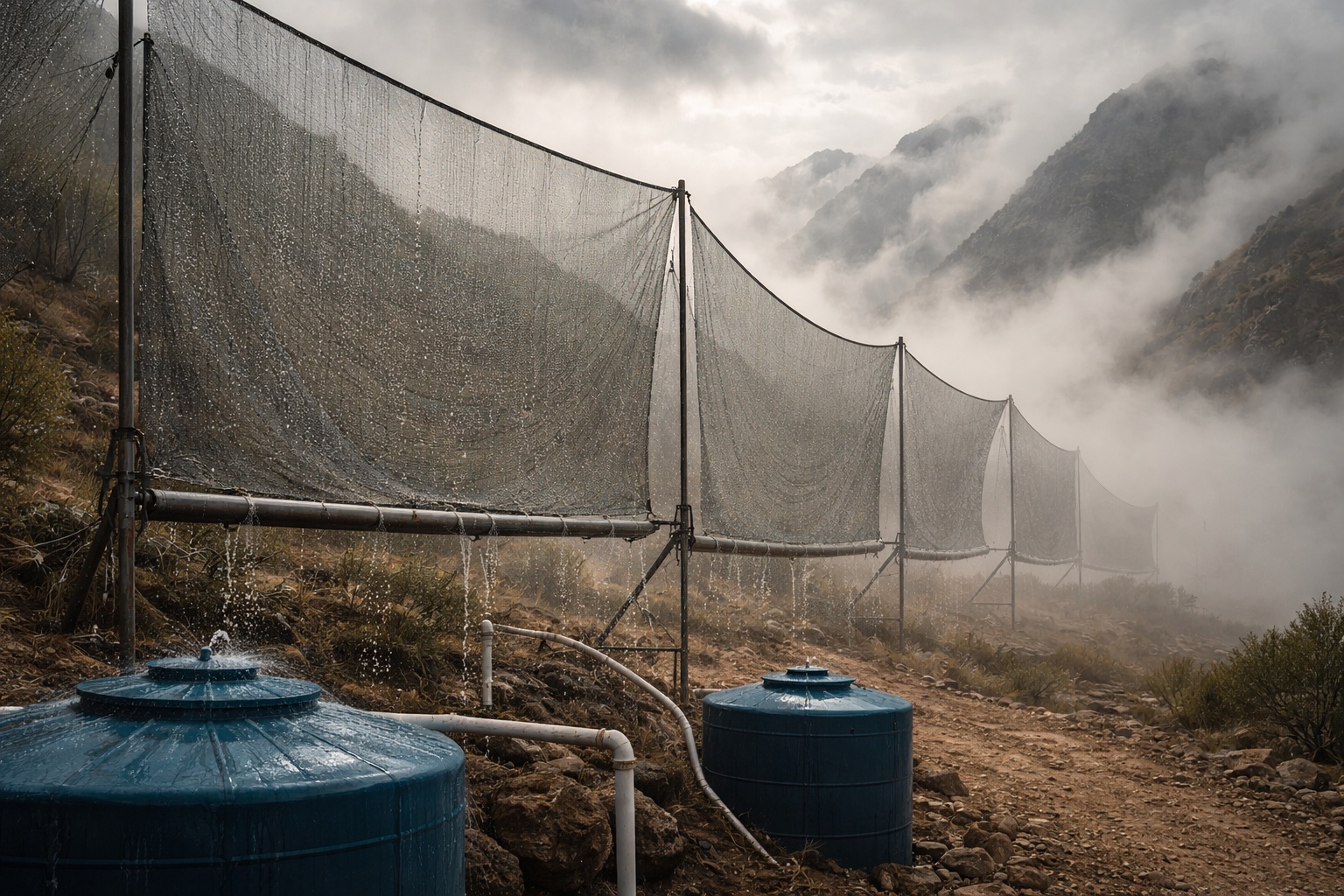


Simple, Battery-Free Technology Transforms Fog Into Drinking Water In 14 Countries. Morocco, Guatemala, Chile, And Peru Already Capture More Than 51,000 Liters Per Day, Supplying Villages With No Rivers Or Rain.
The global competition for fresh water has entered a dramatic phase. Major economies are reconfiguring entire hydrosystems, moving rivers, desalinating seas, pumping water through deserts, and storing strategic water resources as if they were barrels of oil. On one side, Saudi Arabia built the world’s largest underground desalinated water storage system in 2023, capable of storing over 20 billion liters in the desert, ensuring emergency supply in case of conflicts or plant failures. On the other side, China approves mega hydrotechnical projects that divert rivers through tunnels of hundreds of kilometers to irrigate entire regions and sustain industrial hubs far from any natural water source.
But while petrodollars, turbines, and colossal tunnels change the water cycle on a continental scale, a quiet and almost primitive solution is gaining traction in mountainous, arid, and coastal regions: fog capturing, also known as fog harvesting.
This technology does not use pumps, does not use electricity, does not require dams, and does not alter rivers. It simply transforms fog into drinking water using fabric, wind, and gravity. And yes: it works on a useful scale.
-
China creates hypersonic engine that can make planes and missiles fly more than 6 times the speed of sound with less weight, more range, and without system change.

-
Mysterious object on Mars divides NASA and Harvard after Curiosity image reignites suspicions about what was really found on the planet.
-
Giant structures 14 meters beneath Egypt are revealed by satellites and expose a millennia-old secret buried in Buto.

-
Children have been making clay pieces for 15,000 years in Southwest Asia, and fingerprints preserved on 142 ornaments helped archaeologists prove this.

Today, 14 countries already operate real systems, with results that impress hydrologists, environmental engineers, and advocates of water sovereignty, especially in places where there is no rain, rivers have dried up, and truck-operated water transport has become routine.
How Capturing Water From Fog Works

The engineering of fog harvesting is elegant in its simplicity. It is not about collecting atmospheric vapor or condensing air, but intercepting suspended microdroplets typical of fogs formed in mountainous, coastal, and desert regions facing thermal inversion.
The logic is as follows:
- Fog carries microdroplets of water pushed by the wind.
- When it passes through fine mesh nets, part of this humidity impacts the fabric, deposits, and merges into larger droplets.
- These droplets flow downwards by gravity to the lower troughs.
- The system then conducts this water to pipes and reservoirs.
There are no electrical components, no motors, and no need for external power. It is the atmosphere itself doing the work.
The great modern breakthrough is not in the idea that was already used by pre-Columbian Atacameños — but in the new polymers and mesh geometries, which have increased the capture efficiency by up to 5 times compared to old screens.
How Much Does This Really Produce?
The decisive point in turning curiosity into water sovereignty policy is scale. Small networks produce little, but community and regional installations have already shown significant figures.

Based on public data from real projects, the representative sum of four of the leading countries in operation is as follows:
- Morocco (Anti-Atlas – CloudFisher): up to 37,000 liters/day in ideal conditions.
- Guatemala (Techo de Niebla – Sierra Santa Cruz): about 6,300 liters/day on average with 35 collectors.
- Chile (Mejillones Cliffs / Alto Patache – Atacama): around 1,000–5,000 liters/day depending on the season.
- Peru (Lima – Cerro San Cristóbal): around 2,000–3,000 liters/day in community systems.
By adding only the most efficient and well-known projects, without considering dozens of smaller initiatives:
37,000 + 6,300 + 5,000 + 3,000 = 51,300 liters per day
This number is minimum and conservative, considering that:
- there are new initiatives in Spain, Qatar, Ethiopia, Eritrea, Namibia, South Africa, Oman, Colombia, and even Japan
- there are unaccounted military and industrial experimental projects
- many countries do not disclose peak data, only operational averages
That is, the real potential is greater.
Why This Technology Makes Sense In 2026
The three main advantages are energy, capillarity, and independence.
Zero Energy
Unlike desalination that requires osmotic pressure, membranes, pre-treatment, and fossil energy — fog harvesting does not consume electricity, which means:
- very low operational cost
- simple maintenance
- no direct emissions
- no dependence on plants, electrical grids, or diesel
This makes the technology politically attractive for remote villages and mountainous regions where hauling a water truck is expensive and there is no electrical grid.
Territorial Capillarity
Desalination only makes sense in coastal areas and pumping only makes sense if there is pumping. Fog, however, occurs in:
- coastal mountains
- wet valleys
- desert slopes
- high plateau edges
- oceanic islands
- semi-arid regions with sea breezes
In other words, the potential map is enormous, especially in places that historically suffer from drought.
Geopolitical Independence
The third factor is subtle but immensely powerful: fog harvesting is dispersed water sovereignty. A community with 50 collectors:
- does not depend on water trucks
- does not depend on dams
- does not depend on international agreements about rivers
- does not depend on energy
- does not depend on centralized systems
In a world where water is starting to become a reason for dispute, this matters a lot.
Real Cases That Changed Cities And Villages
The Case Of The Anti-Atlas In Morocco
The Anti-Atlas mountain range in southern Morocco is the showcase of modern fog harvesting. The NGO Dar Si Hmad implemented high-efficiency CloudFisher networks that:
- supply villages without rivers
- keep schools operational
- reduce the burden on water distribution trucks
- eliminate the need for children to walk miles for water
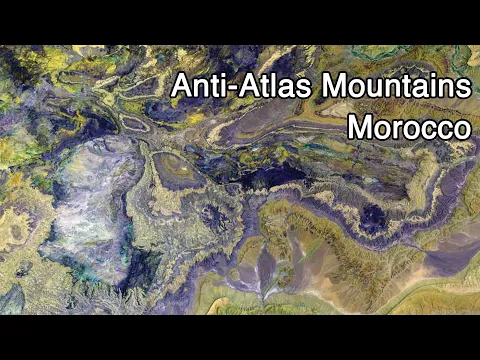
On some peak days, a single installation comes close to 40,000 liters/day, enough to sustain:
- domestic consumption
- irrigation of small gardens
- community reserves
The most impressive part: there are no pumps. It’s all gravity.
The Experience Of Guatemala
On the slopes of the Sierra de las Minas, villages and local organizations have installed dozens of collectors, resulting in about 6,300 liters/day concentrated in communities where the climate fluctuates between dense fog and scant rain.
There, fog harvesting does not replace rivers — because there are no rivers — it replaces wells and trucks.
Resilience In The Chilean Desert
The Atacama Desert is the driest place outside Antarctica, with entire years without measurable precipitation. But the proximity to the Pacific creates a phenomenon known as Camanchaca, a cold coastal fog.
Chilean projects have captured this fog to:
- supply scientific stations
- support indigenous peoples
- irrigate small experimental crops
In some cases, fog harvesting provided up to 15 times more water than the local meteorology estimated as viable.
Where The Technology Has Yet To Explode But Is Ready

Despite its proven effectiveness, fog harvesting is still underutilized for three reasons:
- It is invisible in GDP — it does not interest large companies because it generates little margin.
- It is decentralized — governments prefer large projects that yield political capital.
- It is community-based — the scale is too small to “appear” in rankings.
Still, the global potential is enormous. Regions with the best geography and climate include:
- the coast of Peru and Chile
- Hawaii and Pacific archipelagos
- mountains of Eastern Africa (Ethiopia, Eritrea, Kenya)
- North Atlantic (Madeira, Canary Islands, Azores)
- Macaronesia
- Western Himalayas
- Atlas and Anti-Atlas
- coastal deserts of Namibia
If only 5% of these regions implemented systems equivalent to those in Morocco, we would be talking about hundreds of thousands of liters per day, without energy and without carbon.
Comparison With Other Global Water Strategies
To contextualize the place of this technology in the current world, we need to compare three major approaches:
Desalination
It is the most powerful water solution for large cities, but it is:
- expensive
- energy-intensive
- highly technological
- dependent on maintenance and supplies
Perfect for coastal metropolises, impossible for villages in the mountains.
Interbasin Transfer
This is what China does with the South-North Water Transfer Project — moving water from one place to another to compensate for climate inequalities.
It is efficient, but involves:
- tunnels
- canals
- pumping
- political disputes
- human displacement
- heavy environmental impact
Fog Harvesting
Fills a completely different gap:
- does not replace rivers
- does not replace dams
- does not replace plants
- does not solve megacities
But solves the gaps in the map: small isolated communities far from infrastructure.
And when a village no longer needs a water truck, that changes everything:
- changes the economy
- changes women’s work
- changes health
- changes the retention of youth
- changes local geopolitics
The Future Of Water Will Be Hybrid
Water in the 21st century will not come from one single place; it will be a diversified matrix, like energy.
The most realistic model is:
- seas → desalination
- rivers → interbasin transfer
- groundwater → artificial recharge
- fog → community supply
- reuse → industrial hubs
- solar heating → passive desalination
Each piece serves a niche. Fog harvesting does not compete with Saudi Arabia or China — it competes with drought.
And in a time when the Sahel is collapsing, the Andes are drying up, and the glaciers of the Himalayas are receding, solutions that work without energy and without the state are liquid gold.







Realmente é um ótimo jeito de gerar água. MAS NÃO INTERESSA AOS POLÍTICOS, PRINCIPALMENTE AQUI, ONDE A HONESTIDADE É RARIDADE. muito mais que a ÁGUA
Isso é maravilhoso