





 Portuguese
  English
  Spanish
  3 min of reading
  0 comments


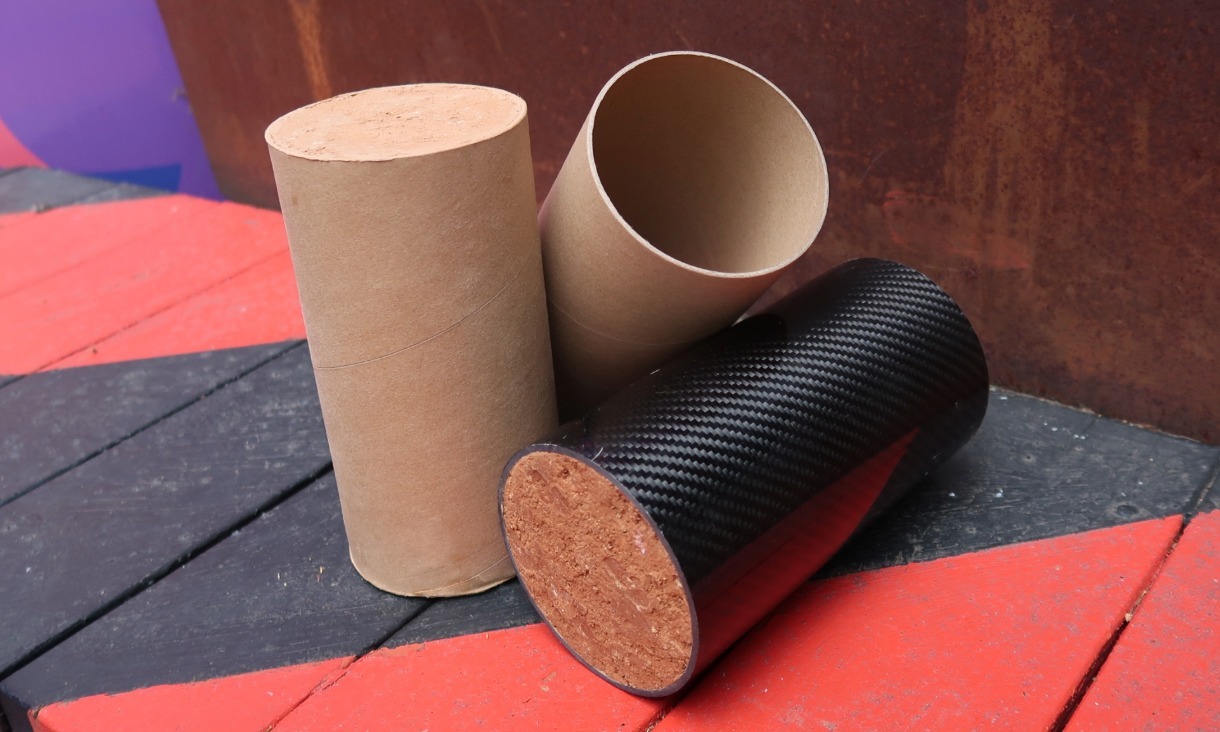
A Study From The Royal Melbourne Institute Of Technology Presents Confined Earth With Cardboard As An Innovative Alternative To Concrete, Leveraging Waste, Reducing Costs And Drastically Cutting Carbon Footprint In Sustainable Construction.
A new building material emerges as a sustainable alternative to concrete. It combines cardboard, water, and soil to reduce environmental impact and gives new purpose to accumulated waste. Created by the Royal Melbourne Institute of Technology (RMIT) in Australia, the material is named confined earth with cardboard.
Researchers explain that this system can form walls strong enough to support low buildings. Moreover, the proposal addresses two major issues: waste of cardboard and carbon emissions from the construction industry.
More than 2.2 million tons of cardboard and paper go to landfills annually in Australia. Globally, the production of cement and concrete accounts for approximately 8% of global emissions.
-
With a cost per shot close to zero, the DragonFire laser could change naval warfare in 2027 and provide British ships with nearly unlimited defense against drones.

-
A British startup creates tires that generate electricity in electric vehicles when passing over potholes, speed bumps, and cracks.

-
Scientists have created robots made with living cells that have their own nervous system, swim on their own, explore the environment, and self-organize without any genetic engineering, and now they want to do the same with human cells.

-
Students create a solar-powered ambulance that operates without a plug, without fuel, and still keeps medical equipment running in remote areas.

“This innovation could revolutionize the design and construction of buildings by using locally sourced materials that are easier to recycle,” said Dr. Jiaming Ma, the lead author of the study at RMIT.
Combining Ancient Techniques And Modern Solutions
The team sought inspiration from iconic works, such as the Papercraft Cathedral by Shigeru Ban. The group decided to combine the traditional strength of earth construction with the adaptability of cardboard, creating a new type of wall.
Earth construction is an ancient method. It uses layers of moist soil, sand, and clay compacted to form a solid surface. In the modern version, cement reinforces the structure. But in the variation developed by RMIT, cement is removed from the equation.
The result reduces the carbon footprint to a quarter of that found in regular concrete. It also cuts costs, as it comes in at less than one-third of the price.
“Earth buildings are ideal in hot climates because their high thermal mass naturally regulates internal temperatures and humidity, reducing the need for mechanical cooling and cutting carbon emissions,” Ma explained in a statement published on September 22.
Strength And Production On-Site
The durability of the new material depends on the thickness of the cardboard tubes. Engineers created a formula that calculates this relationship and allows for predicting wall strength before construction.
Another parallel study showed that when carbon fiber is mixed with compacted earth, the strength approaches that of high-performance concrete.
The manufacturing process also stands out. Workers can produce the material directly on the construction site. They just need to compact the soil and water mixture into the cardboard form. This work can be done manually or with machines.
This logic eliminates the heavy transport of bricks, steel, and pre-mixed concrete.
“Instead of transporting tons of bricks, steel, and concrete, builders would only need to bring lightweight cardboard, as almost all the material can be obtained on-site,” said Yi Min ‘Mike’ Xie, the corresponding author of the study.
According to him, this practice reduces transportation costs, simplifies logistics, and cuts initial material demands.
Practical Applications And Next Steps
This method could become even more advantageous in remote areas. In these locations, abundant red soil provides ideal raw material for this type of construction.
Researchers say they are ready to establish partnerships with industry. The goal is to prepare confined earth with cardboard for large-scale use.
The findings were published in the scientific journal Structures, reinforcing the academic and technical weight of the research.
In summary, the Australian work shows that simple waste, such as discarded cardboard, can be transformed into solid, durable, and inexpensive structures.
And most importantly: they provide a real alternative to concrete, one of the biggest villains of carbon emissions.








-

Uma pessoa reagiu a isso.