





 Portuguese
  English
  Spanish
  5 min of reading
  0 comments


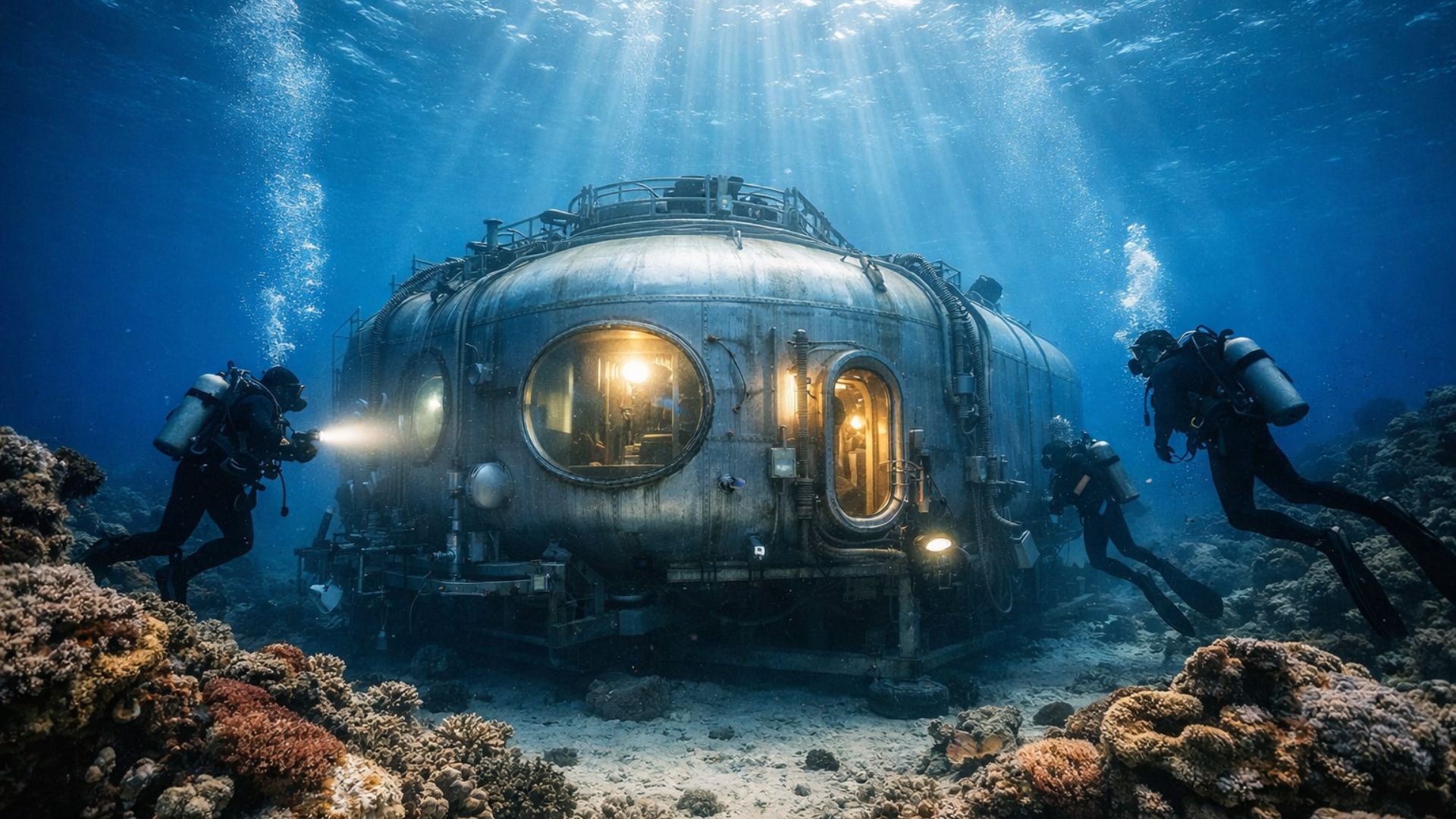
Submersible structure allows continuous presence of scientists at the bottom of the sea, extends research time on reefs, and transforms marine study routines with saturation technology and real-time support.
Installed in the Florida Keys National Marine Sanctuary, near Key Largo, the Aquarius Reef Base combines housing, laboratory, and research field in the same point of the ocean.
Operated by Florida International University, the habitat is described by the university and organizations linked to the marine sanctuary as the only operational underwater laboratory in the world, a condition that has made it a reference for marine studies, technology testing, and training in extreme environments.
At about 19 meters below the surface, the structure was designed to solve a central limitation of science at sea: the limited time available in conventional dives.
-
She took her first steps on the mat while her father was training, started competing at the age of 4, and now at just 9 years old, she is the world champion in Jiu-Jitsu in Abu Dhabi: meet Tina, the girl from Ourinhos who sells canjica at the traffic light to compete in international championships.

-
China has erected a colossal scientific observatory at an altitude of over 4,400 meters, designed to operate with thousands of detectors, track jets from black holes, and investigate the origin of the most energetic cosmic rays in the Universe.

-
A Brazilian inherits a farm with a century-old mansion and 150 years of coffee tradition in Minas Gerais, restores the main house with water-powered machines, creates a new chalet, and transforms the historic property into a space that blends memory, nature, and culture.
-
How hatch covers weighing up to 45 tons seal the largest container ships on the planet and support giant stacks of cargo in open water.

Instead of descending from a vessel, working for a short period, and returning to the surface, researchers can remain in the study environment for days, continuously monitoring the reef without the interruptions imposed by traditional routines of ascent, displacement, and descent.
Underwater laboratory allows continuous research on reefs
The Aquarius is seated on a stable platform of 120 tons, in a sandy area next to the deep reefs of the Florida Keys.
Designed to withstand pressure corresponding to depths of up to 120 feet, equivalent to about 36.5 meters, the module currently operates in a shallower range and keeps the access hatch already in the submerged zone, allowing the team to enter and exit the facility directly to the sea.
This design changes the scale of scientific observation.
Instead of treating the seabed as a location visited for short windows, the habitat transforms the reef into a continuous working area.
This makes it possible to repeat measurements throughout the day, monitor organisms at shorter intervals, install instruments more calmly, and record environmental changes that quick missions often miss.
According to FIU, the main operational advantage of the program lies in the use of saturation diving, a system that offers aquanauts up to ten times more bottom time than what is normally available in traditional dives.
In practice, this prolonged stay increases productivity at sea and reduces dependence on successive entries and exits, a relevant factor in work that requires repetition, precision, and direct observation of the reef environment.
Aquarius structure combines housing and laboratory at the bottom of the sea
Although it seems small against the scale of the ocean, the laboratory concentrates an unusual infrastructure for a base installed at the bottom of the sea.
FIU reports that the habitat is a steel cylinder measuring 43 feet long, 20 feet wide, and 16.5 feet high, equivalent to approximately 13.1 meters by 6.1 meters by 5 meters.
The interior is divided into three compartments and encompasses about 400 square feet, or just over 37 square meters, dedicated to research and living.
Within this space, the base houses a work area, pressurized entry points, six bunks, a freshwater shower, toilet, sink, microwave, refrigerator, computers, and internet access.
The indicated operational capacity is four scientists and two technicians per mission, a configuration that requires an organized routine and efficient use of each sector of the module so that rest, meals, monitoring, and scientific work occur in the same environment.
On the surface, a support buoy sustains a crucial part of the operation.
It houses generators, air compressors, and data connections that supply the habitat through umbilicals, ensuring energy, ventilation, and continuous communication with the team on land.
This arrangement also allows for real-time transmissions and remote monitoring of what occurs both inside the module and in the external area, enhancing technical control over each mission.
Location in the Florida Keys enhances the scientific value of the laboratory
The location of the Aquarius helps explain its scientific weight.
The laboratory is installed next to the Conch Reef Research Only Area, within one of the most studied marine regions in the United States.
There, researchers can closely observe an ecosystem subject to environmental and climatic pressures, in a zone where monitoring reefs, water quality, and marine life has strategic value for conservation and coastal management.
FIU describes the program as a platform focused on coral reef research, long-term coastal monitoring, sensor development, education, and technological testing.
NOAA highlights that the Aquarius supports one of the longest and most detailed coral reef monitoring series, reinforcing the habitat’s role in surveys that depend on temporal continuity and the direct presence of researchers in the field.
This combination of submerged permanence and observation of a real environment differentiates the laboratory from tanks, deep pools, and land simulations.
In an active reef, the team works with natural variations in light, current, animal behavior, and environmental conditions, something difficult to reproduce with the same fidelity outside the ocean.
Therefore, the installation has also been used as a validation space for equipment and protocols intended for more demanding operational contexts.
Submarine base is also used by NASA in simulated missions
Over the years, the Aquarius has also gained relevance outside oceanography.
NASA uses the habitat in the NEEMO program, in which astronauts, engineers, and scientists live in the laboratory as part of analog missions aimed at studying human work in isolation, confinement, and hostile conditions.
For the space agency, the submerged environment offers a convincing setting to test procedures, communication, psychological adaptation, and technical operations in a context comparable, in certain aspects, to that of a space mission.
This expanded use shows that the value of the Aquarius goes beyond biological research.
The installation serves simultaneously as a marine laboratory, training center, and platform for technological development, combining rare characteristics in a single structure.
NOAA also highlights the site as a training space for future deep-sea work and even for operations related to space exploration, reinforcing the uniqueness of the habitat in the international scientific landscape.
On the outside, the base almost disappears into the marine landscape.
There is no large hull breaking the surface nor the classic appearance of a terrestrial scientific station.
What exists is a module fixed to the seabed, discreet from a distance, but capable of keeping teams living and working surrounded by reefs, with routines that combine science, logistics, maintenance, and human adaptation in a reduced space.
It is this combination of isolation, practical utility, and permanence in the observation field that sustains the importance of the Aquarius.
By shortening the distance between scientist and observed phenomenon, the laboratory creates uncommon conditions for continuous monitoring of the ocean, without turning each analysis into a hurried visit to the marine environment.
In an area where observation time is often a scarce resource, the structure installed in the Florida Keys offers exactly what research of this type demands most: prolonged presence, stable technical routine, and direct access to the reef.



Seja o primeiro a reagir!