





 Portuguese
  English
  Spanish
  3 min of reading
  0 comments


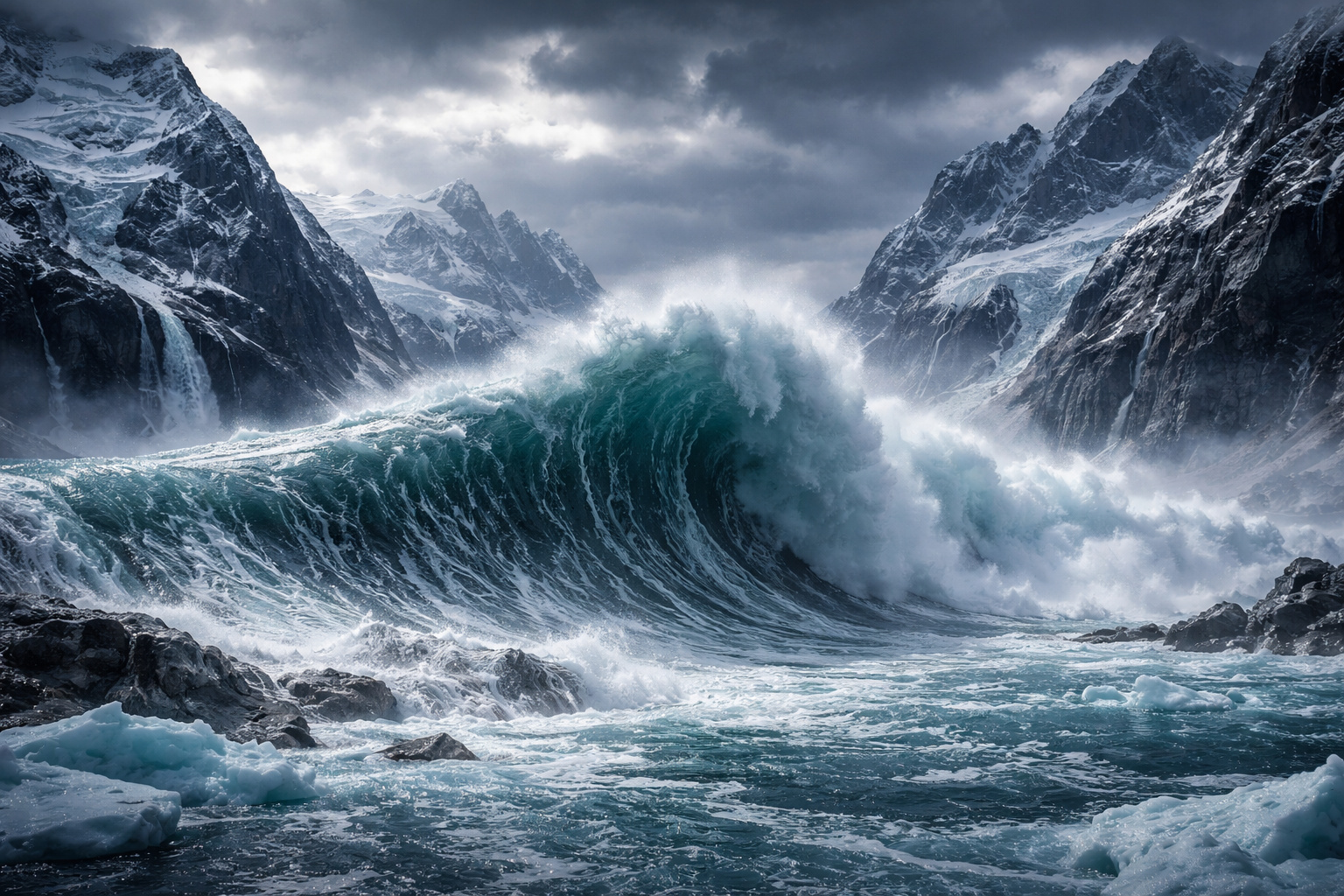
Collapse of mountain in the Arctic generated 200-meter wave and caused rare phenomenon that made the entire planet register continuous vibrations for more than a week
In March 2026, an extreme event caught the attention of scientists worldwide. A massive rockslide in Greenland triggered a mega tsunami that not only reached gigantic proportions but also made the entire Earth vibrate for days.
The information was released by researchers monitoring global seismic activities and extreme weather phenomena, reinforcing the growing impact of climate change in polar regions.
The episode occurred in the Dixon Fjord, located in eastern Greenland. At the time, millions of tons of rock and ice collapsed after the structural weakening of a mountain, caused by the melting of a glacier that supported the slope.
-
Maria Branyas Morera lived to be 117 years old, eating three yogurts a day without developing cancer or dementia, and when scientists analyzed her DNA, they found a secret that no one expected: her biological clocks indicated an age two decades younger than her actual age.

-
Upside Down House transforms abandoned warehouses from the 1970s, blending art with concrete and steel engineering, becoming a phenomenon in South Korea and impressing with a surreal experience that attracts tourists from around the world.

-
Brazil became 18 square kilometers smaller in the new official update from IBGE, which redrew the boundaries of 784 municipalities in 13 states and even changed the names of cities that you might know, such as Açu, which is now called Assú.

-
Stephen Hawking said that the worst enemy of knowledge is not ignorance but the illusion of knowledge, and he dedicated his entire career to proving that science dies when people act as if they already have all the answers.


200-meter wave got trapped in the fjord and generated global vibration


The collapse caused a wave estimated to be about 200 meters high. To put it into perspective, this is a wall of water comparable to a skyscraper, which violently surged through the walls of the fjord.
However, what made this event even more impressive happened next. Since the fjord is narrow, the water did not dissipate as it would in open sea. Instead, the wave became confined and began to move back and forth.
This rhythmic movement is known as seiche, a phenomenon that occurs when water oscillates within a closed space, similar to the effect of a bathtub being shaken.
Consequently, this continuous oscillation generated a vibration in the Earth’s crust. For nine consecutive days, seismographs spread across all continents recorded a constant buzzing, as if the planet were resonating with the movement of the water.
Global warming is destabilizing mountains in the Arctic
The landslide did not occur by chance. Scientists associate the event with the accelerated warming of the Arctic, which is warming faster than the rest of the planet.
With rising temperatures, glaciers that once served as natural support began to melt. Additionally, permafrost — permanently frozen ground that acts as a kind of “cement” — is also losing stability.
Thus, slopes that remained stable for thousands of years are now at risk of collapse.
This scenario worries experts because similar events could occur in other regions. In coastal areas or near shipping routes, for example, a landslide of this type could generate dangerous tsunamis.
Scientists race against time to prevent new disasters
In light of this growing risk, researchers are already using drones and satellites to monitor vulnerable areas in fjords and mountainous regions.
Additionally, the goal is to identify early signs of instability and prevent tragedies in inhabited areas or places with heavy boat traffic.
Therefore, the episode in the Dixon Fjord should not be seen as an isolated event. On the contrary, it serves as a clear warning about the impacts of climate change.
What happens at the poles does not remain confined to those regions. On the contrary, the effects spread and can reach different parts of the planet.
A global alert that cannot be ignored
The mega tsunami, the nine days of vibration, and the buzzing recorded on a global scale show that the planet is undergoing profound transformations.
More than just rising temperatures, climate change is altering geological structures, destabilizing mountains, and creating extreme events.
In this context, the Dixon Fjord becomes a symbol of this new reality. A reminder that nature is responding rapidly to the changes imposed by the climate.
Do you believe that events like this could become more frequent in the future?








Seja o primeiro a reagir!