





 Portuguese
  English
  Spanish
  6 min of reading
  0 comments


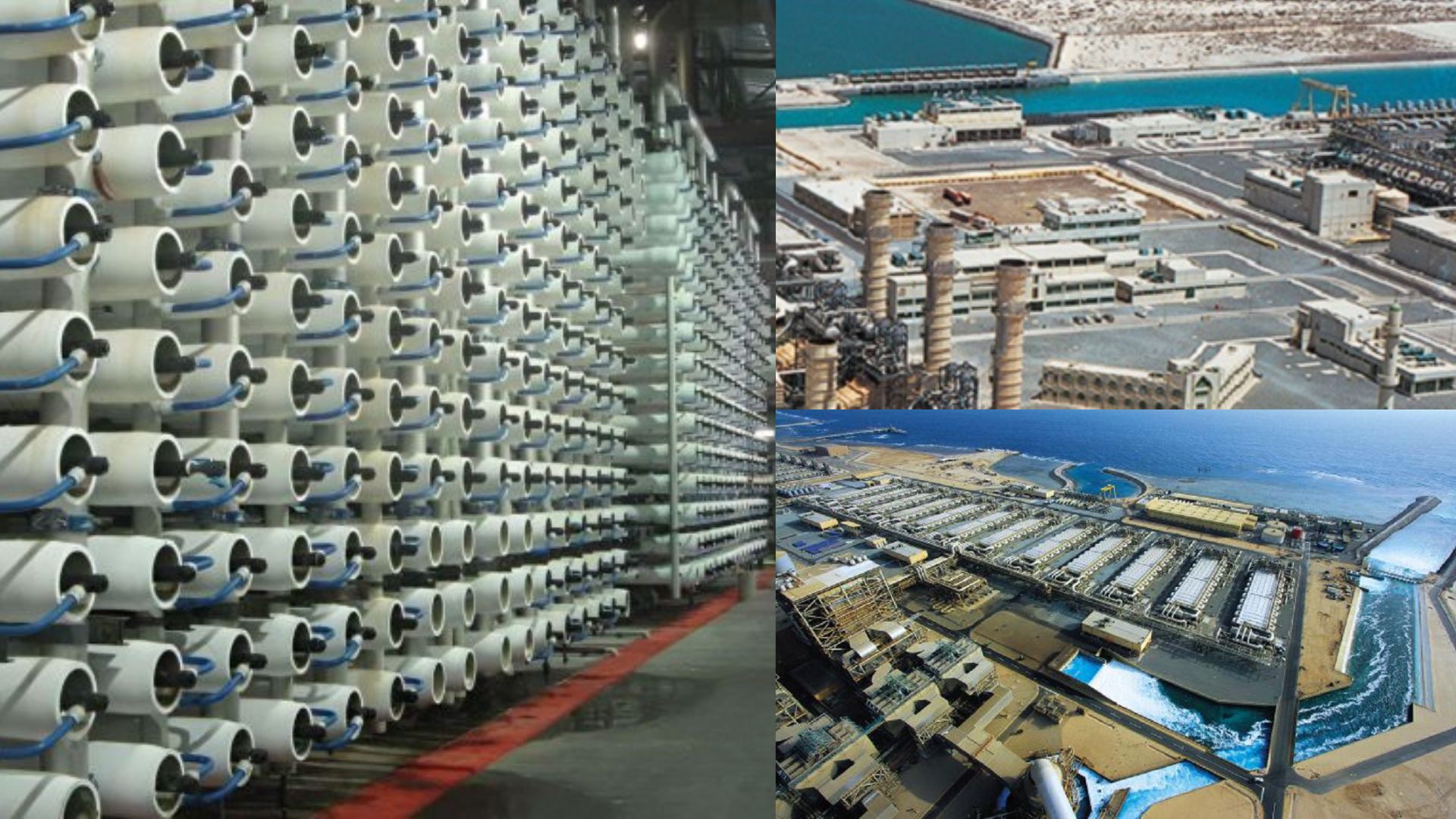
Megacomplex in Abu Dhabi Uses Reverse Osmosis and Solar Energy to Produce Almost 1 Billion Liters of Drinking Water Per Day in the Desert, Changing the Role of the Sea in Supplying Entire Cities.
The Taweelah Reverse Osmosis megacomplex, built about 50 kilometers from Abu Dhabi, in the United Arab Emirates, has established itself as the largest reverse osmosis desalination plant in operation in the world.
With a contracted capacity of 200 million imperial gallons per day, equivalent to approximately 909 thousand cubic meters of drinking water, the system is capable of producing nearly 909 million liters daily from seawater, a volume close to 1 billion liters per day.
According to official data from developers and local authorities, the plant was sized to meet the demand of more than 350 thousand residences in a region with a desert climate and extremely limited natural water resources.
-
With over 14 million baskets of earth moved, an ancient North American metropolis built a monumental pyramid of 30 meters and established a city with 20,000 inhabitants nearly a thousand years ago.

-
A 1,900-year-old treasure emerges from a Roman house destroyed by fire and sealed since antiquity in Romania, with coins and metals fused among the ashes.

-
The Brazilian colonial city that stopped in time and shares territory with a rocket launch base.

-
79-year-old woman challenges limits, visits 193 countries in the world after 56 years of planning and reveals the behind-the-scenes of a global journey that few have managed to accomplish.

Billion-Dollar Investment and Business Model of Desalination
Installed in the Taweelah water and energy complex, the plant operates with seawater reverse osmosis technology, using permeable membrane batteries and high-pressure systems to separate salt from water.
The project is structured as an independent water venture, under the build, own, and operate model, with a 30-year water purchase agreement signed with Emirates Water and Electricity Company (EWEC), the company responsible for water and energy supply in the emirate.

Public information from the involved companies indicates total investment of around 874 million dollars, with participation from groups like ACWA Power, Taqa, and Mubadala.
New Scale Benchmark in Membrane Desalination
The Taweelah plant was designed to exceed the capacity of the largest previously operational reverse osmosis plant by about 44%, establishing a new scale benchmark for membrane desalination.
Technical reports indicate that the facility has been treated as a global reference for efficiency and cost per cubic meter of water produced, both for its size and its design focused on reducing energy consumption compared to traditional thermal technologies historically used in the region.
Paradigm Shift in Desalination in the Middle East
In practice, Taweelah illustrates the ongoing paradigm shift in the Middle East, which for decades has relied on thermal desalination processes for producing drinking water, such as multi-stage distillation.
Studies on desalination in the region point out that reverse osmosis, once a minority, is gaining ground for operating at typical pressure ranges between 55 and 70 bar for seawater and requiring less energy per cubic meter produced, especially when combined with energy recovery systems.
Energy Efficiency and Use of Solar Energy at the Plant
In the case of Taweelah, data released by industry awards and the supply chain itself indicates specific consumption of about 2.81 kWh per cubic meter of water, a value described as one of the lowest ever recorded in desalination megaprojects.

The plant also incorporates a photovoltaic plant of approximately 69 to 70 MWp, which supplies a significant portion of the complex’s electrical demand.
Public information indicates that the goal is for solar energy to account for at least 30% of the project’s electrical capacity in a few years, with plans to increase this share over the lifespan of the contract.
Statistics presented by the companies involved attribute the combination of highly efficient reverse osmosis and solar generation to a reduction of millions of tons annually in CO₂ emissions compared to conventional thermal plants.
Role of Desalination in the Water Security of the Emirates
The operation of the megacomplex is directly linked to the water security strategy of Abu Dhabi and the United Arab Emirates.
Recent data from official bodies and market analyses indicate that over 80% of the country’s drinking water is already supplied by desalination plants, with dozens of facilities operating along the coast to meet residential, commercial, and industrial consumption.
In public reports, local authorities highlight that desalination accounts for a significant portion of urban supply and that the expansion of reverse osmosis-based projects is considered one of the main fronts for reducing the carbon intensity of the water sector.
EWEC Strategy and Water–Energy Decoupling
In official communications, EWEC describes Taweelah as a central piece of the strategy to decouple water production and energy generation in the emirate, gradually migrating from large integrated thermal power complexes with thermal desalination to standalone reverse osmosis units powered by cleaner electrical grids.
The company also points out that the capacity of 200 million gallons per day was planned to significantly contribute to meeting Abu Dhabi’s peak demand, in a scenario of population growth and increased consumption per household over the coming years.
How the Reverse Osmosis Process Works in Taweelah
From a technical standpoint, the process of producing drinking water in Taweelah follows the established logic of industrial-scale seawater reverse osmosis.
After intake and pretreatment to remove suspended solids, organic matter, and marine organisms, the water is pressurized to the operational range necessary to force it through the permeable membranes.
These membranes allow water molecules to pass through their structure, retaining dissolved salts and a large part of contaminants.
Subsequently, the permeate undergoes pH adjustment, remineralization, and disinfection before being delivered to the distribution network.

Brine Management and Automation of the Megacomplex
The scale of the plant also requires care with the management of the resulting brine, a more concentrated flow of salts that returns to the sea after controlled dilution and dispersion.
Environmental documents associated with the project indicate the adoption of mixing and diffusion systems designed to limit local salinity variations and comply with regulatory parameters in the region.
In parallel, the plant was structured to operate with a high degree of automation, with continuous monitoring of flow, pressure, water quality, and membrane performance, aiming to maintain energy efficiency and reduce downtime for maintenance.
Global Expansion of Reverse Osmosis Desalination
The advancement of projects like Taweelah occurs in a context of global expansion of desalination.
Recent studies on the sector indicate that countries in the Middle East and North Africa comprise a majority share of the world’s installed capacity and continue to invest in new plants to face recurring droughts, population growth, and increased industrial demand.
Market reports estimate that the desalination industry could exceed tens of billions of dollars in value in the coming years, with reverse osmosis established as the dominant technology in new projects, due to lower energy consumption compared to thermal processes.
Strategies of the United Arab Emirates for Water in the Heart of the Desert
In the specific case of the United Arab Emirates, official initiatives have combined the expansion of large-scale reverse osmosis plants, like Taweelah, with water use efficiency programs and reuse projects, in line with water security and greenhouse gas reduction goals.
Still, the country continues to heavily rely on desalination to ensure the daily supply of drinking water in densely populated urban areas, in an environment of natural water scarcity and limitations on surface and groundwater resources.






-

-

-

-

-

-

79 pessoas reagiram a isso.