





 Portuguese
  English
  Spanish
  5 min of reading
  0 comments


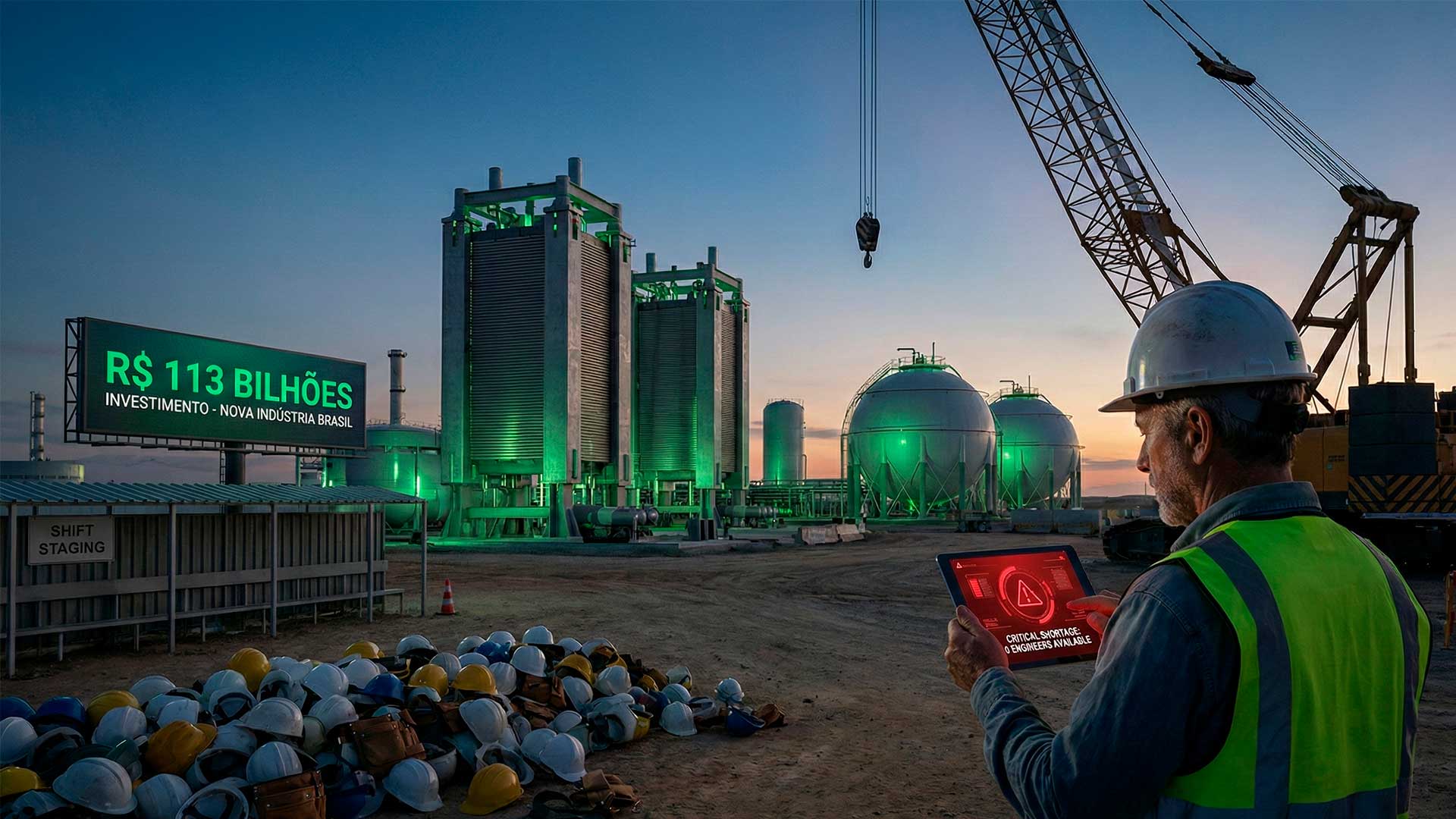
Brazil’s New Industry Mega-Investment Promises to Transform the Productive Matrix of the Northeast, Focusing on Green Hydrogen and Bioeconomy. But the Shortage of Engineers, Technicians, and IT Professionals Is Already Raising Alarm Among Governments and Companies.
The Northeast is experiencing a rare moment of economic optimism. The Call for Northeast of Brazil’s New Industry has selected 189 projects totaling R$ 113 billion in investments for the region, almost 11 times the credit amount initially projected by the federal government.
The resources are concentrated in green industry sectors, such as renewable energy, green hydrogen, low-carbon data centers, pharmaceutical bioeconomy, and the automotive chain linked to agricultural machinery. The aim is to reposition the Northeast on the Brazilian industrial map, generating skilled jobs and new production chains in all nine states of the region.
However, behind the announcements, there is a silent obstacle. The lack of skilled labor threatens to delay construction, increase project costs, and reduce the social impact of this billion-dollar package, particularly in the areas of engineering, technology, and advanced industrial operation.
-
Mothers and daughters come together, create an ‘express’ beauty salon and turn the idea into a network with 21 units, revenue of R$ 16.7 million and 12,000 subscribers.

-
End of the 6×1 schedule: how the reduction of hours can affect service companies, industry, and agribusiness.

-
Brazil Ignores Trump’s threats to BRICS, Buys 42 tons of gold and reduces the Dollar’s share by 6.45% in international reserves.

-
Havan buys historic football land in Blumenau for a million-dollar amount protected by a confidentiality clause and is already planning to change even the layout of streets to build a megastore in half-timbered style costing 80 million reais.

Recent studies show that 84 percent of Brazilian companies have difficulty hiring qualified professionals, according to the Robert Half Confidence Index. In the industry, research supported by Fiesp indicates that about 77 percent of factories in São Paulo faced problems filling positions between 2024 and 2025, illustrating the challenge that the Northeast will have to confront to bring its new projects to fruition.
R$ 113 Billion Boosts Green Industry and Neo-Industrialization in the Northeast
The Northeast Call is part of the New Industry Brazil strategy, a neo-industrialization policy launched by the federal government to stimulate sustainable and technology-intensive projects. In the region, the announcement was structured in partnership with BNDES, Banco do Brasil, Caixa, Banco do Nordeste, and Finep, with technical support from Sudene and the Northeast Consortium, and approved 189 proposals totaling R$ 113 billion in investments.
The result far exceeded initial expectations, which anticipated around R$ 10 billion in credit for the region. According to Sudene and the Northeast Consortium, the final volume is nearly 11 times greater and has a strong component of productive inclusion, as approximately 74 percent of the approved proposals came from micro, small, and medium-sized enterprises.
The majority of the resources will be directed to green hydrogen, energy storage, green data centers, bioeconomy, and decarbonization of already installed supply chains. Governors like Piauí’s Rafael Fonteles have advocated that the package corrects the historic underrepresentation of the Northeast in Brazil’s industrial GDP and can establish the region as a global hub for clean fuels and digital technologies.
Deficit of Engineers and Technicians Exposes Crisis in Professional Training
The euphoria with the credit contrasts with hard data from the job market. The Robert Half Confidence Index itself shows that 84 percent of companies now face difficulties hiring qualified professionals, indicating that the problem is structural and not occasional.
In the industry, the scenario is even more concerning. Recent surveys supported by Fiesp indicate that about 77 percent of industrial companies in São Paulo had difficulty filling positions between 2024 and 2025, and that only a minority of young people wish to work in the manufacturing sector.
In Brazil, the bottleneck is particularly concentrated in engineering. According to economist Edgar Leonardo from Pernambuco, cited in a report by the Movimento Econômico portal, the number of university students enrolled in engineering courses has fallen by about 25 percent between 2015 and 2023, in a country that already proportionally produces fewer engineers than other emerging economies.
The expert attributes this disinterest to a combination of failures in basic education, financial difficulties faced by families, and the perception that the career requires prolonged effort without immediate return. In many cases, students drop out before completing their courses, which exacerbates the mismatch between industry demand and the supply of qualified professionals.
For the Northeast preparing to welcome green hydrogen, e-methanol, and green data center plants, the effect is twofold. The region must compete for the limited talent already trained with the wealthier areas of the country and, at the same time, accelerate local qualification efforts so that future jobs are not filled only by professionals coming from elsewhere.
Suape Becomes a Laboratory for Energy Transition and Talent Drain
The Suape Port Industrial Complex in Pernambuco clearly illustrates this paradox. The state government has signed a contract with GoVerde to install a factory for e-methanol derived from green hydrogen, with an estimated investment of R$ 2 billion in the first phase and an expected operational start by 2028, alongside other similar plants already announced in the region.
These projects promise thousands of direct and indirect jobs in engineering, industrial operation, and support services, but depend on a workforce that does not yet exist in sufficient numbers. To try to get ahead, Suape has structured the Suape Census 2024 as a mapping tool for qualification bottlenecks and has broadened cooperation with Senai, Senac, IFPE, and other institutions, aligning technical courses and internship programs with the actual needs of the new port industry.
Technical Schools and Digital Training Rush to Keep Up with Brazil’s New Industry
The Pernambuco Department of Economic Development states that it is expanding the network of State Technical Schools to meet the demand created by the new investments. According to information released by the state management and compiled by Movimento Econômico, the state plans to open 15 new units and more than 15,000 vacancies, in addition to strengthening the technical training pathway in high school and rapid qualification programs like Trilhatec.
The capital of Pernambuco is also focusing on digital talent training, a key piece to support green data centers and technology companies linked to the new industrial matrix. The Digital Boarding program, a partnership between the Recife City Hall and Porto Digital, offers scholarships for higher education technology courses aimed at graduates of the public school system and has already benefited thousands of vulnerable young people by connecting them to job openings in local IT companies.
Despite these efforts, experts warn that it is still necessary to scale up and better integrate education and innovation policies with the plans of New Industry Brazil. Without clear goals to reverse the decline in engineering and technician training, the risk is that the R$ 113 billion investment cycle will turn into a missed opportunity, with delayed works and high-income jobs migrating to other regions or even other countries.
In your opinion, does it make sense to announce billions in credit for green hydrogen and Industry 4.0 if the country is not training engineers and technicians at the same pace? The government should prioritize scholarships, internships, and tax incentives for companies that invest heavily in local training, even if this raises project costs in the short term. Leave your comment and let us know if you believe that the Northeast risks seeing the new industry arrive without its local population occupying most of the future job vacancies.








-

Uma pessoa reagiu a isso.