





 Portuguese
  English
  Spanish
  8 min of reading
  0 comments


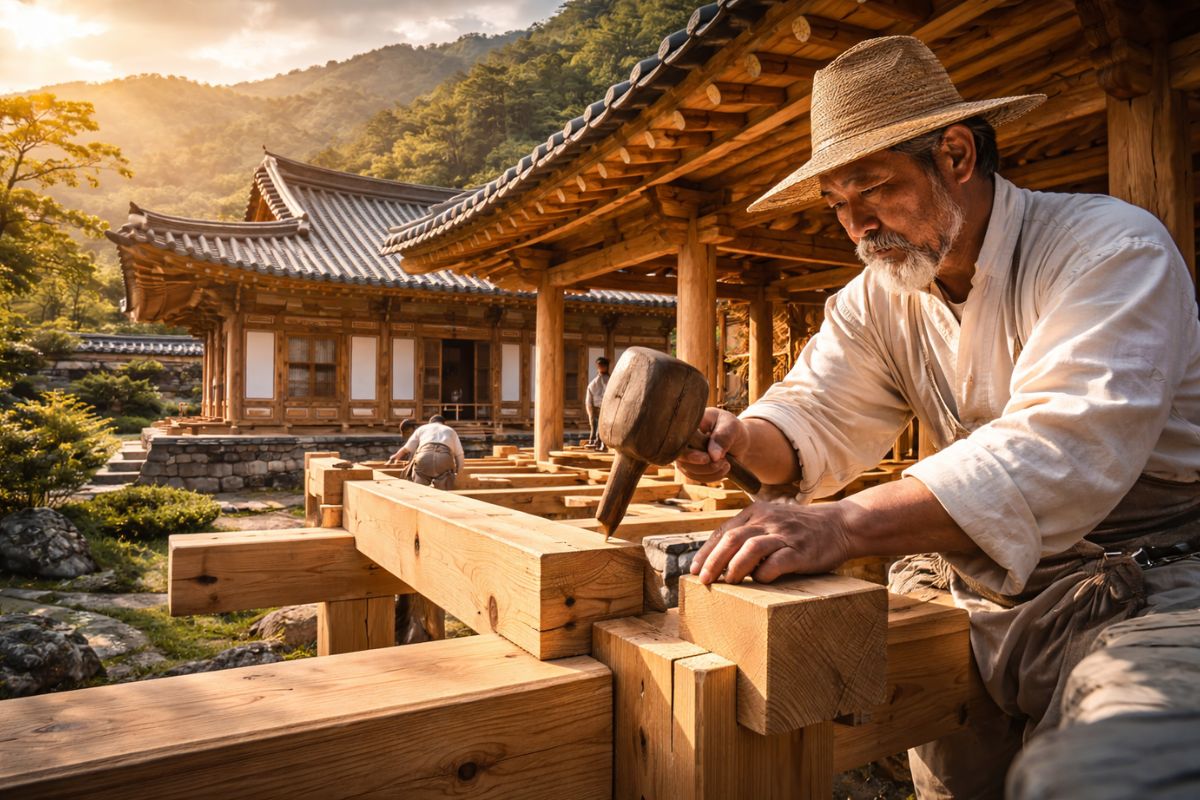
When Telling the Story of Choi Gi-young, a Korean Carpenter Recognized as Daemokjang, the Hanok Tradition Appears Less as Nostalgia and More as a Construction Technique Based on Pine, Clay, Stone, Paper, and Structural Joints That Regulate Indoor Air, Respect the Climate, and Promise Seismic Resistance Without Visible Metal Fixtures.
The Korean carpenter Choi Gi-young describes the hanok as a structure that is not limited to sheltering people, but accompanies the surrounding environment with natural materials and construction solutions that, according to him, remain alive even after being incorporated into the house. One of the three existing daemokjang in Korea, he has become a national reference in traditional restoration and construction by taking on the entire process, from the choice of wood to the final closing of the structure.
The strength of this vision comes from a life marked by war, poverty, early work and hard learning, but also from the conviction that ancient construction principles still respond to very current demands, such as thermal comfort, durability, integration with nature, and structural safety. It is at this point that the hanok ceases to seem a relic and begins to compete with contemporary architecture.
From Poverty in the Post-War Era to the Master Carpenter Position
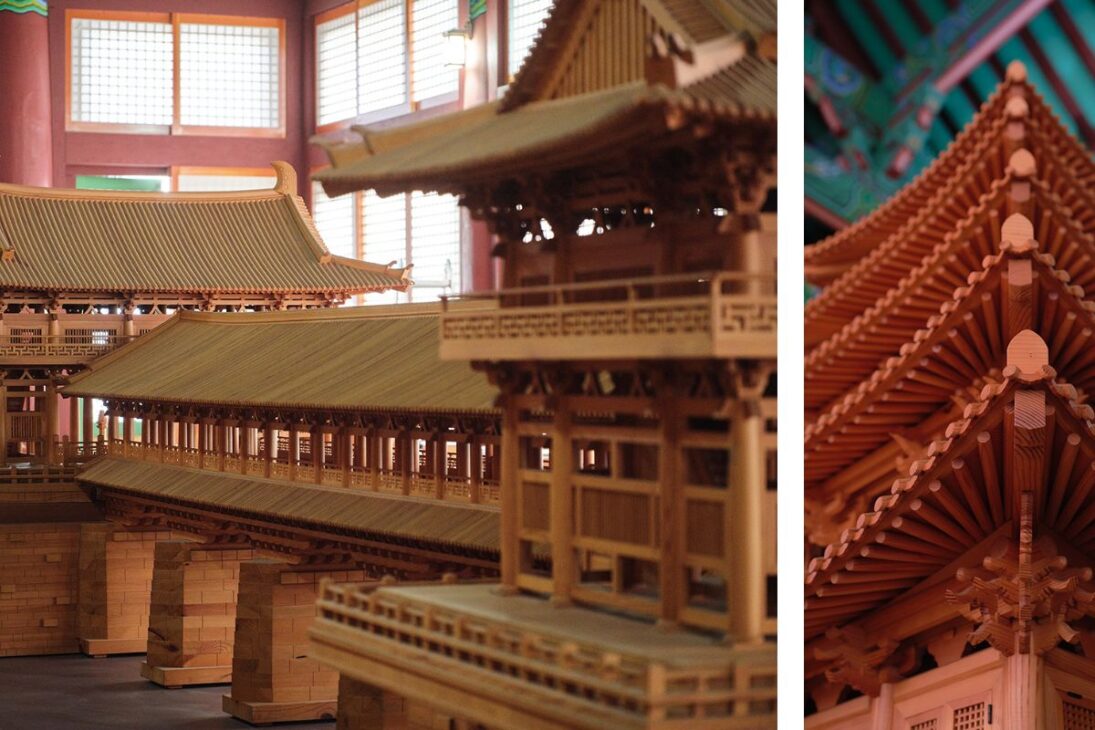
Choi’s biography helps explain why his relationship with carpentry has never been treated as cultural ornamentation.
-
Attracting around 250,000 people a year, a lighthouse 200 meters from the sea, on a 60-meter high cliff, on the North Sea coast in Denmark, becomes one of the most impressive examples of how nature can threaten historical buildings.

-
The narrowest house in the world is only 63 centimeters wide, but inside it can accommodate a bathroom, kitchen, bedroom, office, and even two staircases.

-
In the middle of the sea, these enormous concrete and steel structures, built by the British Navy to protect strategic maritime routes, look like they came straight out of a Star Wars movie.

-
For years, no one could cross a neighborhood in Tokyo because of the tracks, but an impressive solution changed mobility and completely transformed the local routine.

Born in 1945, shortly after Korea’s liberation from Japanese colonial rule, he grew up in a country devastated by the Korean War.
He lost his father at the age of 5, saw his family plunge into extreme poverty, and barely finished elementary school, as he spent his days collecting firewood in the mountains and cutting grass in the fields. Before there was prestige, there was survival.
It was in this environment that he decided to learn a trade. The choice, according to his own account, did not arise from idealized vocation but from material necessity.
As a young man, he attended a seodang, a traditional Confucian academy, where he received basic training in Chinese classics, content that would later help him better understand Korean architecture.
Carpentry emerged at that moment as a stable path to support his own life. What followed was the result of discipline, repetition, and an above-average ability to observe, memorize, and reproduce complex shapes.
Over time, the Korean carpenter began working with masters like Kim Deok-hee and Kim Chung-hee and traveled the country on significant projects, including interventions at Woljeongsa Temple in Pyeongchang-gun County and Deoksugung Palace in Seoul.
At night, while others rested, he studied blueprints, climbed walls, illuminated eaves and pillars with a lantern, and drew details under the moonlight when he had nothing else at hand.
The technical mastery was not treated as a spontaneous gift but as the result of an obsession with structure, proportion, and fit.
This journey helps to understand why the title of daemokjang carries a weight that goes far beyond manual skill. In Korean tradition, the master does not merely execute cuts and assemblies.
He assumes total responsibility for the project, for wood selection, for space reading, and for the coherence of the work. He is not just a specialized worker.
He is someone who thinks about the house from its internal logic to its adaptation to the resident’s lifestyle.
Why the Hanok Is Described as a House That Breathes
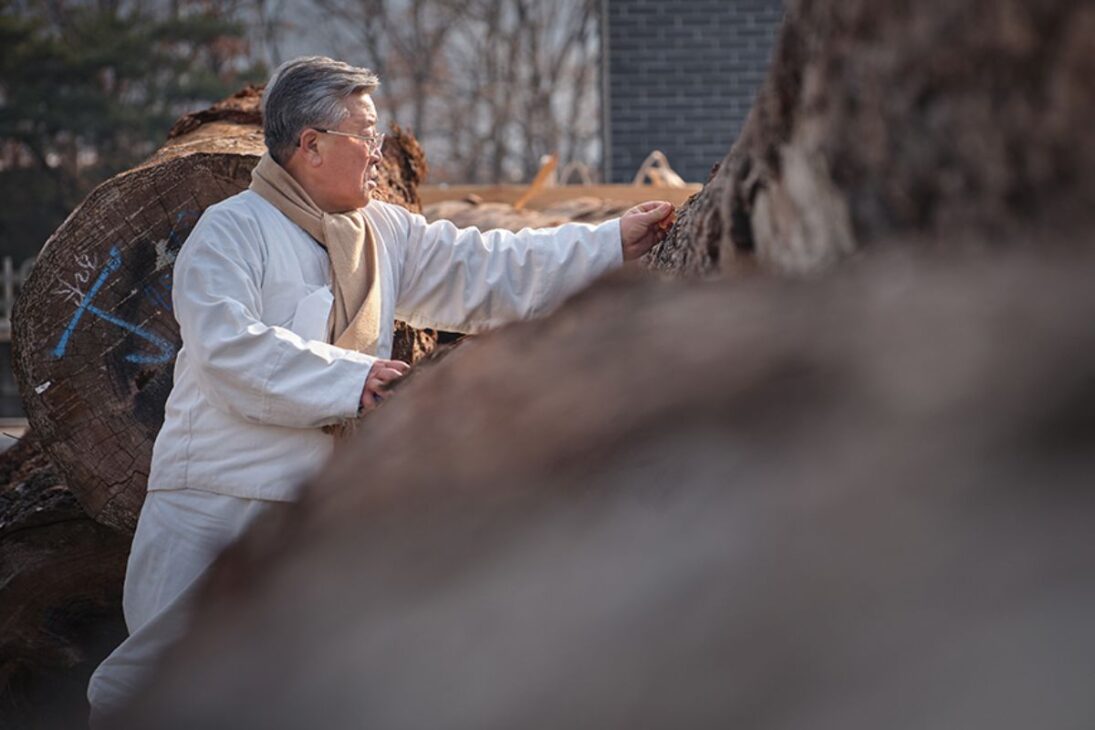
When Choi states that the hanok “breathes,” he is not just using a poetic image. His explanation starts from the materials. Korean pine, earth, stone, tiles, and paper appear as natural components that maintain exchanges with the environment, rather than forming a completely sealed box.
In the master’s view, even after being cut, the wood remains alive, and the resin of the pine continues to circulate like a kind of structural blood.
The house, in this understanding, does not interrupt nature; it extends nature in built form.
This reading is also connected to durability. Choi insists that a well-made hanok can last a thousand years if it is inhabited and maintained, even though time may leave cracks in earthen and wooden walls.
His argument is not about an untouchable perfection, but about longevity compatible with continuous maintenance and respect for construction fundamentals. This shifts the debate from the idea of impeccable finishing to the idea of permanence.
A traditional house would not be valuable for appearing new forever but for aging without losing its integrity.
The Korean carpenter also relates this system to everyday comfort. He claims that the natural materials used in walls, ceilings, doors, and windows act as high-quality filters, retaining what would be undesirable for the human body.
Ventilation, material texture, and the very logic of the internal environment are part of this experience. Rather than a sealed and stuffy space, the hanok appears as a place where air circulates more evenly.
It is a conception of dwelling where health, climate, and construction are not kept separate.
Another decisive element in this perception is the ondol, the traditional underfloor heating system.
Choi presents it as a solution that organizes the temperature difference between the lower and upper part of the room, generating a comfort sensation distinct from that obtained in artificially heated, closed concrete environments.
His comparison is direct: a sealed house can get hot, but it can also suffocate. In the hanok, the heating does not eliminate the breathing of the house.
Interlocked Wood and the Promise of Structural Protection
One of the strongest points in Choi’s account is the defense of the wooden frame as an intelligent structural system.
According to him, the hanok structure fits together precisely, forming a natural barrier against earthquakes.
This statement does not appear as technological spectacle but as a consequence of how the pieces are designed to adjust and distribute forces within the set.
Safety, in this case, comes from the assembly principle, not from excess material.
This logic helps explain why tradition demands so much from the master carpenter. It is not enough to know generic measurements. One must decide height, width, thickness, proportion between columns, relationship between the roof and the internal space, as well as the specific quality of each piece of wood.
Choi summarizes this rigor by saying that a true master thinks about the lifestyle of those who will occupy the building and calculates every detail based on that.
The house, then, is not composed of indifferent modules but rather by decisions that articulate use, climate, and resistance.
In the case of historical works, this knowledge reveals itself even more demanding. Choi dismantled, repaired, and reassembled the Geungnakjeon Hall of Bongjeongsa Temple in Andong, a building constructed around 1200 and regarded as the oldest surviving wooden structure in Korea.
Dealing with such a structure does not mean merely restoring an old surface. It means understanding the original constructive reasoning, respecting the logic of the joints, and restoring stability without erasing the identity of the work.
Restoration, in this context, is proving that the system can still function centuries later.
The temporality of the work also matters. The Korean carpenter explains that winter is seen as a favorable season for this type of construction because the cold and low humidity help in cutting and drying the wood.
The works would begin before the ground froze, the base was resolved early, the structure needed to be ready before March, and the tiles should be laid before the rainy season.
Even the plaster followed the calendar, yielding better results before and after Chuseok, when the cycle of humidity and drying tended to reduce cracks. The schedule, therefore, was not an administrative detail but part of the technique.
Living Tradition, New Works, and a Model That Resists Time
The permanence of the hanok does not depend only on the preservation of temples and palaces. Choi asserts that modern buildings continue to be erected in different parts of the country, maintaining traditional methods even in current contexts.
By recommending the Hanok Yechon Hotel in Namwon, Jeollabuk-do, he highlights an essential point: tradition does not need to exist only as frozen heritage. It can continue operating as housing, lodging, and contemporary living experience.
This argument gains strength because the master does not treat the hanok as a museum piece. For him, the world can accelerate, machines can reduce work time and increase convenience, but construction principles remain the same.
The essence, in his view, lies not in rejecting the present but in the permanence of the fundamentals. Modernizing tools should not mean abandoning the logic that gives meaning to the house.
There is also an important symbolic component in this defense. In a rapidly transforming society, the hanok would appear as a message of continuity.
Eating remains a human need, regardless of whether the food is cooked in a cauldron or an electric pot. Likewise, living continues to require healthy shelter, comfort, and a balanced relationship with the environment.
The Korean carpenter uses this comparison to assert that the value of tradition does not lie in the past itself, but in the permanence of needs that the present has not yet abolished.
At the same time, Choi’s personal history prevents this defense from sounding naive. He does not idealize artisanal work as an easy refuge.
His journey has been one of deprivation, few hours of sleep, continuous training, and growing responsibility for historically significant works. Perhaps that is why his words about the hanok carry special weight.
They come from someone who did not inherit comfort but built technical authority piece by piece.
Choi Gi-young’s journey transforms the hanok into something greater than a traditional Korean house admired from a distance.
In the way he describes the selection of wood, the use of clay, stone, tiles, and paper, the functioning of the ondol, and the structural joints of the frame, it is clear that this architecture carries a complete vision of construction.
It unites environment, health, proportion, construction time, and resistance in a coherent system, even when faced with the speed of modern construction.
If you had to choose a single criterion to define a good house, would you choose the speed of construction, the longevity of centuries, the use of natural materials, or the feeling of breathing better inside it? And, looking at the logic of the hanok, do you believe that current architecture has lost fundamentals that still make a difference in daily life?






-

-

-

-

8 pessoas reagiram a isso.