





 Portuguese
  English
  Spanish
  3 min of reading
  0 comments


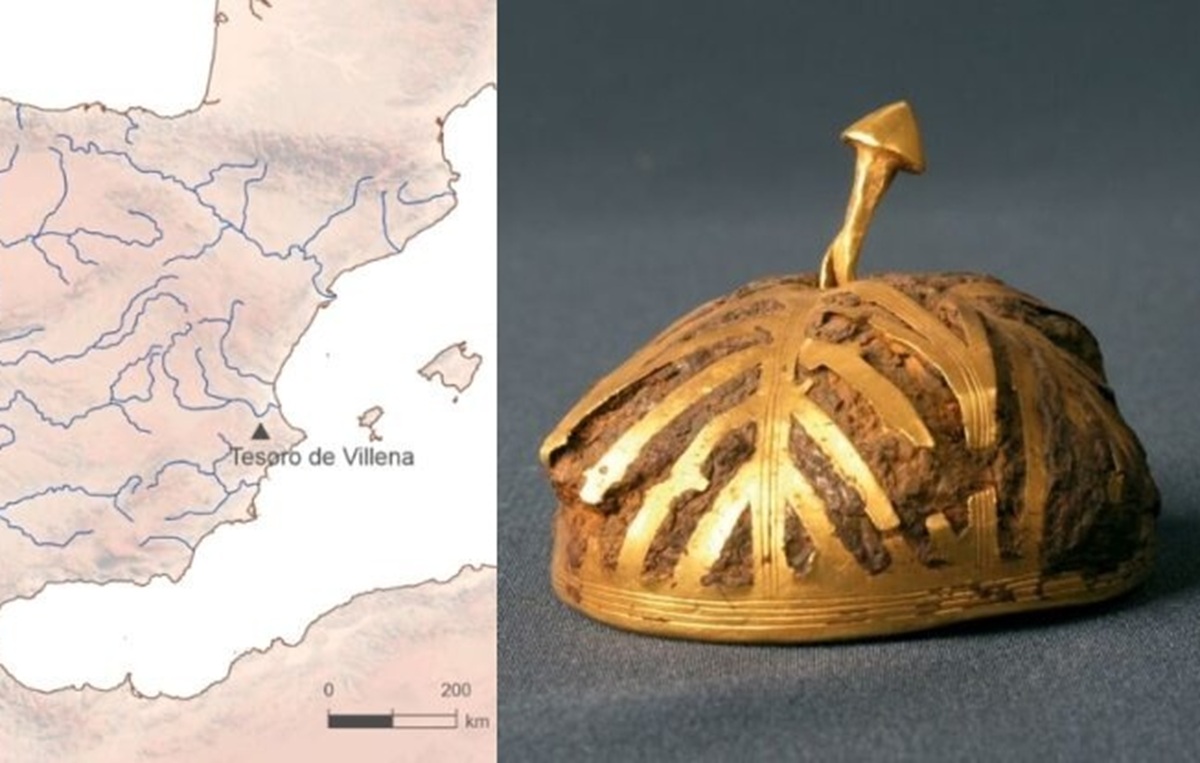
Chemical Analyses Identified High Nickel Content in Two Artifacts from the Villena Treasure, Indicating Use of Meteoric Iron Between 1400 and 1200 B.C., More Than Five Centuries Before the Start of Terrestrial Iron Metallurgy in the Iberian Peninsula, According to a Study Published in 2024
A study published in 2024 identified that two objects from the Villena Treasure, found in 1963 in Alicante, were forged with meteorite iron, indicating advanced metallurgy over 3,000 years ago and resolving a chronological impasse regarding the origin of these pieces in the collection.
A Treasure Dominated by Gold and Marked by Two Exceptions
The Villena Treasure consists of 66 objects, mostly made of gold, and is considered one of the most important collections of goldsmithing from the Bronze Age in the Iberian Peninsula and in Europe.
Among the gilded and well-preserved pieces, two objects have always stood out from the rest of the collection due to their corroded and ferrous appearance: a torque-shaped bracelet and a small hollow hemisphere decorated with gold.
-
He started running at 66 years old, broke records at 82, and is now a subject of study for having a metabolic age comparable to that of a 20-year-old, in a case that is intriguing scientists and inspiring the world.

-
Oldest tree on the planet reappears after 130 years of searches: Wattieza, 385 million years old, was 10 meters tall and had no leaves or seeds; Gilboa fossils in New York solved the mystery in 2007.

-
A 48-square-meter house assembled in hours with 4,000 bricks made of recycled plastic that does not absorb moisture, has natural thermal insulation, and costs less than 90,000 reais in a complete kit.

-
Luciano Hang revealed that Havan’s air fleet has already accumulated more than 20,000 landings, 10,000 flight hours, and 6 million kilometers traveled, and he says that without the planes, the company would never have grown so quickly.


The hemisphere is interpreted as part of a scepter or a sword handle, while the bracelet features unusual characteristics for the metallurgical context of the period associated with the treasure.
The Chronological Problem of the Presence of Iron
In the Iberian Peninsula, the Iron Age, marked by the widespread use of iron extracted from the earth’s crust, only began around 850 B.C., according to archaeological consensus.
However, the gold objects from the Villena Treasure were dated between 1500 and 1200 B.C., creating a temporal conflict that was difficult to resolve due to the presence of the two ferrous-looking pieces.
Determining whether these objects belonged to the same period as the rest of the treasure or if they were later intrusions became a true puzzle for researchers over decades.
Iron from the Sky as a Technological Alternative
Terrestrial iron is not the only possible source of malleable metallic material in periods prior to the Iron Age, as demonstrated by artifacts produced with meteorite iron in various regions of the world.
One of the best-known examples is the dagger attributed to Pharaoh Tutankhamun, as well as other weapons from the Bronze Age made with this highly valued material.
Meteoric iron is distinguished from terrestrial iron by its significantly higher nickel content, a characteristic that allows its identification through laboratory analyses.
Chemical Analyses and Obtained Results
With permission from the Villena Municipal Archaeological Museum, researchers collected small samples from the bracelet and the hemisphere for composition analyses.
The material was subjected to mass spectrometry, a technique that allows the identification of the chemical elements present and their proportions, even in artifacts with a high degree of corrosion.
Despite the alterations caused by corrosion over millennia, the results strongly suggest that both objects were produced with iron of meteoric origin.
Reframing the Villena Treasure
The identification of meteoric iron consistently resolves the chronological dilemma, indicating that the two objects were likely manufactured around the same time as the gold pieces.
Based on the available data, the artifacts are now attributed to a chronology between about 1400 and 1200 B.C., corresponding to the Late Bronze Age in the Iberian Peninsula.
According to the researchers, the bracelet and hemisphere would be the first two pieces attributable to meteoric iron identified in the Iberian region to date, expanding the understanding of local metallurgical techniques.
Limitations and Future Perspectives
The authors of the study emphasize that the high degree of corrosion of the objects prevents absolutely definitive conclusions, making the results suggestive but not entirely conclusive.
They point out that more recent and non-invasive techniques may be applied to the artifacts in the future, allowing the acquisition of more detailed data without compromising their integrity.
The conclusions of the study were published in the scientific journal Trabajos de Prehistoria, reinforcing the relevance of the Villena Treasure to European archaeology.









-

-

-

-

-

-

34 pessoas reagiram a isso.