





 Portuguese
  English
  Spanish
  5 min of reading
  4 comments


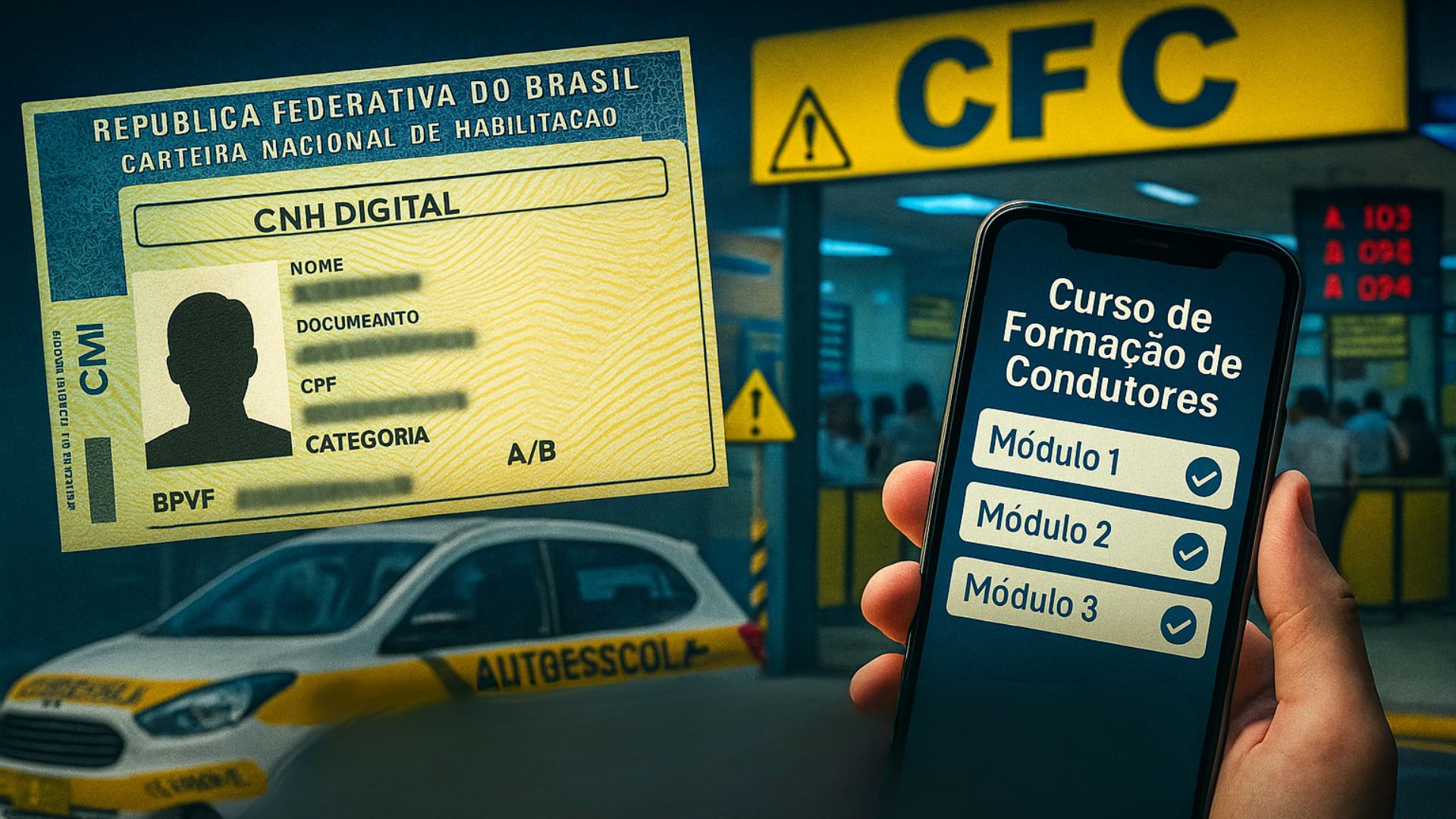


Transformations in the CNH Expose Operational Flaws, Raise Doubts About Safety in Driver Training, and Reveal a Backdrop of Uncertainty in Driving Schools.
The new rules announced by the federal government for obtaining and renewing the National Driver’s License (CNH) have left Driving Schools across the country facing an uncertain environment.
Although the Ministry of Transport claims that the digital model simplifies steps and can reduce costs, representatives of the sector report technological lag, unmeasured impact on the routine of driving schools, and doubts about the quality of training for new drivers.
In Rio Grande do Sul, the vice president of SindCFC-RS, Rodimar Dall’Agnol, detailed these concerns in an interview with the Bom Dia Cidade program on Rádio CDN.
-
The institute that trained the greatest aerospace engineers in Brazil has just opened its first campus outside São Paulo after 75 years: ITA Ceará will have R$ 445 million, new courses in energy and systems, and classes are expected to start in 2027.

-
Luciano Hang, owner of Havan, goes to Juiz de Fora after the tragedy in February, brings R$ 1 million, hands out R$ 2,000 cards, and donates up to R$ 15,000 to victims in the region.

-
The Brazilian passport allows legal residence in dozens of countries without the need for a prior visa, and most Brazilians are unaware that they can apply for residency directly upon arriving in nations in South America, Africa, and even Europe.

-
Petrobras sends a message to Brazilian truck drivers after fuel collapse and reveals plan to have 100% domestic diesel.

According to him, even the state’s Detran does not yet know how it will conduct service under the new guidelines.
The leader summarizes the atmosphere among students and instructors as a poorly explained transitional period, in which rules are published but do not yet correspond with the systems that should implement them.
According to Dall’Agnol, the most frequent question among candidates seeking driving schools is straightforward: “And now, what do I do?”.
The question, repeated by those trying for their first license or by drivers who only need to renew the document, reveals the mismatch between the announcement of the rules and the operational reality of the states.
Detran Systems Still Do Not Reflect the Changes
According to the leader, despite the provisional measure and the resolutions from Contran that underpin the new format, nothing changes immediately for those in the training process in Rio Grande do Sul.
Driving schools continue to use the same systems and remain unintegrated with the digital tools that will be adopted in the future.
The adaptation, he explains, depends on Detran-RS, which has received a deadline of up to 180 days from Cetran to update internal routines and platforms.
In the meantime, candidates intending to complete theory and practical classes through the in-person model can open their processes and proceed normally, without changes to mandatory hours or exam schedules.
The recommendation from SindCFC-RS for those who have already started training is to stick to the original plan.
This way, students avoid interruptions while the state adjusts to the new digital flow.
Toxicology Exam May Raise Costs of First License
Another point emphasized by Dall’Agnol is the requirement for a toxicology exam for the first license, established after recent changes in federal legislation.
The leader notes that this exam, which has its own cost and is carried out in accredited laboratories, is now part of the list of obligations for candidates, regardless of the category intended.
He claims that this requirement calls into question the promise that the new model will result in a cheaper process.
Although the online theoretical course is free, the total of the toxicology exam along with medical reports, psychological exams, and any additional practical classes may nullify the savings expected by the government.
Digital Course for Autonomous Instructors Raises Concerns in the Sector
Commenting on how the new guidelines were structured, Dall’Agnol speaks of accelerated and poorly founded changes.
He points out a lack of connection between parts of the norms and states that the combination of the provisional measure and resolutions presents gaps that create legal insecurity for the sector.
The legal department of the union, according to him, is already analyzing the possible labor impacts and responsibilities in cases of incidents involving autonomous instructors.
The main concern is the creation of a flow in which different agents begin to operate in driver training without clear definition of who is responsible for each step.
The most forceful criticism, however, falls on the digital course for training autonomous instructors.
In his interview, Dall’Agnol reported that he completed the content in about 15 minutes and stated that his own 13-year-old son took approximately 20 minutes to complete all activities in a test environment, which in the real model would be sufficient for issuing the certificate.
For the leader, this episode exposes fragility in the qualification process.
He compares the new format to the previous regime, in which instructors underwent 180 hours of university training and were required to perform periodic retraining.
According to Dall’Agnol, the change raises doubts about the solidity of the training and the future impact on the safety of those on the roads.
Two Paths Coexist for Those Seeking the CNH
While the digital rules are not fully in effect in the states, those seeking the CNH are navigating two possible realities.
Those opting for the new model will be able to take the theoretical course for free on the CNH do Brasil app or on the Ministry of Transport’s portal, completing modules at their own pace and generating the certificate online.
After this stage, medical and psychological exams, as well as the in-person theoretical test at Detran, remain mandatory.
At the same time, those who prefer the traditional model may continue through the driving schools, which maintain the structure of in-person classes and the previous minimum course load until the systems are updated.
For these candidates, the process remains with the usual flow of scheduling and taking tests.
What Is Already Defined in the New CNH Model
The new design provides:
– Digital opening of the process.
– Free and completely online theoretical course.
– Reduction of the minimum practical lesson load to 2 hours.
– Possibility of practice with an autonomous instructor or in a personal vehicle.
– Theoretical and practical exams conducted in person.
– Free retake of the practical exam in case of initial failure.
– Automatic renewal for drivers with no infractions, according to Detran’s criteria.
– Accreditation and oversight of autonomous instructors by state agencies.
With systems adapting, accelerated training, and new requirements such as the toxicology exam, how to ensure that the training of future drivers is truly compatible with the complexity of Brazilian traffic?









tao recebendo quantos pela defamação ?
Essa nova modalidade para obtenção da CNH, parece com o supletivo, o qual se pula várias etapas para obter o certificado de conclusão do ensino médio. É fácil, é… Mas concluir em 20 minutos, é o mesmo que dizer que não acompanhou a aula na íntegra, pois somente um dos vídeos contém 18 minutos.
Infelizmente, governo atual mostra o quanto é sanguinário pelo poder. Faz politicagem eleitoreira em uma lei enganadora a população Brasileira. E o povo que é levador de vantagens … Acredita…