





 Portuguese
  English
  Spanish
  4 min of reading
  0 comments


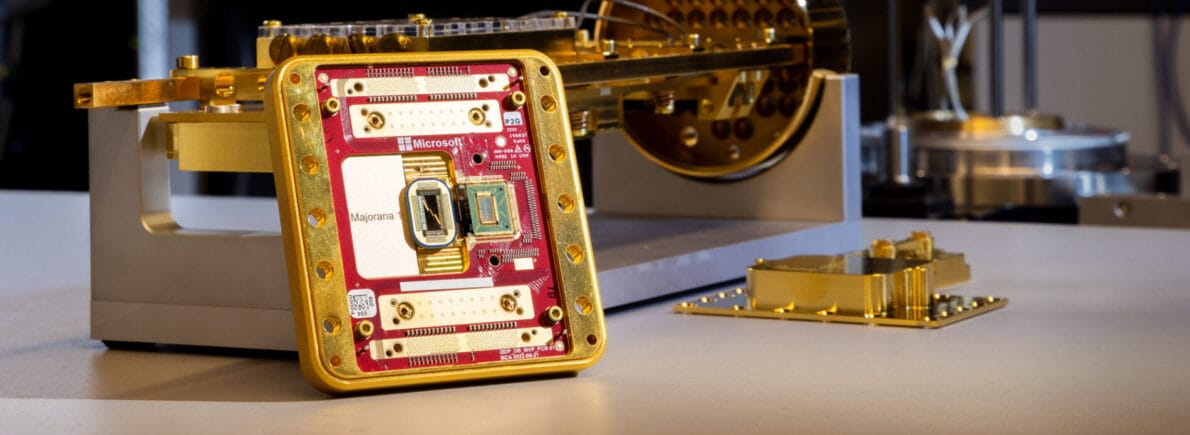
Majorana 1 Launches Unprecedented Topological Architecture That Promises to Revolutionize Entire Industries with Stable and Controllable Qubits
Microsoft has announced an unprecedented milestone in the race for quantum computing: the development of Majorana 1, the first quantum chip based on Majorana particles and powered by a Topological Core architecture. The innovation was presented alongside a peer-reviewed scientific publication in Nature, validating the results obtained.
Unlike previous approaches that rely on fragile and failure-prone qubits, Microsoft’s new chip represents a paradigm shift. It is powered by the world’s first topological superconductor – a type of topological superconductor that can control Majorana particles to build more stable, scalable, and digitally operable qubits.
According to the company, this innovation could accelerate the arrival of quantum computers with one million qubits, capable of solving problems considered impossible for classical machines – and this in years, not decades.
-
The Caspian Sea intrigues scientists as it is neither officially a sea nor a lake: the largest lake on the planet holds a hybrid crust, submerged cities, mud volcanoes, and billions of barrels of oil hidden at the bottom.
-
Why did the sky turn blood red in the west of Australia and it wasn’t sunset? Discover what is behind the change that took over the horizon for miles.

-
The most feared warplane of the United States is over 70 years old, carries 32 tons of explosives, flies 14,000 kilometers nonstop, and has just been sent to the United Kingdom amid escalating tensions with Iran.

-
Satellites and radars revealed, beneath 2 kilometers of ice in Antarctica, a lost world the size of Wales, with rivers, valleys 1,200 meters deep, and plateaus sculpted by water, frozen for 34 million years, when the continent had temperate forests and was part of a supercontinent that included South America.

What Are Majorana Particles and Why Are They Important?

The Majorana particles, theorized by physicist Ettore Majorana in 1937, are exotic quantum entities that are their own antiparticles. Although they have never been observed in nature in a stable form, scientists have been able to induce their existence under highly controlled conditions by combining superconductivity and magnetic fields.
Microsoft’s advancement lies in not only creating and controlling these particles but also integrating them into a functional quantum chip, measuring their behavior with high precision. This was made possible by a new material stack built atom by atom, combining indium arsenide with aluminum and other nanoscale structures.
The result is a topological qubit with inherent fault resistance built into the design of the hardware — representing a colossal leap over current qubits, which require constant error correction and delicate analog control.
A Quantum Chip Designed to Scale Up to 1 Million Qubits
For Microsoft, any serious attempt at quantum computing needs to have a realistic path to scale up to one million qubits. Only then will it be possible to tackle complex problems involving chemistry, physics, biology, climate, and advanced materials.
The architecture used in the Majorana 1 quantum chip allows not only stacking thousands of qubits on a single chip but also controlling them digitally — something that drastically reduces operational complexity. The qubits can be turned on or off by simple electrical pulses, similar to light switches, eliminating the need for individual adjustments for each unit.
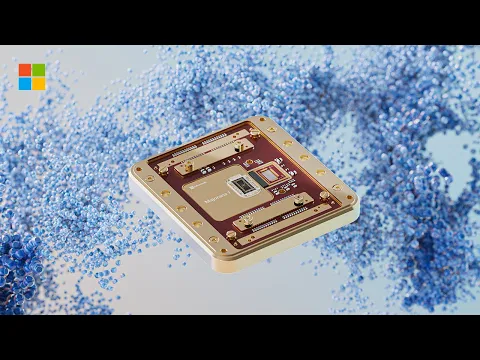
Additionally, its compact design allows the chip to fit in the palm of a hand, making it suitable for integration with Azure Datacenters, Microsoft’s cloud platform. This is a significant advantage compared to current architectures, which require huge and costly systems to maintain qubit stability.
A Quantum Computer That Solves What Classical Ones Cannot
According to Microsoft, the new generation of quantum computers will be able to solve industrial, scientific, and environmental issues that are currently insurmountable. Some examples include:
- Breaking down microplastics into harmless or recyclable materials;
- Creating self-healing materials for construction, health, and industry;
- Developing customized catalysts to accelerate chemical reactions;
- Exploring agricultural enzymes to enhance soil fertility and combat hunger;
- Designing new chemical compounds and medications with atomic precision;
- Drastically reducing the time and cost of product development.
Furthermore, the combination of quantum computing with artificial intelligence will allow researchers to describe problems in natural language and receive exact solutions back, designed qubit by qubit.
Topological Superconductors: The “Transistor” of the Era of Quantum Chips
Chetan Nayak, a technical member of Microsoft, compared topological superconductors to the semiconductor revolution of the last century. Just as transistors enabled the digital age, these new quantum materials may usher in an era where computers are designed to solve previously impossible problems with speed, precision, and reliability.
The topological superconductor created by the company is not a solid, liquid, or gas — but rather a topological state of matter, where information is protected from external disturbances. This characteristic is essential for keeping qubits operating long enough to perform trillions of operations.
Microsoft Advances in Partnership with DARPA
Microsoft’s quantum project has caught the attention of DARPA (Defense Advanced Research Projects Agency), one of the most influential agencies in research and security in the United States. The company has been selected for the final phase of the US2QC program, which aims to develop a fault-tolerant quantum computer at utility scale.
According to Matthias Troyer, another senior researcher at Microsoft, the goal from the beginning was to build a computer with commercial impact, not just conceptual. The company also collaborates with partners like Quantinuum and Atom Computing, advancing with different types of qubits while finalizing the new generation of machines with its proprietary architecture.
The development of Majorana 1 required materials engineering at the edge of precision. Each layer of the stack was designed to minimize defects that could compromise quantum stability. According to Krysta Svore, from Microsoft’s technical team, any imperfection could destroy the qubit.
“We are literally spraying materials atom by atom. These materials need to align perfectly,” Svore explained. “Ironically, that’s why we need a quantum computer — to understand and predict these very materials with greater accuracy.”
The Near Future: Quantum Computing at Commercial Scale
Microsoft claims that with this new chip, it is closer to the dream of creating a practical, scalable, reliable quantum computer integrated with artificial intelligence and classical computing. Instead of a distant horizon of 20 or 30 years, the company is working with implementation goals in just a few years.
The idea is that anyone or any company, in the near future, can access this computational power via the cloud, through Azure Quantum — democratizing the use of qubits in real applications, from materials science to global sustainable development.
Source: Official Microsoft Blog





Seja o primeiro a reagir!