





 Portuguese
  English
  Spanish
  4 min of reading
  0 comments


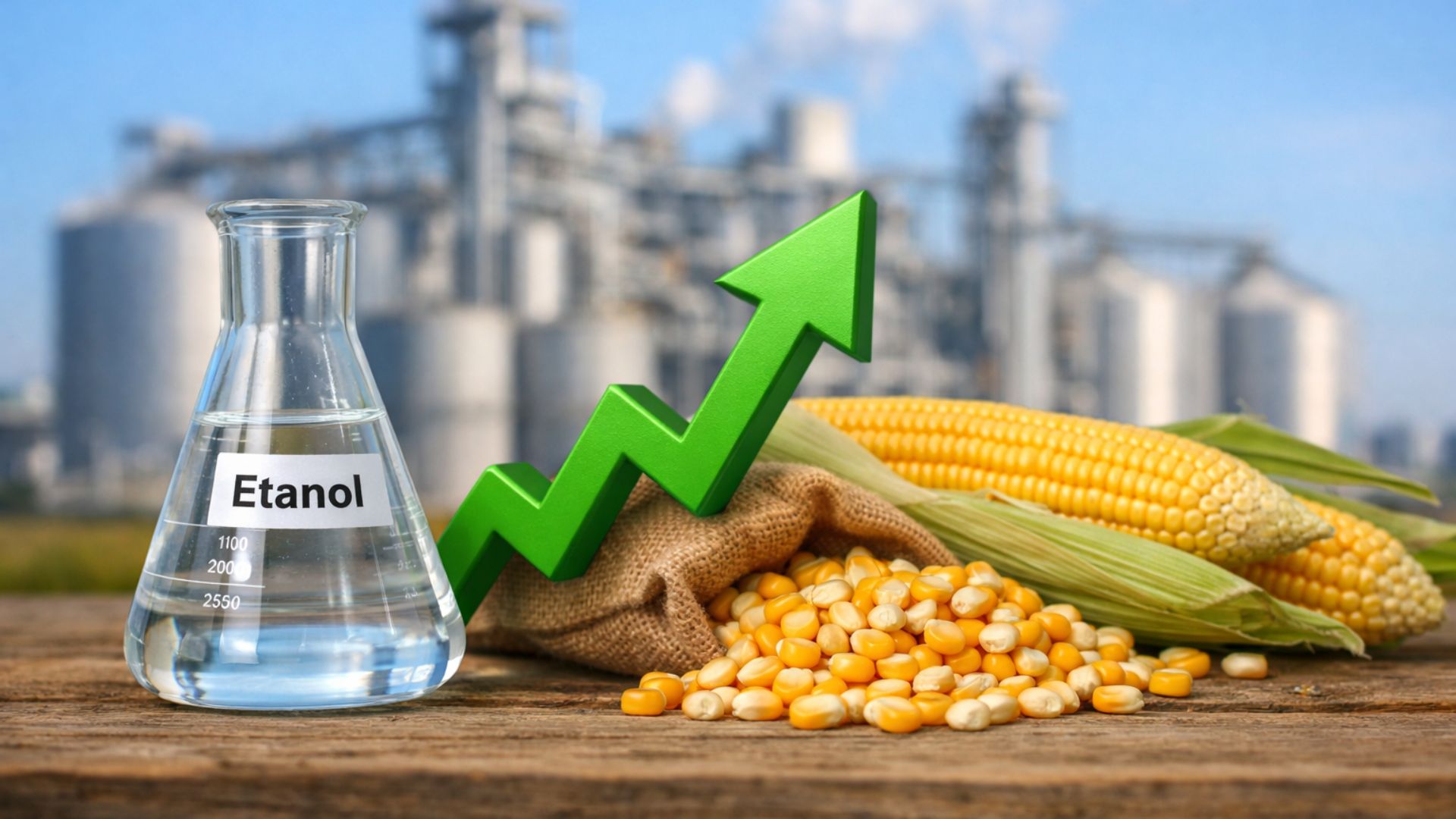
EPE Projects Strong Expansion of Ethanol Production in Brazil by 2035, with Corn Advancements, Growth of Biofuels, New DDG Markets, and Impacts on the Energy Matrix
In December 2025, the Energy Research Company (EPE) released a strategic study projecting a structural change in the renewable fuels sector in Brazil. According to the state-owned company linked to the Ministry of Mines and Energy, corn could account for up to 42% of national ethanol production by 2035, establishing itself as one of the main drivers of biofuels and Brazil’s energy transition.
According to an article published by Agência Eixos on Friday (26), the survey analyzes supply and demand scenarios between 2026 and 2035 and indicates that ethanol production in the country is expected to grow consistently, driven primarily by the accelerated expansion of corn-based ethanol, the strengthening of structural public policies, and the expansion of related markets, such as DDGS and corn oil. For EPE, ethanol will continue to be a key component of the energy matrix, regardless of the economic environment.
EPE Projects Robust Growth of Ethanol Production by 2035
According to the recently released study by EPE, ethanol production in Brazil could range between 44.8 billion and 58.8 billion liters by 2035, depending on factors such as economic growth, investment pace in the sugar-energy sector, and consolidation of public policy incentives for biofuels.
-
CNPE strengthens policy and prevents imported biodiesel from being mixed with diesel, aiming to strengthen the Brazilian industry and protect jobs by reducing external dependence amid tensions in the global market.
-
Revolution in public transport: Goiânia puts into circulation the first articulated buses powered by biomethane in Brazil and promises to drastically reduce pollution on the Anhanguera Corridor.

-
From the field to the pipelines: Mato Grosso do Sul accelerates the energy transition and consolidates a new axis in renewable energy with the arrival of a giant biogas plant.

-
The Economist states that Brazil has a “secret weapon” against expensive oil and highlights how the country can reduce economic impacts even in international scenarios of high volatility.

The report outlines three distinct trajectories—high, medium, and low growth—considering the use of sugarcane and corn as raw materials. In all scenarios, ethanol solidifies as a central element of the national energy strategy, directly impacting greenhouse gas emissions reduction and supply security.
Corn Gains Prominence in Ethanol Production in Brazil
One of the central points of the EPE study is the consistent advancement of corn-based ethanol. In 2024, production from the cereal reached 7.6 billion liters, accounting for about 20% of national ethanol production. By 2025, production accumulated until November reached approximately 9 billion liters, equivalent to 25% of the total produced in the country.
Projections indicate that, by 2035, the share of corn-based ethanol is expected to vary between 33% and 42% of total supply, highlighting a profound transformation in the structure of the Brazilian biofuels chain.
Advantages of Corn Drive Ethanol Production and Biofuels
According to EPE, the growth of corn-based ethanol is directly linked to the agronomic and logistical characteristics of the cereal. Key factors include the possibility of multiple harvests per year, especially in rotation systems with soybeans, and the grain’s storage capacity, which allows for continuous operation of the plants throughout the year.
Additionally, ethanol production from corn generates relevant co-products, such as corn oil and DDGS (dried distillers grains with solubles), widely used in animal nutrition. The recent certification of Brazilian plants for exporting DDGS to China has expanded the sector’s revenue potential and reinforced the competitiveness of national biofuels in the international market.
Sugarcane Maintains Strategic Role in Biofuel Production
Despite the advancement of corn, sugarcane remains one of the pillars of ethanol production in Brazil. The EPE study indicates that the sugar-energy sector is undergoing a financial adjustment process, driven by the attractiveness of sugar in the international market and gains in agricultural and industrial efficiency.
Positive factors include the renewal of sugarcane fields, reduced cultivation costs, increased use of irrigation, biogas production, and the advancement of second-generation ethanol (E2G). These initiatives contribute to maintaining the competitiveness of sugarcane within the group of biofuels.
Ethanol Production Grows Without Necessitating Agricultural Area Expansion
One of the most relevant aspects highlighted by EPE is that the increase in ethanol production does not necessarily imply a proportional expansion of agricultural area. Much of the projected growth is expected to occur through land-saving techniques, such as increased agricultural and industrial productivity, expansion of second-crop corn, and greater utilization of agro-industrial waste.
In this context, the relationship between production expansion and land use is likely to become increasingly dissociated. Second-crop corn, mainly cultivated after soybean harvest in already consolidated areas, is cited as an example of agricultural intensification without territorial advancement.
Biofuels Expand Energy Generation and Reduce Emissions
In addition to fuel ethanol, the EPE study highlights the growth of bioelectricity from sugarcane biomass. Even in the most conservative scenario, bioelectricity could inject up to 4.2 GW average into the electrical system by 2035, reinforcing national energy security.
The use of residues such as vinasse and filter cake also creates opportunities for biogas production. For the horizon up to 2035, EPE estimates a potential generation of between 3 billion and 3.4 billion cubic meters, varying according to the efficiency of the plants and the volume of investments in biofuels.
From an environmental perspective, the gains are significant. The avoided emissions of greenhouse gases could vary, by 2035, between 71.8 million and 80.5 million tons of CO₂ equivalent, depending on the scenario considered.
Corn, Ethanol, and the New Design of the Brazilian Energy Matrix
The EPE study also analyzed the impacts of expanding ethanol production on the fossil fuel market. In medium and high growth scenarios, imports of gasoline A would be eliminated before 2030, reinforcing the country’s energy security.
By projecting corn as the protagonist of future production, EPE signals a structural change in the Brazilian energy matrix, aligned with international climate commitments and public policies such as RenovaBio and the Future Fuel Law.







Seja o primeiro a reagir!