





 Portuguese
  English
  Spanish
  7 min of reading
  2 comments


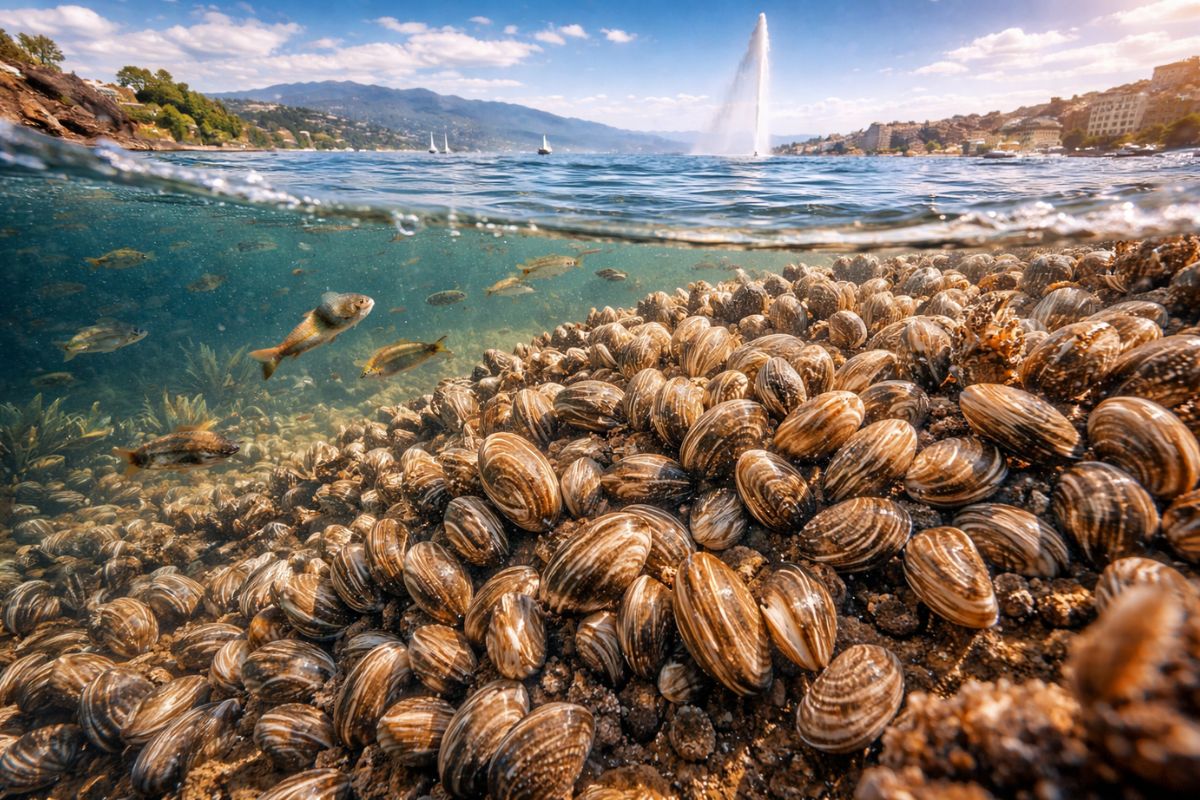


Millions of Zebra Mussels Took Over Lake Geneva, Act as Invasive Species, Topple the Food Chain, Affect Biodiversity, and Transform the Lake Forever.
At first sight, Lake Geneva looks the same as always, with snowy mountains reflecting on the blue surface. But, in the depths, millions of zebra mussels have transformed this lake into a new environment, occupying almost all available space on the bottom and crushing the old food chain that sustained fish, invertebrates, and professional fishing.
What started as a discreet invasion, hidden in technical piping and sand layers, has evolved into a scenario where millions of zebra mussels dominate the biomass of invertebrates, clogging essential infrastructure and pushing the lake into a completely different ecological state. To understand what is happening, one must look simultaneously at the cooling pipes of a university and the dark bottom 250 meters down.
The Silent Invasion That Started in the Pipes

In practice, the crisis became evident when technicians from the École Polytechnique Fédérale de Lausanne noticed that something was wrong with the cooling system.
-
With a cost per shot close to zero, the DragonFire laser could change naval warfare in 2027 and provide British ships with nearly unlimited defense against drones.

-
A British startup creates tires that generate electricity in electric vehicles when passing over potholes, speed bumps, and cracks.

-
Scientists have created robots made with living cells that have their own nervous system, swim on their own, explore the environment, and self-organize without any genetic engineering, and now they want to do the same with human cells.
-
Students create a solar-powered ambulance that operates without a plug, without fuel, and still keeps medical equipment running in remote areas.


Pipes that drew cold water from 75 meters deep in Lake Geneva began losing efficiency and, in a few years, were infested with shells.
Just as fat clogs an artery, millions of zebra mussels accumulated along 5 kilometers of piping, to the point of reducing the power of some heat exchangers by one-third. Rooms that should remain below 24 degrees in summer began registering 26 or 27 degrees, even with the system running at its limits.
The problem was not just thermal comfort. The university depends on this cold water to maintain data centers and long-term experiments, which cannot tolerate temperature variations.
One of the symbols of this dependence is the Tokamak, an experimental nuclear fusion facility that attempts to replicate, on a laboratory scale, the process that powers the Sun.
If the cooling system fails because of the mussels, the equipment does not explode; it goes into standby mode and research simply halts.
And the risk is not limited to the campus. The airport, which uses a similar system, has also been impacted. Potable water pumping systems for Geneva and Lausanne operate in the same depth range, within the colonization risk zone.
In practice, any infrastructure that depends on the deep water of the lake is exposed to the pressure of millions of zebra mussels accumulating on every available surface.
From Postcard to Zebra Mussel “Pasture” on the Bottom of the Lake
Viewed from a floating research station, the surface of the lake appears untouched. But it took pulling a line from the bottom to reveal the new reality.
The metal links surfaced covered in zebra mussels, as if they were heavy jewelry encrusted with shells.
Before the invasion, snails, shrimp, and native mussels formed the base of the invertebrate community on the bottom.
Now, researchers report that these organisms have practically disappeared. Even after a hundred meters of line, it is still possible to find mussels stuck, highlighting how much they have taken over the water column.
In the words of one of the ecologists studying the lake, down there, the scene resembles a “quagga field”, a reference to another invasive mussel related to zebra mussels. Instead of sand, there is a continuous layer of shells occupying every inch of substrate.
The data shows why the sensation is of total occupation. On average, around 4,000 zebra mussels were found per square meter in the lake, with some spots exceeding 35,000 individuals per square meter.
In 2022, 98.9 percent of the samples collected consisted of zebra mussels, and in a later survey, the situation became even more extreme. Researchers recorded that zebra mussels represented 100 percent of the samples at certain locations.
When Millions of Zebra Mussels Take Over the Biomass
The story of Lake Geneva is not an isolated case. Similar invasive mussels from the Caspian Sea region have already invaded North America’s Great Lakes since 1989.
In some of these lakes, they have come to represent over 99 percent of the entire biomass of invertebrates, signaling almost complete collapse of the native bottom fauna.
In the United States, this type of invasion is linked to the collapse of fish populations and significant economic impacts.
Legislators have already spoken about the need for around 500 million dollars, about 375 million reais, in federal resources to tackle the problem in the coming decades.
In Lake Geneva, the pattern appears to follow the same trajectory, on another scale. Millions of zebra mussels today form a biomass comparable to that recorded in the Great Lakes, according to researchers monitoring the Swiss lake.
At the same time, shipwrecks that have been preserved for over a century in North American waters are now covered by these mussels, a sight that serves as a warning of what could happen long-term in other systems.
More recently, mussels were detected for the first time in Northern Ireland, prompting authorities to call for increased surveillance and monitoring.
The message coming from these cases is clear for ecologists: once millions of zebra mussels establish themselves in a lake, reversing the process is no longer a realistic strategy.
How Mass Filtration Changes the Water and Collapses the Food Chain

Each individual is small, but a single mussel can filter up to two liters of water per day, feeding primarily on phytoplankton, the microorganisms that form the basis of the aquatic food chain. In a scenario where millions of zebra mussels occupy the bottom, the cumulative effect is enormous.
When phytoplankton disappears from the water column, water fleas and other small crustaceans that depend on these microorganisms lose their main food source. Consequently, fish that feed on these creatures are also impacted.
The result is a chain reaction that threatens the foundation of the entire food web of the lake, with direct consequences for the approximately 120 professional fishermen who make a living from the waters of Geneva.
Intense filtration also alters the appearance and physical behavior of the lake. The water becomes clearer, allowing light to penetrate to greater depths.
In combination with global warming, this can raise temperatures in previously cold layers, favoring the proliferation of toxic blue-green algae.
Another concerning effect is the alteration of the water mixing dynamics. Previously, cold air from the atmosphere created currents that mixed deep and surface layers, redistributing oxygen and nutrients. Since 2012, this pattern has ceased to be observed.
The combination of climate change and the presence of millions of zebra mussels is rewriting the physical and biological rules of the lake in just a few decades.
Infrastructure at Risk and a Race Against Time
The impacts are not limited to biology. The infrastructure around the lake now coexists with the constant risk of clogs, failures, and shutdowns.
Pumping systems for drinking water, building cooling, airport air conditioning, and high-tech laboratories now operate knowing that any pipe in contact with the lake water can become a colonization point.
In the case of the university, the only long-term solution to protect against millions of zebra mussels is to build a new closed-loop cooling system that does not come into direct contact with the lake water.
The project is scheduled to begin in 2027 and is expected to take about five years to complete, in a true race against time to ensure that the mussels do not further compromise operations.
Meanwhile, other facilities near the shores face the same challenge. The logic is simple: any permanent solid surface in the colonization zone quickly becomes a new “condominium” for mussels, whether it be a collection grill, the hull of a leisure boat, the hull of a fishing vessel, or submerged concrete structures.
No Turning Back and No Simple Solution for Millions of Zebra Mussels

From an ecological perspective, scientists are direct. Once millions of zebra mussels settle in a lake, there is no practical tool to remove them without destroying all the remaining aquatic life in the process.
The possible strategy then becomes another: to prevent the species from colonizing new environments, mainly through rigorous cleaning of boats, fishing equipment, and structures that move between lakes.
The North American experience shows that even after 30 years of colonization, there are no clear signs of decline in these invasive populations.
In Lake Geneva, after thousands of years of relative stability, the system is undergoing enormous and irreversible changes in just a decade.
Some ecologists speculate that, in the future, fish and other animals may adapt to exploit the mussels as a food resource.
Even so, the expectation is that the lake will never return to its state before the advance of millions of zebra mussels, both because of the invasion and the climate changes occurring in parallel.
The message emerging from fieldwork is harsh. Returning to the past is seen as an illusion. The realistic path lies in understanding in detail what these mollusks are doing to the lake, tracking cascading effects on biodiversity, and admitting that it is, in practice, a new ecosystem.
And you, in light of this story, do you think we should invest more in barriers to prevent millions of zebra mussels from reaching other lakes, or do you believe the priority should be to adapt our cities and economies to these ecosystems that have already changed forever?






Idaho is cleaning the Snake River up there of the invasive species quagma muscles or zebra mussels it went so well a couple years ago they’re continuing further down the river to eliminate them there also we need to find out what they’re using and do the same thing why let them take over when there is a way to get rid of them just have to be rigorous and have to be on it and not give up if it takes two times it takes two times but get it done and save the fresh water lakes and rivers instead of being lazy and brushing it off like no big deal this is the the new Norm no it’s not people don’t want to do their jobs anymore or do anything anymore becoming lazy but there are people out here that do want to work and would love to take their jobs over and do it properly but stop bowing down to sensei and start stepping up and doing their job eradicating the problem there is solutions stop trying to look for the next cop out to get out of doing something to help the world mother Earth and keep our fresh clean water people go to college for this and then not not use it if I know it and I haven’t been to college then there’s other people out there that know it also but again nobody wants to do their job they just want to collect their checks and go home go on vacations get raises but actually have to work and make a change in the world God forbid
We must find a biological solution utilizing a living agent which kills these mussels.