





 Portuguese
  English
  Spanish
  4 min of reading
  1 comment


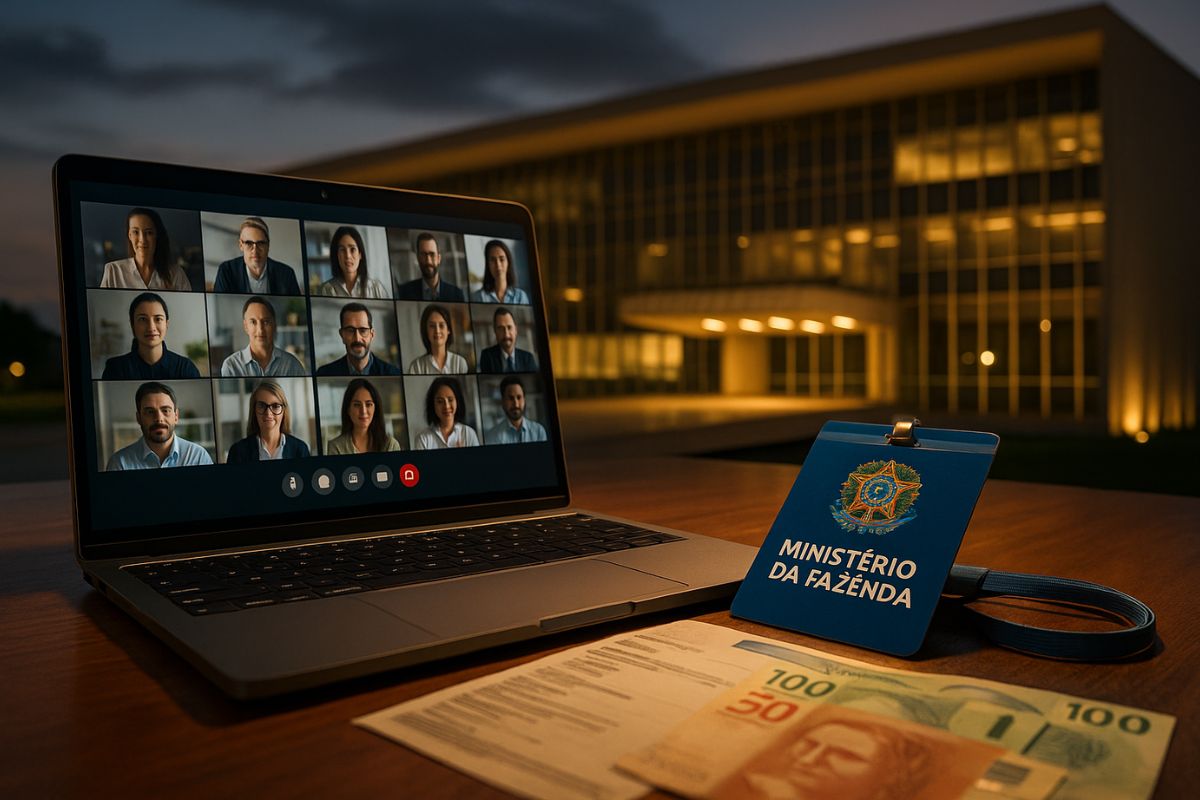


The Ministry of Finance Concentrates Almost Half of Its Workforce in Remote Work, with 10,090 Employees, Including 42 Working Abroad, Revealing the Previously Unseen Dimension of Teleworking in Federal Public Service.
According to the midianews portal, the Ministry of Finance has become the main example of the transformation of teleworking in federal public service. According to the Performance Management Program (PGD), 10,090 employees already work remotely or in a hybrid model, equivalent to 47.1% of the active workforce, including 42 professionals working from outside the country. This data reveals not only the unprecedented dimension of the change but also how the ministry has taken a leading role in this model.
In the federal administration as a whole, 145,279 employees have adopted teleworking, or 32.47% of the total.
The comparison highlights the weight of the Ministry of Finance, which alone accounts for almost a tenth of the remote workers in the Union. This advancement shows a structural shift in the way public management organizes its routines.
-
The largest executive jet in Brazil belongs to the Safra Family and is for sale: it is a 2002 Boeing BBJ, with a range of 11,500 km, 80 m² of interior space, a master suite, an office, and capacity for 18 passengers.

-
BRICS is building its own payment system that could be operational by 2030, and experts say it could increase trade between the countries by up to 10% per year and add 3% to the GDP of each member of the bloc.

-
Government suspends over 3 million traffic fines in Brazil and drivers breathe a sigh of relief.

-
Iran has just approved toll charges for ships in the Strait of Hormuz and has completely prohibited the passage of vessels from the United States and Israel in the world’s most important maritime route for the global energy market.


How the Performance Management Program Works
The PGD was created in 2023 to replace the logic of physical presence with one of results. Instead of controlling schedules and locations, managers monitor individual work plans, goals, and deliveries.
The proposal is to modernize the public machine, reduce costs, and increase efficiency, ensuring flexibility without giving up on performance accountability.
The model has spread rapidly. In addition to Finance, the Ministry of Management and Innovation in Public Services (3,791 employees), the AGU (3,181), Health (1,872), and Agriculture (1,605) also show significant adoption.
These numbers indicate that the trend is consolidated, although with different intensities among the agencies.
Benefits Already Observed with Teleworking
Reports from the Federal Court of Accounts (TCU) show that 14 out of 15 evaluated units reduced costs since adopting the PGD.
The AGU, for example, saved R$ 30 million on rent between 2019 and 2023, in addition to cutting R$ 9.6 million in operational expenses at the height of the pandemic.
In the Ministry of Finance, large-scale adoption impacted the routine at the headquarters in Brasília. Hallways and rooms are visibly emptier, but according to the ministry, results have not been compromised.
The argument is that teleworking is only authorized when it does not hinder the delivery of public policies and essential activities.
The Controversy Surrounding Productivity and Regulation
Despite the reported gains, the topic divides opinions. In Congress, Deputy Pedro Paulo (PSD-RJ), rapporteur of the administrative reform, proposed limiting telework to just one day a week, citing abuses.
Public management experts consider the measure drastic and argue that standardized productivity reports should be implemented first, so decisions are based on evidence.
The debate gains momentum when compared to the private sector. In 2025, Itaú Unibanco laid off a thousand employees after assessing a drop in remote performance, which reignited comparisons about how companies and government monitor results.
Risks and Limits of the Model
Researchers such as Humberto Falcão Martins, from Fundação Dom Cabral, remind us that teleworking in public service will only succeed if there are solid performance management mechanisms.
Without proper monitoring, there is a risk of decreased productivity and negative perceptions from society.
Another sensitive point is the presence of employees abroad. Although the number is small (42 cases), it draws attention and raises debates about control limits, data security, and equity among employees remaining in Brazil.
What Is at Stake for the Future of Public Service
The most symbolic data is that the Ministry of Finance leads the adoption of teleworking, transforming almost half of its team into remote workers.
This movement signals a paradigm shift and aligns Brazil with global trends, but also pressures managers and lawmakers to find a balance between flexibility, efficiency, and transparency.
The challenge now is to define whether the model will be consolidated as a permanent policy or if it will face restrictions in a potential administrative reform.
The Future of Public Service may depend on how this balance is achieved.
And you, do you believe that teleworking in the Ministry of Finance and other public agencies increases efficiency and reduces costs, or do you see risks of losing productivity and control?
Leave your opinion in the comments; your perspective can enrich this debate.










O teletrabalho é uma forma de reduzir gastos, evita deslocamentos e consumo de tempo e combustível inerentes. Ajuda na diminuição do estresse e da ansiedade o que redunda num aumento de produtividade. (Logicamente, nem todo trabalho pode ser convertido em teletrabalho)