





 Portuguese
  English
  Spanish
  4 min of reading
  0 comments


Scientists Find Cosmic Object Near Earth Emitting Radiation at Record Levels
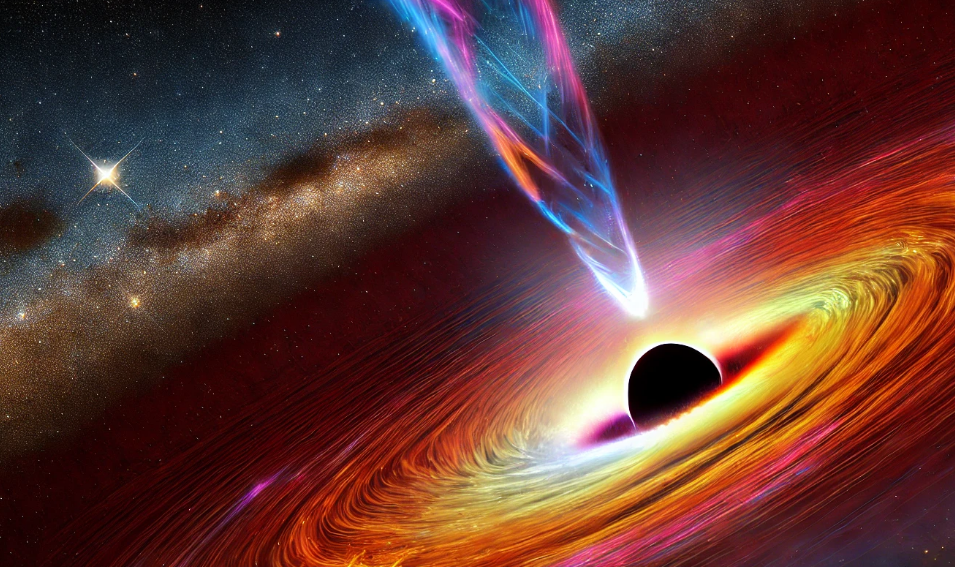
Astronomy is a science full of surprises and discoveries that change our perspective of the cosmos. Recently, astronomers revealed one of those shocking discoveries: the most intense gamma rays in the universe do not come from supermassive quasars as we thought, but from a small microquasar in our galaxy called V4641 Sagittarii. Located in the constellation of Sagittarius, 20,000 light-years from Earth, this microquasar is a true cosmic “heavyweight.”
What Is V4641 Sagittarii?
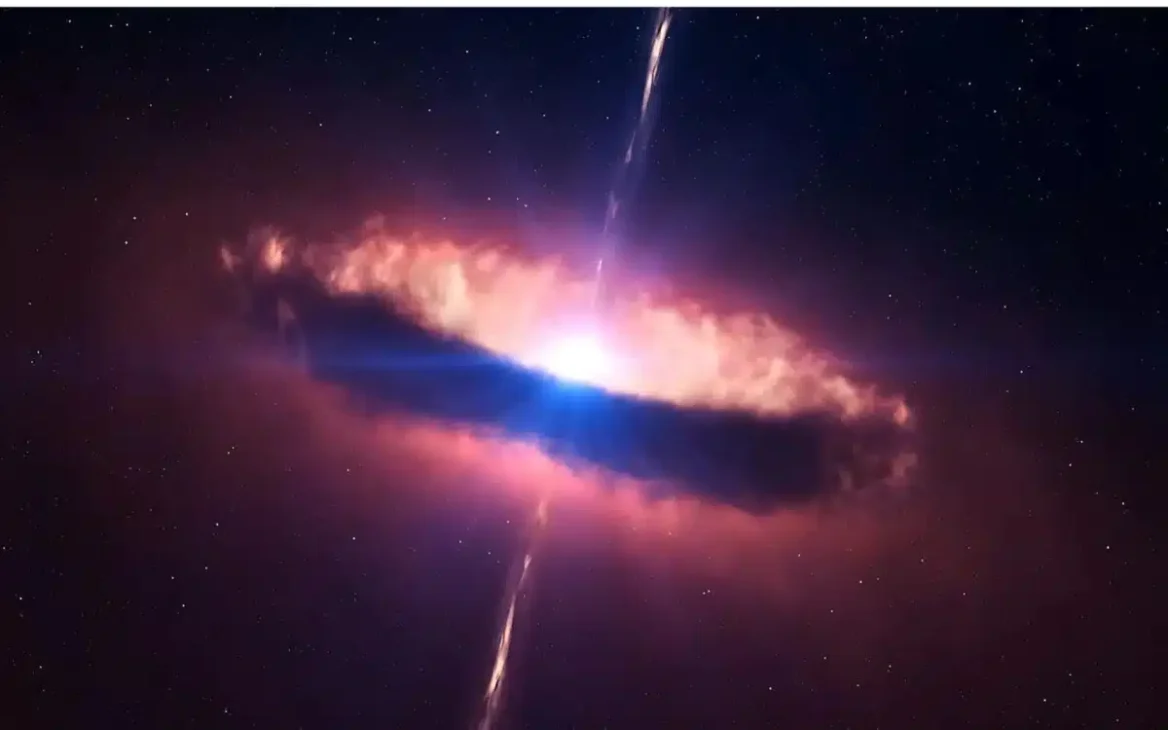
V4641 Sagittarii is a binary system where a black hole, with a mass six times greater than the Sun, orbits a star that is three times more massive than the Sun. This black hole not only orbits its stellar companion but also feeds on it, sucking in material and emitting intense radiation — like a “little monster” of cosmic proportions. With this dynamic, the system generates immense energies, similar to the powerful quasars that inhabit the cores of distant galaxies.
The Discovery of Gamma Rays at 200 TeV
To put the magnitude of this discovery into perspective, we need to understand the numbers. Gamma rays emitted by V4641 Sagittarii reach an impressive 200 teraelectronvolts (TeV), a value 200 trillion times more energetic than visible light! Until recently, it was believed that such extreme energies could only be generated in quasars, where supermassive black holes devoured matter. But it seems that V4641 Sagittarii is an exception to this rule.
-
In a flooded well, archaeologists found a 1,700-year-old Roman egg that still contains clear and yolk intact inside the very thin shell.

-
Something is happening around the Earth: Inside the huge explosion of fireballs in 2026

-
A hot air bubble coming from Argentina expands over Brazil, causing thermometers to exceed 38 degrees with a thermal sensation of 40 degrees in late March, affecting 6 states at once.

-
The radish leaf that almost everyone throws away has more polyphenols, flavonoids, and fiber than the consumed root, and a 2025 study showed that the leaf contains compounds that protect the intestine, combat inflammation, and may inhibit the growth of cancer cells.


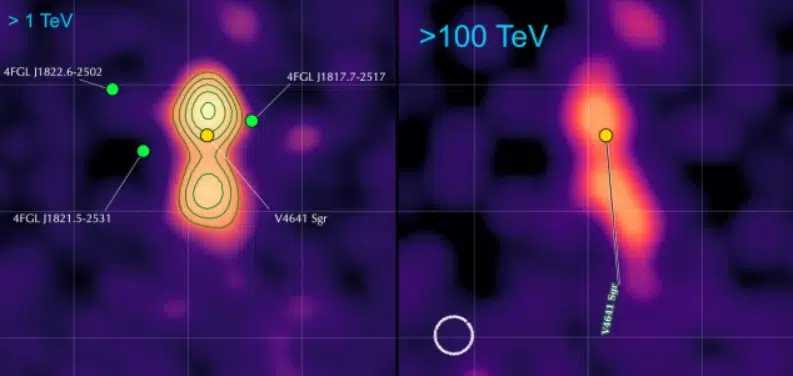
This break from expectations became clear thanks to the work of scientists like Sabrina Casanova from the Nuclear Physics Institute of the Polish Academy of Sciences. According to Casanova, images of microquasars typically have much lower energies. However, an analysis of V4641 Sagittarii revealed photons thousands of times more energetic, a discovery that challenges our understanding of cosmic powers.
How the Discovery Was Made
The High-Altitude Water Cherenkov (HAWC) gamma-ray observatory, located in the Sierra Negra in Mexico, was essential for this discovery. With a unique setup of 300 tanks of purified water, HAWC can capture high energy particles that traverse the Earth’s atmosphere, allowing scientists to identify Cherenkov radiation — a luminous “shock wave” that points to the cosmic origin of these particles.
HAWC’s wide-angle view, covering 15% of the sky at any given time, makes it ideal for continuously monitoring vast regions of space. And it was during this cosmic surveillance that Xiaojie Wang, a physicist and researcher at HAWC, saw something unusual: a bright spot of gamma rays emerging in an area where there had previously been no known signals. With scientific curiosity, Wang dove deeper into his analysis, discovering the extraordinary intensity of gamma rays from V4641 Sagittarii.
The Impact of the Discovery on Science
The discovery of V4641 Sagittarii goes far beyond our galaxy. It raises new questions about the ability of microquasars to generate extreme energies, a phenomenon that until now was believed to be exclusive to quasars. Other microquasars, such as SS 433, have already been reported emitting photons above 25 TeV, but nothing comes close to the 200 TeV of V4641 Sagittarii. This value places the microquasar on a power level comparable to that of quasars billions of light-years away, indicating that even small black holes can act as large-scale particle accelerators.
Furthermore, microquasars provide a unique opportunity for the study of cosmic processes. While quasars reveal their physics over millions of years, microquasars like V4641 Sagittarii perform the same “maneuvers” in a matter of days or weeks, allowing scientists to track the evolution of these processes at an accelerated pace.
What Does This Mean for the Future of Astronomy?
The discovery of V4641 Sagittarii is a milestone that promises to change our approach to studying the universe. We now know that microquasars can be natural labs of high-energy physics, facilitating the study of features that we would otherwise only see in galaxies billions of light-years away. It’s as if the cosmos is giving us a “free sample” of its deepest secrets, bringing closer specifications that were previously out of reach.
This advancement may inspire new missions and observatories dedicated to observing these cosmic “mini accelerators,” helping us better understand the mechanisms that govern the extreme energies of the universe. And who knows what else we might discover in our own galaxy?
In a universe of constant surprises, V4641 Sagittarii is a reminder that even in the vicinity of our galaxy, the cosmos still holds mysteries beyond our imagination. And with technological advances and the insatiable curiosity of scientists, each discovery like this brings us a little closer to understanding the secrets of the universe.








Seja o primeiro a reagir!