





 Portuguese
  English
  Spanish
  3 min of reading
  0 comments


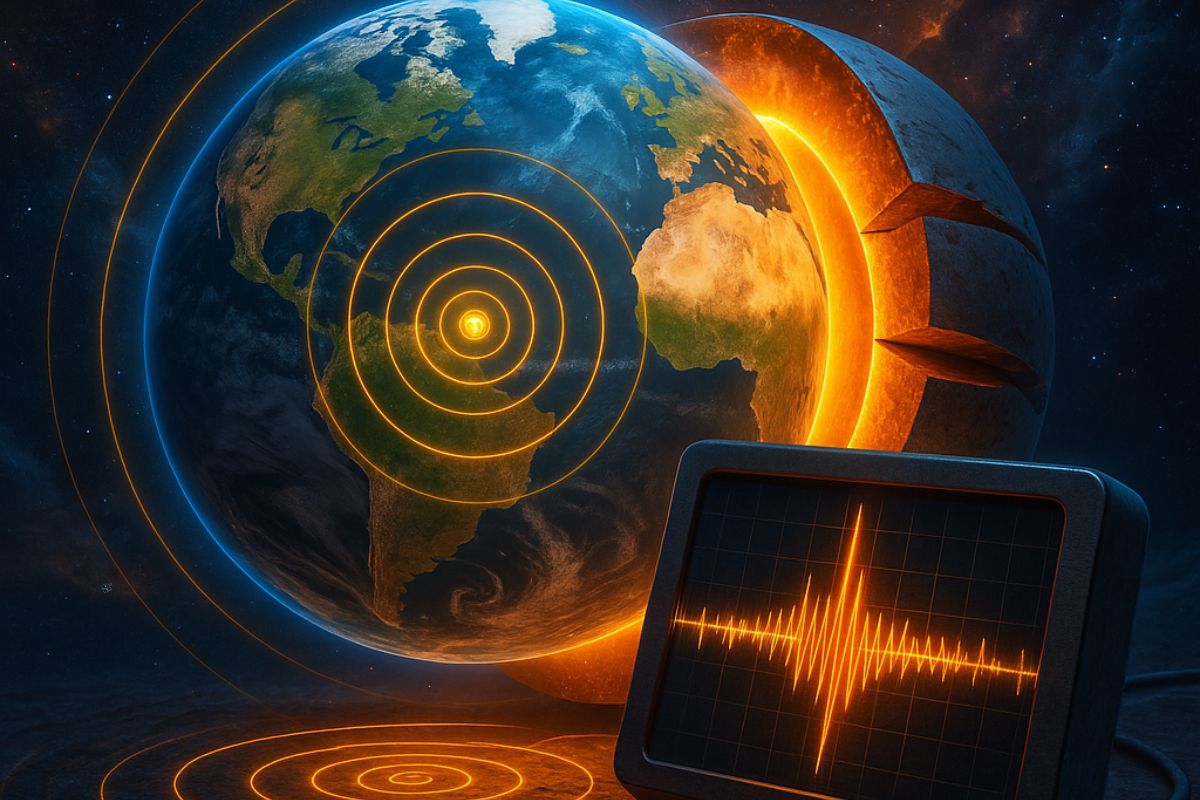
According to Olhar Digital, the pulse of the Earth is registered every 26 seconds since 1962 and continues without a definitive scientific explanation.
The pulse of the Earth is one of the greatest enigmas of modern geology. Since 1962, seismographs around the world have recorded a regular seismic beat, always with an interval of 26 seconds, originating from the Gulf of Guinea in Africa. Despite six decades of studies, science has yet to explain the cause of the phenomenon.
According to Olhar Digital, the pulse manifests as low-frequency seismic waves that traverse the planet and appear in records as if the “heart” of the Earth is beating at constant intervals. The mystery gets even bigger because, during certain periods, the frequency accelerates for a few days before returning to the original rhythm.
What Is the Pulse of the Earth?
The phenomenon was first described by the American geologist Jack Oliver in 1962 when analyzing records of microtremors.
-
An aquatic seed consumed for centuries in Asia is going viral in the West after studies highlighted its antioxidant compounds and potential anti-inflammatory properties. It pops like popcorn, has low fat content, and is already being called the new functional snack.

-
China showcases robot dogs that act in groups like a coordinated pack, make decisions together, and could change the way modern wars operate.

-
The coldest seawater ever recorded in Earth’s history was hidden under extreme ice 717 million years ago and reached an impressive -15°C.

-
China has launched the world’s first floating artificial island, a scientific structure designed to face open seas, test equipment weighing hundreds of tons, and reach depths of 10,000 meters.


Every 26 seconds, a low-intensity wave appears, even detectable at seismic stations located thousands of kilometers from the epicenter.
These waves are not strong enough to be felt by the population, but they interfere with more complex seismic analyses, such as monitoring earthquakes and volcanoes.
Therefore, the pulse has become a permanent research subject among geophysicists.
Where Does the Phenomenon Occur?
The epicenter of the pulse of the Earth has been located in the Gulf of Guinea on the west coast of Africa.
The intensity and regularity of the signals allow the event to be perceived all over the planet, even though it originates from a single region.
Scientists believe that the location of the epicenter is linked to specific geological characteristics of the African seabed, but the lack of direct data prevents solid conclusions.
The Hypotheses Under Debate
Over the decades, several theories have been proposed to explain the phenomenon.
In 2013, researchers suggested the influence of underground volcanic systems, but the hypothesis was not confirmed.
Other studies pointed to the interaction between ocean movement and the seabed, but without conclusive evidence.
More recently, research published in 2023 showed that the pulse accelerates during certain periods, which raises even more questions.
No current physical model has managed to accurately explain the origin and regularity of this seismic beat.
Why Does the Mystery Continue?
Even with technological advancements, science still knows little about the deeper layers of the planet.
A significant part of the Earth’s interior remains inaccessible, and seismographs provide only indirect clues about subterranean processes.
For specialists, the pulse of the Earth may be a sign of internal dynamics that are not yet understood, related to magma, volcanic activity, or unprecedented geological interactions.
To this day, the mystery remains one of the unanswered questions in geophysics.
An Enigma That Challenges Science

The pulse of the Earth is a reminder that, even in the midst of the technological era, the planet holds inexplicable phenomena.
Every 26 seconds, for more than 60 years, the Earth sends a signal that no scientist has been able to fully decipher.
This invisible beat reinforces how much we still have to learn about the Earth’s internal dynamics and how deep secrets can influence the surface without us realizing.
In your opinion, is the pulse of the Earth a result of volcanic activity, ocean movements, or something still unknown? Do you believe that science will reach an explanation, or will the phenomenon remain a geological mystery? Leave your opinion in the comments — we want to hear from those following this discovery in practice.








-

Uma pessoa reagiu a isso.