





 Portuguese
  English
  Spanish
  4 min of reading
  0 comments


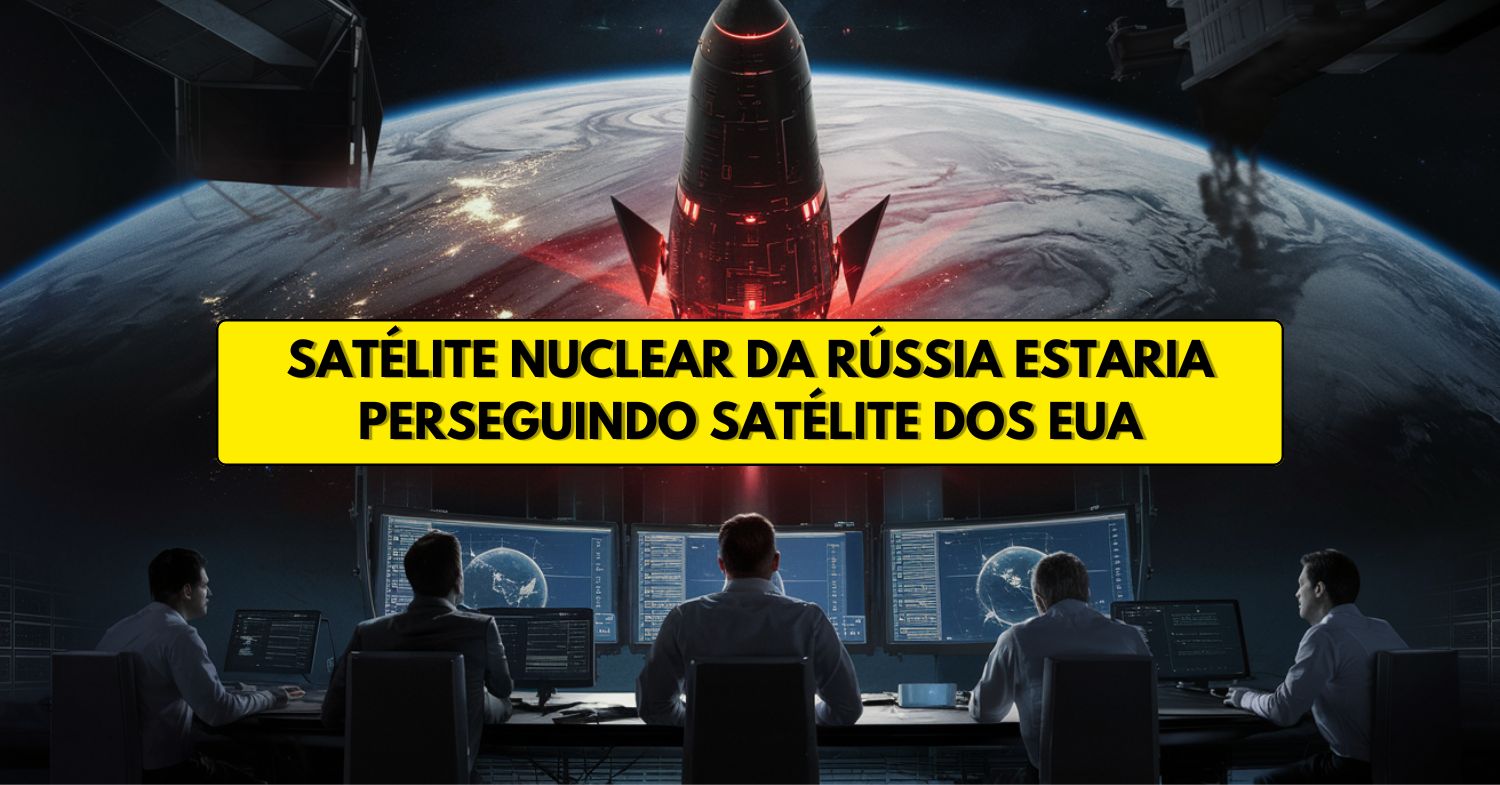
With Unknown Purpose According to NASA, The Russian Military Satellite Has Been Orbiting Earth Since May 2024 and Raises Concerns About Global Space Security.
The space race has taken a new turn that seems straight out of a science fiction movie. Russia launched the military satellite Kosmos 2576, which, according to the USA, could be a new nuclear weapon in space. Officially classified by NASA as a “satellite of unknown purpose,” the Kosmos has been orbiting Earth since May 2024 and is already generating international concerns about the future of space security.
Does Russia Have an Anti-Satellite Weapon?
Although the Russian government denies any military intent, experts in the United States believe that Kosmos 2576 was designed to destroy other satellites. Pavel Podvig, from the United Nations Institute for Disarmament Research, suggested that the satellite is “chasing” USA 314, a U.S. spy satellite from the Keyhole 11 series. The distance between them can be as little as 50 km — something insignificant in space, but extremely close in orbital terms.
According to Podvig, Russia often calls these satellites “inspectors,” but their proximity to American satellites keeps the Pentagon and NASA on alert. The possibility that Kosmos has capabilities to attack other satellites is a direct threat to space security, according to analysts.
-
The coldest seawater ever recorded in Earth’s history was hidden under extreme ice 717 million years ago and reached an impressive -15°C.

-
China has launched the world’s first floating artificial island, a scientific structure designed to face open seas, test equipment weighing hundreds of tons, and reach depths of 10,000 meters.

-
China accelerates global science and may surpass the United States in 2 years with increased public investment, continuous growth, and direct impact on the global technological competition.

-
Scientific studies indicate that drought may be strengthening a much greater silent threat: more resistant superbugs.


Russia’s Denial and International Treaties
In February 2024, Russian President Vladimir Putin categorically denied that Russia is developing nuclear weapons in space. He reiterated that his country opposes the use of weapons of mass destruction in orbit and called on all governments to respect international disarmament treaties. However, actions speak louder than words. When Japan and the U.S. proposed strengthening the space non-armament treaty at the UN Security Council, Russia vetoed the measure, raising suspicions.
The lack of transparency surrounding Kosmos 2576 reinforces the doubts. Robert Wood, U.S. Ambassador to the UN, called the satellite an “anti-space weapon,” claiming it has the potential to attack satellites in low orbit. The proximity of Kosmos to Earth, if it were carrying a nuclear warhead, could cause devastating impacts, even without directly hitting the Earth’s surface.
The Danger of a Russian Nuclear Weapon Explosion in Space
History shows us that nuclear explosions in space are not just theories. In 1962, during the Cold War, the U.S. conducted the Starfish Prime test, detonating a 1.4 megaton bomb at an altitude of 400 km — the same distance as the International Space Station. The result was catastrophic: electrical grids in Hawaii experienced outages, satellites were rendered useless, and a radiation belt was created around Earth, taking months to dissipate.
Soviet nuclear tests in space also caused enormous damage, such as the destruction of a power plant in Kazakhstan. Today, with over 10,000 satellites orbiting Earth, many responsible for essential services like GPS, communications, and meteorology, a nuclear attack in orbit could devastate civilian and military systems indiscriminately.
Why Take Nuclear Weapons to Space?
The idea of storing nuclear weapons in space may seem illogical at first glance. After all, launching an attack from orbit requires planning and time, making ground-based missiles a faster and more efficient option. The cost of space operations is astronomical, not to mention the collateral damage caused by an explosion in orbit.
Despite this, the militarization of space remains a growing concern. For countries like Russia, possessing technologies like Kosmos 2576 may be a way to demonstrate power and intimidate rivals. Even if the satellite is empty at the moment, as experts suggest, its mere existence raises questions about what may lie ahead.
The Response of the USA and NASA
The presence of Kosmos 2576 in orbit generated immediate reactions in the U.S. NASA, though focused on space exploration, highlighted the risks of armament in orbit. The Pentagon views the satellite as a direct threat to national security, warning that its attack capability is similar to other devices launched by Russia in 2019 and 2022.
Michael Turner, Chairman of the U.S. House Intelligence Committee, classified Kosmos as a “serious threat,” and the White House has been pushing for more international regulation to prevent the militarization of space.
The Future of Space Security
The presence of a satellite like Kosmos 2576 raises a warning about the dangers of militarization of space. If in 1962 there were only a few dozen satellites orbiting Earth, today there are thousands, many of which are essential for modern life. The possibility of a nuclear explosion in orbit represents an unprecedented risk, affecting not only technological systems but also the very sustainability of space exploration.
Russia, the USA, and other powers need to decide whether space will be a battlefield or a territory for peaceful collaboration. In the meantime, NASA and other international agencies must continue monitoring the situation, ensuring that scientific development is not hindered by geopolitical disputes.
Space has always been seen as the next step for humanity. The question now is: will it be a step toward progress or destruction?









-

-

3 pessoas reagiram a isso.