Portuguese
  Spanish


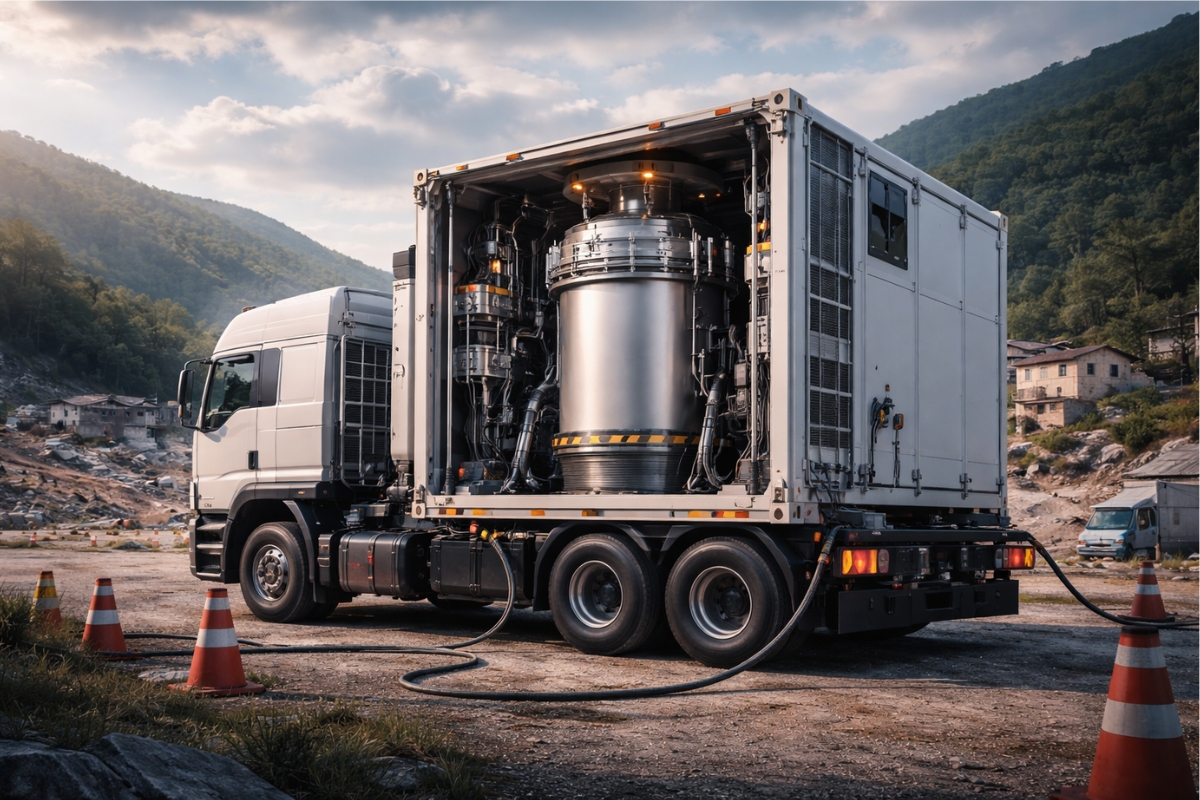


In Japan, Mitsubishi Heavy Industries Develops 3-Meter Nuclear Microreactors, Weighing Less Than 40 Tons and with Power of Up to 500 kW to Supply Remote Areas and Disaster-Stricken Regions, Promising Carbon-Free Energy and a New Chapter After Fukushima.
The accident at the Fukushima Daiichi Nuclear Power Plant in 2011 completely changed the course of nuclear energy in Japan. The country halted expansion plans and faced strong environmental and regulatory pressure.
Now, more than a decade later, a new strategy is beginning to gain traction. Instead of focusing only on large plants of over 1 gigawatt, Japan is targeting small, compact, and transportable reactors.
What seemed unlikely after Fukushima may transform into a new technological frontier. The bet is on the so-called nuclear microreactors.
-
Scientists Convert Food Waste into Aviation Fuel, Successfully Test 50% Blend with Conventional Kerosene to Cut Emissions and Promote Sustainable Flights

-
OnePlus N6 Smartphone to Launch in India with 8,000mAh Battery and 45W SuperVOOC Charging, Lasting Up to Three Days
-
Scientists Plan to Release Air Bubbles Underwater to Protect Antarctica’s “Doomsday Glacier” from Melting

-
Chinese R6000 Drone Combines Airplane and Helicopter Features, Carries Up to 12 People for Multiple Missions

Microreactors Can Be Transported by Truck
Mitsubishi Heavy Industries designs reactors that are only 3 meters tall and 4 meters wide.
The weight will be less than 40 tons. The entire system, including the power generation equipment, will fit inside a shipping container truck.
This allows the reactor to be transported to remote locations, isolated islands, or areas affected by natural disasters. Mobility is one of the most notable differentiators.
Additionally, the design is compact enough to be buried underground, reducing risks in case of accidents.

Notable data from the article: ~3 m tall, <40 tons, power of up to 500 kW, estimated operational autonomy of up to 25 years without fuel recharge, with compact design and focus on safety.
Power of Up to 500 kW and Cost Much Lower Than 1.2 Gigawatt Plants
Each microreactor will have a maximum power of 500 kilowatts. This represents about one-twentieth of the capacity of conventional reactors that generate over 1 gigawatt.
While a large nuclear power plant of 1.2 gigawatts can cost over 6 billion dollars, each microreactor will require tens of millions of dollars.
The cost per kilowatt-hour will be higher than that of a conventional reactor. Nonetheless, it will be comparable to the value currently paid to power isolated islands in Japan.
The impact could be immediate for communities that rely on expensive and polluting power generation.
25-Year Lifespan and Highly Enriched Fuel
The microreactors will use highly enriched uranium as fuel.
The design anticipates that the reactor will not need to be refueled during its estimated lifespan of 25 years. After fuel depletion, the equipment may be recovered.
All components, including the core, coolants, and internal systems, will be housed in hermetically sealed capsules.
Since they will be near inhabited areas, they will need to meet even stricter safety standards than traditional reactors.
Solid Graphite Replaces Liquids and Allows Natural Cooling
One of the most innovative aspects lies in the cooling system.
Instead of liquid coolants, the microreactors will use solid-state graphite, a material with high thermal conductivity.
During normal operation, the graphite envelops the core and distributes heat to the power generation system.
In the event of an accident, the natural ambient cooling removes excess heat, reducing the need for complex active systems.
The microreactor is designed to generate electrical power typically up to 10 MW, and while it is not yet commercialized, similar projects are advancing in licensing processes in North America and Europe, with demonstrations expected in the coming years.
Commercialization Expected in the 2030s and Possible Use Even in Space
Mitsubishi aims to start commercialization in the 2030s, after obtaining approval from the Japanese government and other countries.
In addition to terrestrial applications, the technology can also be employed in space exploration.
The proposal is clear: to provide a compact, carbon-free energy source adaptable to different scenarios.
After the trauma of Fukushima, Japan is betting on a smaller, more controlled, and technologically advanced model to meet its future energy needs.
Do you believe that transportable microreactors can become a real solution for isolated regions and disaster-affected areas? Please share your thoughts in the comments.