





 Portuguese
  English
  Spanish
  6 min of reading
  0 comments



In Xi Jinping’s China, The Chinese Model Blends Anti-Welfare Speech, 996 Workdays, Strong State in the Economy and Low Social Spending; Led Hundreds of Millions into the Middle Class Since the 1980s, but Deepened Inequality, Increased Family Costs and Accelerated the Aging of the Urban Working Population in the 21st Century, According to a Report from Brasil Paralelo
On December 10, 2021, at a conference of the Chinese Communist Party, Xi Jinping argued that countries that invested in high social benefits fell into the middle-income trap and became stuck in low growth. While criticizing what he called “Latin American welfare,” the president indirectly described Brazil and presented the Chinese model as a path of fiscal discipline, focus on productivity, and rejection of income transfer policies seen as populist.
Since the economic opening in the 1980s, the country has combined a single party, political centralization, and an increasingly market-driven economy. The result has been accelerated growth, driven by the largest workforce in the world, low wages, and massive attraction of foreign factories, while the State maintained low social spending and accepted significant human costs to sustain the pace of industrialization and large-scale urbanization.
Speech Against Welfare and The Middle-Income Trap
In his 2021 speech, Xi Jinping argued that “increased social benefits cannot be reduced” and that this would create dependent groups, who are unproductive and politically difficult to confront.
-
A new Brazilian shopping center worth R$ 400 million will be built in an area equivalent to more than 4 football fields, featuring 90 stores, 5 cinemas, a supermarket, a college, and parking for 1,700 cars, potentially generating 3,000 jobs.

-
Larger than entire cities in Brazil: BYD is building a 4.6 km² complex in Bahia with a capacity for 600,000 vehicles per year, but the discovery of 163 workers in conditions analogous to slavery has shaken the entire project.

-
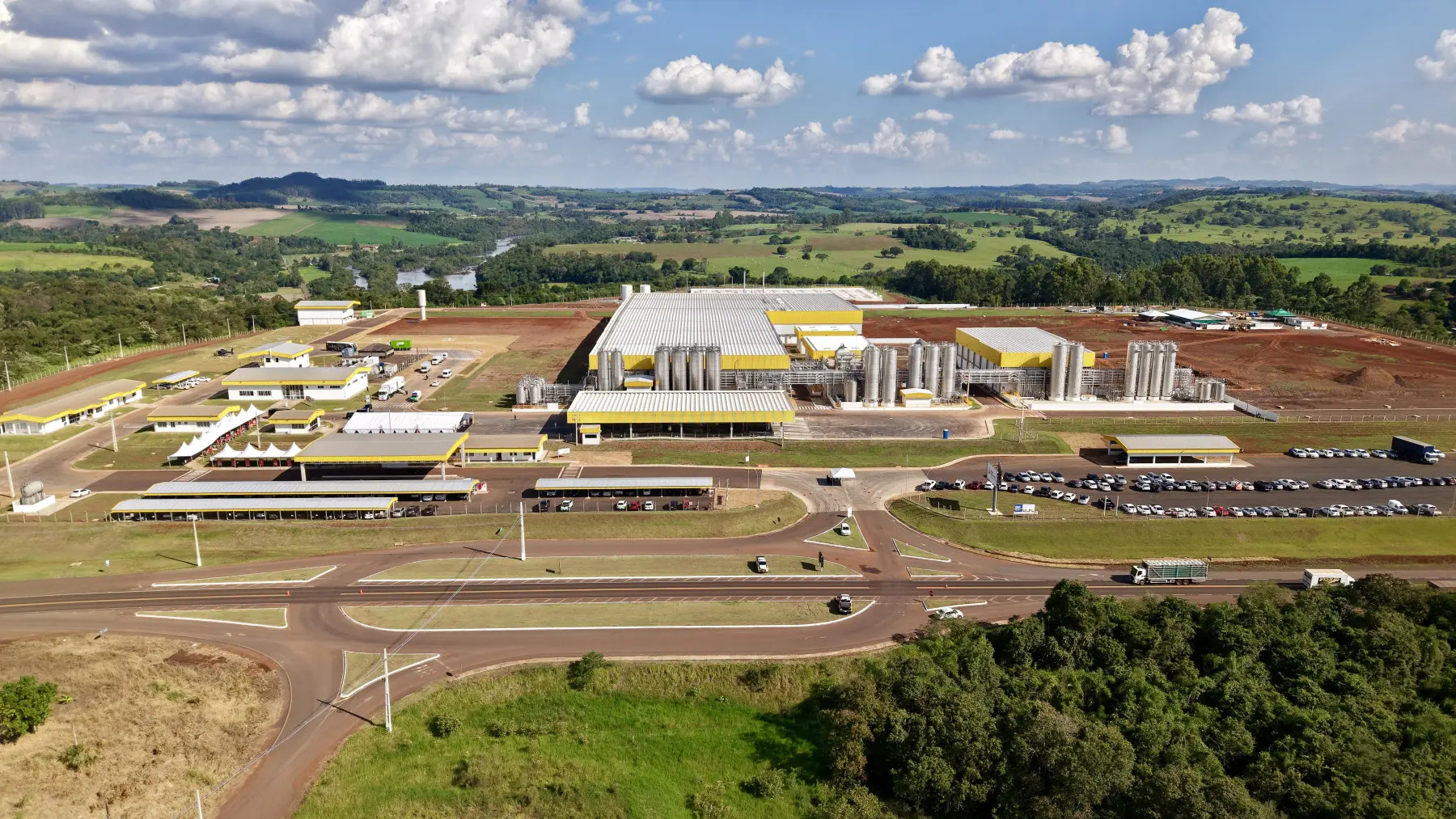
With an investment of R$ 612 million, a capacity to process 1.2 million liters of milk per day, Piracanjuba inaugurates a mega cheese factory that increases national production, reduces dependence on imports, and repositions Brazil on the global dairy map.
-
Brazilian city gains industrial hub for 85 companies that is equivalent to 55 football fields.

This reading supports the idea that the Chinese model avoids permanent welfare, privileging investment in industry, infrastructure, and export capacity.
The message is clear: the stability of the regime depends more on continuous growth than on universal benefits.
In practice, this has meant keeping wages relatively low for decades, delaying the full expansion of social welfare, and using household savings to finance banks and state-owned enterprises.
At the same time, the government advocates for the goal of “common prosperity,” but with an emphasis on discipline and intense work, not on expanding income transfers.
Communist Party, Market Economy and Entrepreneurial State

One of the pillars of the Chinese model is the entrepreneurial state.
The government owns hundreds of thousands of state-owned enterprises and maintains a stake in a large number of private companies, ensuring direct influence over strategic sectors, credit, and investment decisions.
The Party not only governs but also participates in the management of industrial and financial conglomerates, organizing mergers, financing external projects, and managing currency devaluation to favor exports.
At the same time, the economy operates on market logic: companies compete for productivity, exports, and technology, cities compete for investments and talent, and the business environment is shaped by goals set by the Party.
This combination produces a system where the government is strong in macroeconomic direction but weak in the protection of labor rights and in providing wide-ranging social benefits, leaving citizens’ security more dependent on employment and private savings than on public safety nets.
Shenzhen, “Time Is Money” and 996 Culture


The city of Shenzhen synthesizes the Chinese model of accelerated growth.
In just a few decades, it transformed from a fishing village to a technology hub that hosts giants like Tencent and Huawei and accounts for hundreds of billions of dollars in annual exports, with a heavy weight in electronics.
At one of its intersections, the slogan “time is money, efficiency is life” summarizes the logic that guided the transformation.
In concrete terms, this logic was translated into workdays known as 996 culture: working from 9 a.m. to 9 p.m., six days a week, especially in technology companies and competitive sectors.
Even after court rulings recognized the illegality of the practice without adequate compensation, limited enforcement and pressure for productivity maintain exhausting routines in many Chinese corporate environments, reinforcing a culture of personal sacrifice in the name of growth and job stability.
Extreme Cases of Work and Limits of Enforcement
The Chinese model has also been marked by extreme cases in global production chains.
Factories linked to major international brands reported episodes of such long workdays and such rigid targets that they resulted in protests, complaints, and even series of employee suicides in 2010, generating strong international repercussions and emergency prevention measures.
Years later, other cases pointed to workers being exposed to toxic solvents and reports of child labor among industrial suppliers, indicating that the combination of low costs, aggressive targets, and irregular enforcement poses constant risks to the health and dignity of the workforce.
Although some practices have been formally condemned by the judiciary and labor authorities, competition among companies and cities maintains structural pressure for more hours, more productivity, and lower costs per worker.
Hukou, Low Social Spending and Territorial Inequality
Another central element of the Chinese model is the residential registration system known as hukou, which functions as an “internal passport”.
Access to health, education, welfare, and subsidized housing depends on the official place of birth.
Rural migrants to large industrial cities often maintain reduced social rights compared to original residents.
In 2016, China spent a smaller share of GDP on social programs than developed countries and significantly below that of Brazil, relieving pressure on public budgets, but forcing families to save more and bear the costs of health and education emergencies directly.
This arrangement allowed much of the domestic savings to be channeled into banks and productive investments, at the cost of a visible divide between wealthy coastal metropolises and less developed inland regions, as well as between workers with local hukou and migrants with partial rights coverage.
Intensive Work, Middle Class and Aging Population
The Chinese model has led the country to become wealthier, on average, than Brazil, with a significant portion of the population entering income brackets associated with the urban middle class.
This was achieved through the combination of a large workforce, historically low wages, efficient infrastructure, and a more flexible regulatory environment for labor-intensive industrial and service companies.
But the social cost has been high.
Chinese workers accumulate, on average, hundreds of hours more of work per year compared to Brazilians.
At the same time, rising living costs in major cities, pressure for performance, and the lack of broad social protection networks contributed to a sharp decline in the birth rate.
Projections indicate that China is likely to become one of the most aging countries in the world by 2050, which raises questions about the long-term sustainability of a model based on an abundance of cheap young workers.
Why The Chinese Model Does Not Fit Easily in Brazil
In light of Brazil’s weak growth over the past few decades, it is common for part of the national debate to ask whether simply importing the Chinese model would unlock the economy.
However, direct comparison ignores deep cultural, institutional, and legal differences.
Brazil has more protective labor legislation, a higher level of social benefits, and a society that has historically reacted to attempts to increase work hours or rapidly reduce rights.
Moreover, factors that helped China attract factories, such as lower corporate taxes, superior logistical infrastructure, and cheaper energy, do not automatically replicate by decree.
Copying only the hard part of the Chinese model, such as long hours and reduced social spending, without reproducing the conditions of competitiveness and investment, would mean imposing social costs without ensuring the same gains in productivity and income, generating political resistance and likely instability.
Ultimately, the Chinese experience shows a country that united a communist party, market economy, and intense labor to accelerate material wealth but accepted significant inequalities, strong state control, and rapid aging of the population as side effects.
The question for Brazil is less whether the Chinese model works there and more which elements, if any, can be adapted without breaking with the culture of social rights and the Brazilian constitutional framework.
Do you think the Chinese model would be worth the social cost if applied in Brazil in exchange for more economic growth or would the price in rights and quality of life be too high?








Seja o primeiro a reagir!