





 Portuguese
  English
  Spanish
  4 min of reading
  1 comment


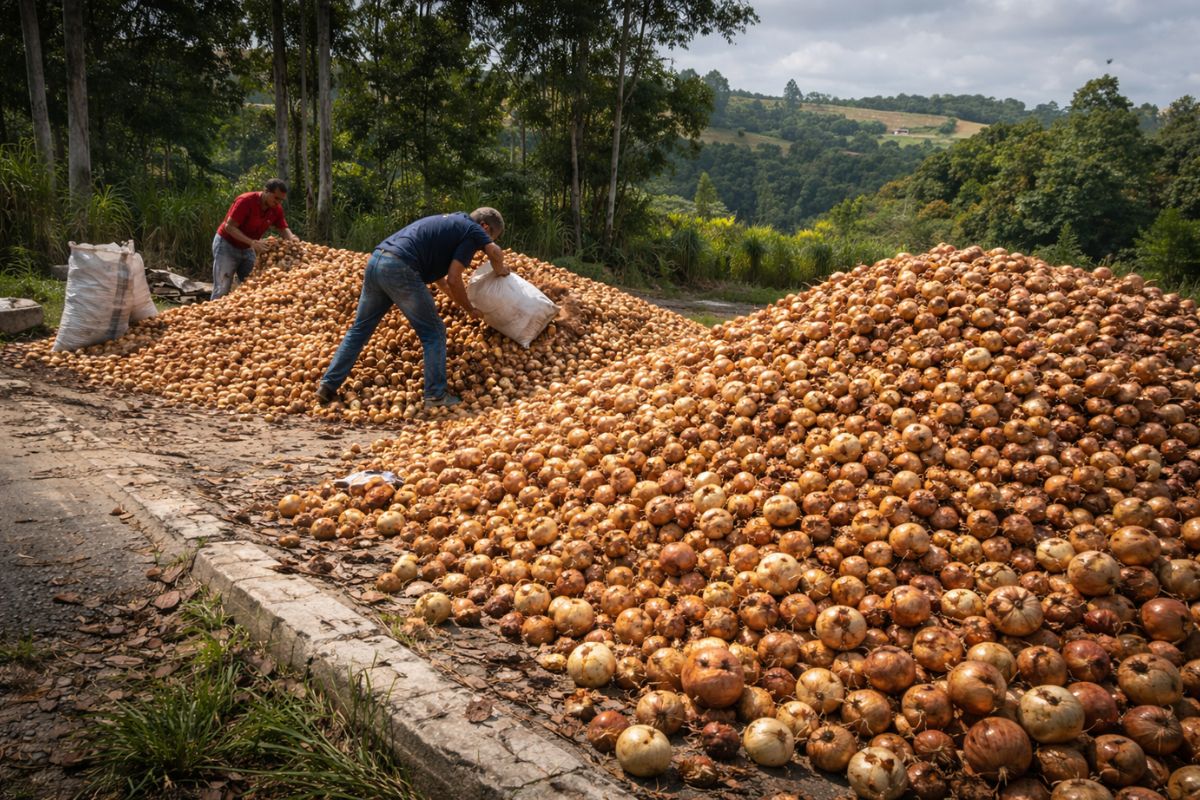


With At Least 11 Mounds Discarded in Aurora, the Onion Chain in Alto Vale do Itajaí Faces Prices Below Costs, Loss of Income, and Difficulty in Marketing; the Crisis Reaches Ituporanga, Already in Emergency for 180 Days, While Part of the Harvest Goes to Fertilization in the Producing Region.
The onion has gone from economic asset to a visible symbol of crisis in Alto Vale do Itajaí. In Aurora, the discarding of at least 11 large mounds along the highway has laid bare a scenario where the selling price is below the production cost, squeezing the income of producers and accelerating losses.
The episode occurred in an area near Ituporanga, a municipality nationally recognized for the production of the food, and gained regional dimensions by synthesizing a problem that had already been reported: harvest in strong rhythm, difficulty to market, negative margins, and increasing pressure on families that directly depend on the local agricultural chain.
The Breaking Point: When the Onion Loses Value Before Leaving the Field

When the price of onions falls to a level below the cost, the economic logic of the harvest reverses. What should represent revenue begins to generate loss at every stage, from harvest to transport. This is the moment when production stops being a solution and becomes a liability, because every new load moved can increase the producer’s total loss.
-
The water that almost everyone throws away after cooking potatoes carries nutrients released during the preparation and can be reused to help in the development of plants when used correctly at the base of gardens and pots, at no additional cost and without changing the routine.

-
The sea water temperature rose from 28 to 34 degrees in Santa Catarina and killed up to 90% of the oysters: producers who planted over 1 million seeds lost practically everything and say that if it happens again, production is doomed to end.

-
An Indian tree that grows in the Brazilian Northeast produces an oil capable of acting against more than 200 species of pests and interrupting the insect cycle, gaining ground as a natural alternative in soybean, cotton, and vegetable crops.

-
The rise in oil prices in the Middle East is already affecting Brazilian sugar: mills in the Central-South are seeing their margins shrink just as ethanol gains strength.


In this context, discarding does not appear as a simple decision, but rather as a consequence of a critical chain: a pressured market, insufficient remuneration, and marketing bottlenecks. The image of the mounds by the roadside grabs attention precisely because it makes concrete a problem that, most of the time, is diluted in accounts, debts, and overdue payments in the local economy.
Aurora and Ituporanga in the Same Productive Epicenter

Aurora, located about 14 kilometers from Ituporanga, shares the same productive environment and the same market vulnerabilities. The geographical proximity facilitates the understanding of the impact: when onions lose value at one point in the regional chain, the effect quickly spreads to neighboring municipalities that depend on the same commercial dynamics.
Ituporanga, identified as “Land of the Onion,” is facing not only a pricing issue but a shock to its strategic activity. The crisis ceases to be sectoral and becomes territorial, as it affects employment, income circulation, investment capacity in the field, and the predictability of the entire harvest. In regions with strong agricultural specialization, this type of collapse tends to reverberate throughout the municipal economy.
The Emergency Decree of 180 Days and What It Allows in Practice
The declaration of a state of economic emergency for 180 days formalizes the seriousness of the situation and paves the way for exceptional administrative measures. In practice, this allows for prioritizing actions aimed at the onion chain, expanding support programs for production, facilitating access to credit, and creating conditions for debt renegotiation in a moment of tightened cash flow.
There is also room for seeking technical and financial support from governments and financial institutions, with monitoring from the Municipal Department of Agriculture. The decree, in itself, does not resolve the price imbalance, but creates instruments to reduce immediate damages and organize a coordinated response, especially to prevent new episodes of waste from repeating on the same scale.
Authorized Discard and Reuse as Fertilizer: Damage Reduction, Not Structural Solution
In the case recorded in Aurora, the landowner authorized the discard and informed that the material would be reused as fertilizer.
This decision reduces part of the environmental impact of an already established loss, as it prevents improper disposal and returns some agronomic value to the material that did not find a commercial outlet.
Nevertheless, reuse does not eliminate the core of the economic problem. Transforming onions into fertilizer is management of consequence, not correction of cause.
The producer remains exposed to the same central risk: selling below cost, and the region still needs solutions involving price, marketing flow, and stability instruments for the chain.
What the Onion Crisis Reveals About the Organization of the Chain in Alto Vale
The sequence of losses suggests that the current crisis cannot be read as an isolated event but as a result of accumulated fragilities between production and market.
When there is a lack of predictability in remuneration, the harvest can grow and still convert volume into loss. In this scenario, the problem is not just in producing but in ensuring that production finds an economically viable outlet.
For Aurora, Ituporanga, and surrounding municipalities, the discussion involves regional coordination, public response, and minimum income protection in critical cycles.
Without mechanisms to cushion sharp price declines, the onion oscillates between prosperity and collapse with a direct impact on those who plant, harvest, and sustain the main local agricultural chain.
After the Shock, the Debate That Remains
The discarding of mountains of onions in Alto Vale do Itajaí has undeniably exposed the magnitude of a crisis that has been unfolding in the fields.
There is an immediate picture of loss, waste, and pressure on producers, and a medium-term question: how to prevent a historic harvest from ending as a historic loss.
In your view, what measure would have the quickest effect to prevent another onion collapse in the next harvest: emergency credit with renegotiation, direct support for marketing, or a regional minimum price protection model? If you live in an agricultural town, tell how this affects the day-to-day economy.










A cebolas caras nos mercados sacolaos abc sp e vez de jogar foras as cebolas fazer conservas sopas em po farinhas de cebolas em po temperos adoro cebolas e so vender para pessoas de fabricar temperos sopas de cebolas legumes verduras macarrao com sabor miojos lamems outros empresas de caldos temperos sopas farinhas cooperativas mercados reustaurantes quitadas sacoloes barracas nas cidades usar a inteligencias evitar despercios de alimmentos vender por pessoas para vender os produtos na cidades vilas bairros favelas barracas ruas estradas praias 26