





 Portuguese
  English
  Spanish
  5 min of reading
  0 comments


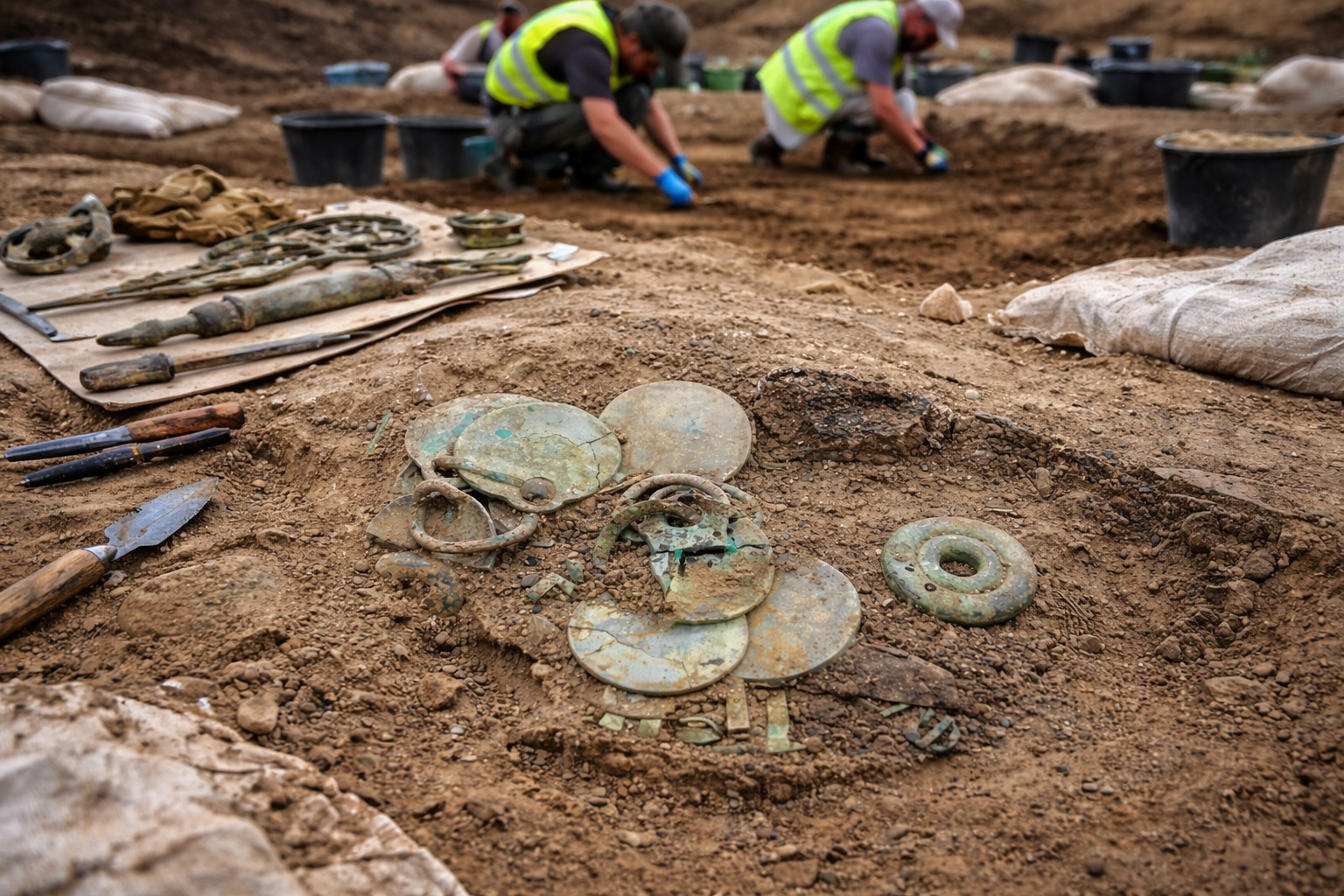
More than 500 Bronze Age objects found in 3 thousand year treasure in Scotland, including rare pieces that intrigue archaeologists.
In 2020, an archaeological discovery in southern Scotland, near the Peebles area in the Scottish Borders, caught the attention of the international scientific community by revealing one of the largest collections of Bronze Age artifacts ever found in the United Kingdom. The find, known as the Peebles Hoard, was initially located by an amateur detectorist and later excavated by specialized teams with support from National Museums Scotland.
According to information released by institutions such as National Museums Scotland and specialized media in art and archaeology, the treasure includes more than 500 objects, many of which are exceptionally preserved and some considered unprecedented for Western Europe. The most striking fact is that some of the items had never been recorded in previous excavations, indicating practices and technologies still poorly understood from the late Bronze Age, about 3 thousand years ago.
The discovery not only expands knowledge about this period but also raises new questions about trade, ritual, and social organization in an era marked by profound technological transformations.
-
Luxurious mansion in Rio valued at up to R$ 40 million has already impressed international celebrities and belongs to a well-known Globo presenter.

-
Friends have been building a small “town” for 30 years to grow old together, with compact houses, a common area, nature surrounding it, and a collective life project designed for friendship, coexistence, and simplicity.

-
This small town in Germany created its own currency 24 years ago, today it circulates millions per year, is accepted in over 300 stores, and the German government allowed all of this to happen under one condition.

-
Curitiba is shrinking and is expected to lose 97,000 residents by 2050, while inland cities in Paraná such as Sarandi, Araucária, and Toledo are experiencing accelerated growth that is changing the entire state’s map.


What is the Peebles Hoard and why is it considered exceptional
The so-called Peebles Hoard is not just a collection of ancient objects, but one of the largest deposits of Bronze Age artifacts ever found in Britain. The collection includes metal objects, preserved organic artifacts, everyday and ceremonial items, as well as pieces in fragmented and intact condition.

The quantity and diversity of the items classify the find as one of the most important in Western Europe for this historical period. Unlike many treasures found in isolation, the Peebles Hoard presents a structured set, suggesting an intentional deposit rather than just accidental loss.
Unprecedented objects and the challenge of archaeological interpretation
One of the most relevant points of the discovery is the presence of objects that have no known parallels in Western Europe. Among the items found are bronze pieces with unusual shapes, components of possible harnesses or wooden structures, decorative elements with poorly documented techniques, and fragments of rarely preserved organic materials.
The presence of these unprecedented objects indicates that the material culture of the region was more complex and diverse than previously thought. This factor makes the work of archaeologists more challenging, as it requires new interpretations and comparisons with other European sites.
The importance of preserved organic materials
Another aspect that differentiates the Peebles Hoard is the preservation of organic materials, something relatively rare in such ancient archaeological contexts. Among the identified materials are wood, leather, and plant fibers.

These elements provide a unique opportunity to understand how objects were used in daily life, something that metal alone cannot reveal. The preservation of these materials suggests that the environment where the treasure was buried had specific conditions that prevented complete decomposition over the millennia.
Historical context: the Bronze Age in Western Europe
The Bronze Age, which extends approximately from 3,300 BC to 1,200 BC, was a period marked by significant technological and social transformations. During this time, there was progress in metallurgy, increased social complexity, the emergence of trade networks, and the development of elaborate ritual practices.
The use of bronze allowed for the production of more efficient tools and sophisticated decorative objects, driving profound changes in human societies. In the case of Britain, this period is also associated with practices of ritual deposition of objects, often in specific locations.
Was the treasure hidden, buried, or offered?
One of the main questions raised by archaeologists is why the treasure was buried. There are three main hypotheses: ritual deposit, temporary storage, and concealment during a crisis.

The organization of the objects and the context in which they were found suggest that the deposit may have had a symbolic significance, not just economic. In various Bronze Age cultures, it was common to offer valuable objects to spiritual entities, burying them in specific locations as a form of ritual.
Indications of trade networks and technology circulation
The analysis of the objects from the Peebles Hoard may also reveal information about trade networks of the time. Some items exhibit characteristics that suggest influence from other European regions, exchange of materials and techniques, and circulation of technological knowledge.
This indicates that the communities of Scotland were not isolated but were part of a broader system of cultural and economic interaction. This view contrasts with older interpretations that saw these societies as relatively isolated.
The role of the detectorist and modern archaeology
The initial discovery was made by an amateur detectorist, raising discussions about the role of these enthusiasts in contemporary archaeology. In the case of the Peebles Hoard, the process followed legal and scientific protocols, with immediate communication to the authorities.
This type of collaboration between civilians and institutions allows important discoveries to be preserved and studied properly. After identification, professional teams conducted detailed excavations to ensure the integrity of the archaeological context.

Current studies and the future of research
The objects found are still being analyzed by specialists using advanced laboratory techniques. Among the methods used are:
- Metallurgical analysis;
- Radiocarbon dating;
- Microscopic studies;
- Digital reconstruction.
These studies may take years, but they are essential for fully understanding the significance of the find. The expectation is that new discoveries will arise from these analyses, further expanding knowledge about the period.
Scientific and archaeological impact of the discovery
The Peebles Hoard is already considered a landmark in Bronze Age archaeology. Its importance is due to factors such as the quantity of objects, diversity of materials, presence of unprecedented items, and preserved context.
These elements allow for a more complete view of the social, economic, and religious practices of the time. Furthermore, the find contributes to reevaluating existing theories about the organization of Western European societies.
A treasure that rewrites part of history
The discovery of the Peebles Hoard in Scotland represents much more than a simple buried treasure. It offers a window into a distant period, revealing aspects of the life, technology, and beliefs of societies that lived around 3 thousand years ago.
By gathering more than 500 objects, including unprecedented pieces, the find challenges previous interpretations and reinforces the complexity of Bronze Age cultures.
This type of discovery demonstrates that there are still important chapters of human history waiting to be revealed, even in regions that have already been extensively studied.









Seja o primeiro a reagir!