





 Portuguese
  English
  Spanish
  4 min of reading
  0 comments


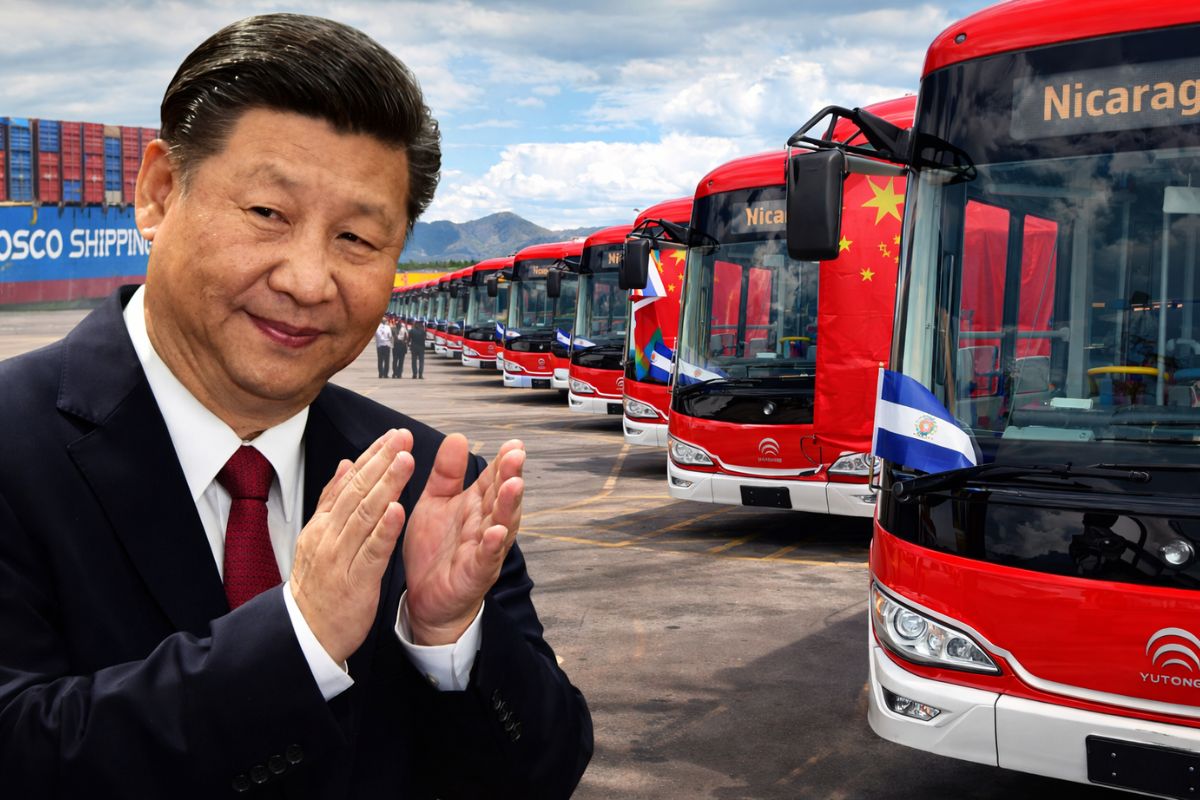
China has reached an agreement to supply Nicaragua with hundreds of Yutong buses throughout the year in an operation aimed at completely renewing public transport in the Latin American country, which has already begun with the delivery of 180 vehicles confirmed by co-president Rosario Murillo.
China has just taken the first concrete step in an ambitious plan to transform public transport in a small country in Latin America. According to the portal Cronista, on Monday, February 2, Nicaragua received the first batch of 180 Yutong buses manufactured in China, marking the start of an operation that plans to deliver 600 state-of-the-art vehicles throughout the year. The confirmation came directly from co-president Rosario Murillo, who announced the arrival of the first units.
What stands out is not only the volume of the operation but the scale of the intended transformation. The China is not selling a handful of buses for a pilot program; it is supplying an entire country with a new, modern fleet distributed among municipalities in different regions. For Nicaragua, this is one of the largest public transport renewal processes in its history. For China, it is another demonstration of strategic influence in Latin America through infrastructure and technology.
Why China chose Nicaragua for this transport project

The relationship between China and Nicaragua is not new, but it has deepened in recent years on various fronts, and public transport is one of the most visible.
-
Brazil has just joined the select group of countries capable of manufacturing a 100% national jet turbine for military drones, alongside the United States, United Kingdom, France, Israel, and China. It is the heart of the new Albatroz Vortex, which flies for 24 consecutive hours and reaches an altitude of 12,000 meters.

-
A silent boat powered solely by solar energy sits in the middle of the planet’s most polluted rivers, swallowing up to 50 tons of trash per day, and it does this alone, without fuel and without stopping, before the plastic reaches the ocean.
-
SpaceX will dock a $843 million vehicle to the International Space Station to push a nearly 420-ton laboratory against the atmosphere and make the debris fall in a controlled manner into the ocean.

-
Quarry almost wipes out a 1,700-year-old village in Germany, but archaeologists arrive before the machines and reveal wooden houses, a textile workshop, ancient tools, and a rural community preserved under 3,200 m² of soil.



China’s strategy of exporting infrastructure to developing countries gains an important chapter with this operation, which goes beyond a simple commercial sale and fits into a context of bilateral cooperation with clear political and economic objectives.
For Nicaragua, a need was urgent. Public transport fleets in many municipalities operate with old, worn-out vehicles that are insufficient for a growing demand.
The arrival of the buses manufactured in China addresses a real need for millions of Nicaraguans who depend on public transport daily. The local government treats the investment as part of a long-term vision focused on sustainable mobility and strengthening public services.
What are the Yutong buses that China is sending
Yutong is the largest bus manufacturer in the world by production volume and is Chinese. The company exports vehicles to over 40 countries and has become a constant presence in fleet renewal projects in Latin America, Africa, and Asia.
The Yutong buses that China is delivering to Nicaragua are state-of-the-art models designed to offer more safety, efficiency, and comfort than the vehicles currently operating in the country.
The choice of Yutong is not accidental. The brand has already supplied buses to other Latin American countries and has experience in adapting its vehicles to local operating conditions, from roads in varied conditions to tropical climates.
For China, each Yutong bus operating in another country is a technological and commercial showcase, reinforcing the image that the Chinese industry can deliver large-scale transport solutions with competitive pricing.
How the 600 buses will be distributed throughout Nicaragua
The 180 buses that arrived in the first batch will not be concentrated in a single city. The strategy of the Nicaraguan government is to distribute the vehicles among transport operators in different municipalities, strengthening both urban and regional routes that connect smaller cities and rural communities.
This decentralized distribution is one of the most relevant points of the project. In many Latin American countries, investments in public transport tend to concentrate in the capitals, leaving the interior with dilapidated fleets.
Nicaragua opted for a different model: the buses transported by China will be allocated according to the demand of each region, which can benefit families in municipalities that have not seen a new vehicle on local routes for years.
The complete plan foresees the incorporation of 600 units throughout the year, consolidating a renewal that changes the standard of public transport in the country.
What the arrival of these buses means for Latin America
The case of Nicaragua is not isolated. China has systematically expanded its presence in Latin America through infrastructure projects, ports, railways, telecommunications networks, and now public transport.
Each project strengthens trade ties and creates dependence on Chinese technology and parts, which guarantees China long-term influence in the region.
For other Latin American countries facing similar crises in public transport, the Nicaraguan model can serve as a reference or a warning, depending on the perspective.
The accelerated renewal of an entire fleet with vehicles from China immediately solves a mobility problem, but it also raises questions about technological and geopolitical dependence. In any case, 600 new buses circulating through the streets of a country that desperately needed them is a concrete fact, and Nicaraguan passengers are the first to feel the difference.
What do you think of China’s strategy of sending buses to Latin American countries? Legitimate investment or geopolitical influence? Leave your opinion in the comments.


Be the first to react!