





 Portuguese
  English
  Spanish
  4 min of reading
  0 comments



Unusual Modification in Mid-Size Motorcycle Caught Attention on Busy Stretch of BR-116 and Ended Up Revealing an Irregularity That Goes Beyond the Attempt to Evade Law Enforcement. Case Registered by the Federal Highway Police Brings Together Elements That Weigh on Both Vehicle Identification and Road Safety.
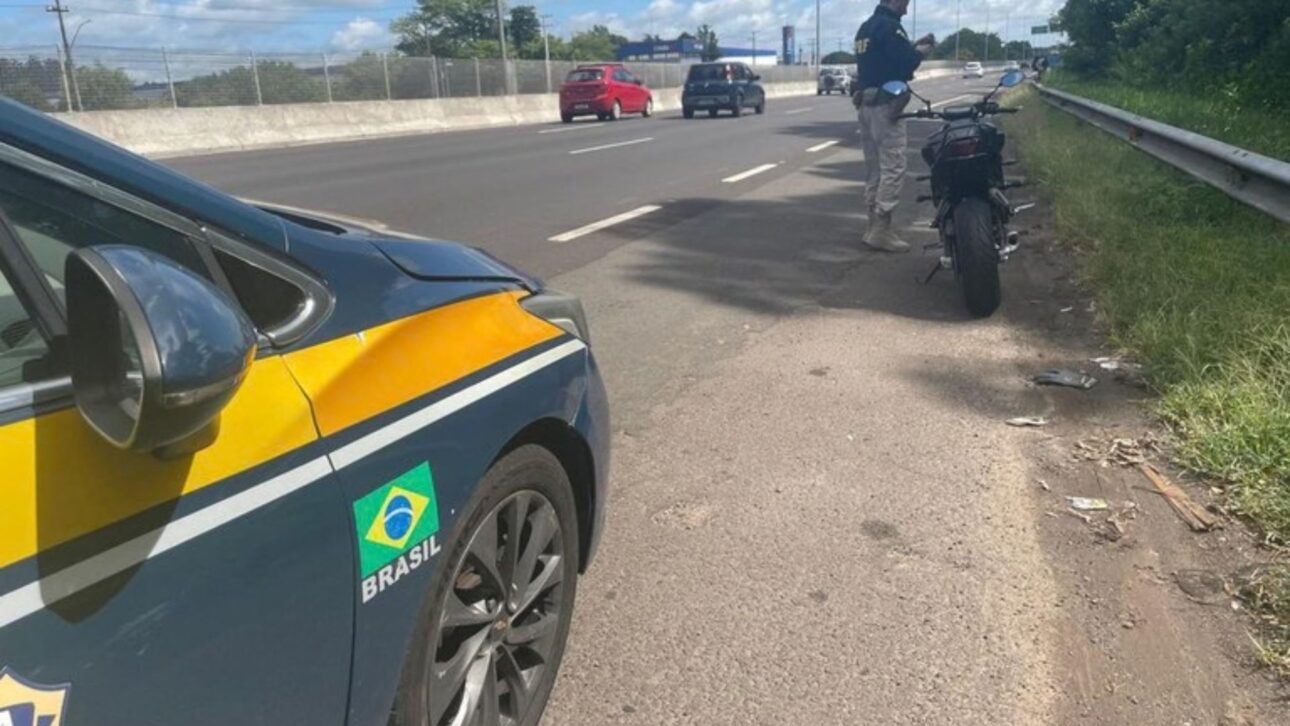
A motorcycle modified with a mechanism that allowed the rear plate to tilt upwards was seized by the Federal Highway Police on BR-116, in Esteio, in the Metropolitan Region of Porto Alegre.
According to the corporation, the device made it difficult to identify the vehicle by radars and field inspections.
The approach occurred on the morning of Sunday, February 1, 2026, during an action of Operation Rodovida.
-
These living root bridges and ladders are over 700 years old and help indigenous people survive in one of the rainiest regions in the world.

-
From sertanejo star to international investor: Ana Castela invests millions in a mansion in the USA, creates a themed accommodation in Orlando, and shows that the “boiadeira” also wants to grow away from the stage.

-
The 10 most stunning motorhomes in the world: a $3 million trailer with a rooftop nightclub and garage for a Ferrari, “palaces on wheels” with Italian marble, private cinema, and five-star hotel luxury for billionaires.

-
Trump wanted to spend $400 million on the White House, but the courts prohibited the million-dollar construction.


The officers noticed the motorcycle traveling with the plate raised, a condition that compromised the reading of the main identification element of the vehicle by those following behind and by electronic equipment.
After the stop order, the agents confirmed that the plate structure had been installed to become foldable by manual activation of the driver.
In practice, the system allowed for changes in the position of the rear identification throughout the journey, which, according to the PRF, reduced the visibility of the plate and made enforcement more difficult.
Foldable Plate Caught Attention on BR-116
The motorcycle was a Yamaha MT-07, registered in Canoas (RS), and was circulating on the urban stretch of BR-116 in Esteio when it caught the attention of the team.
The plate tilted upwards was the first sign of irregularity, as this position prevents proper reading in a situation of following or electronic monitoring.
Subsequently, the inspection confirmed that it was not a casual flaw or wear of the fixation.
The setup had been adapted precisely to allow the movement of the plate, altering the manner in which it should remain installed and visible during circulation, according to the requirements for vehicle identification.
The PRF also reported that the motorcycle was circulating without rear turn signals, another mandatory safety item.
Thus, the occurrence ceased to be restricted to the visibility of the plate and also included a second irregularity related to indispensable equipment for regular circulation and signaling maneuvers in traffic.
What the Traffic Code Provides for a Plate Without Visibility
The Brazilian Traffic Code provides for a serious infraction for vehicles that travel with a plate lacking legibility and visibility.
The same regulation also categorizes the operation of a vehicle without mandatory equipment or with defective items as an infraction, and it prescribes administrative removal measures in applicable cases.
In the case of motorcycles, the requirement for visibility is even more critical because identification is concentrated at the rear.
Educational material from Senatran highlights that, precisely because there is only this external identification at the rear, the plate must remain in perfect readable and exposed condition during the use of the vehicle.
This classification helps to explain why the modification caught the attention of enforcement so quickly.
Even though the device was simple from a mechanical perspective, it directly interfered with a basic requirement for circulation: allowing the immediate identification of the vehicle in situations of control, recording of infractions, police occurrences, or emergency response.
Operation Rodovida Reinforces Motorcycle Inspections
The seizure occurred in the context of Operation Rodovida, a program used by the PRF to intensify inspections and preventive actions during periods of higher traffic and risk on federal highways.
During these phases, the corporation typically concentrates efforts on more potentially harmful behaviors, including irregularities that affect road safety and the capacity for enforcement.
Although the plate modification may seem a point-specific trick, the practical effect goes beyond attempting to evade radar.
By reducing the visibility of the identification, the vehicle also complicates the work of agents in the field, jeopardizes tracking in case of infraction or occurrence, and undermines an essential control element in busy traffic stretches.
On busy highways like BR-116, where enforcement coexists with heavy traffic, varying speeds, and small distances between vehicles, rapid reading of plates, lights, and signaling is not a detail.
These elements support both law enforcement and response to risk situations, collisions, escapes, and other incidents on the route.
After issuing the citations, the PRF removed the motorcycle to impound.
The corporation maintains phone number 191 as an emergency channel on federal highways, used for occurrences like accidents, ongoing crimes, and situations that pose immediate risk to road safety, including cases requiring quick police verification.








-

Uma pessoa reagiu a isso.