Portuguese
  Spanish


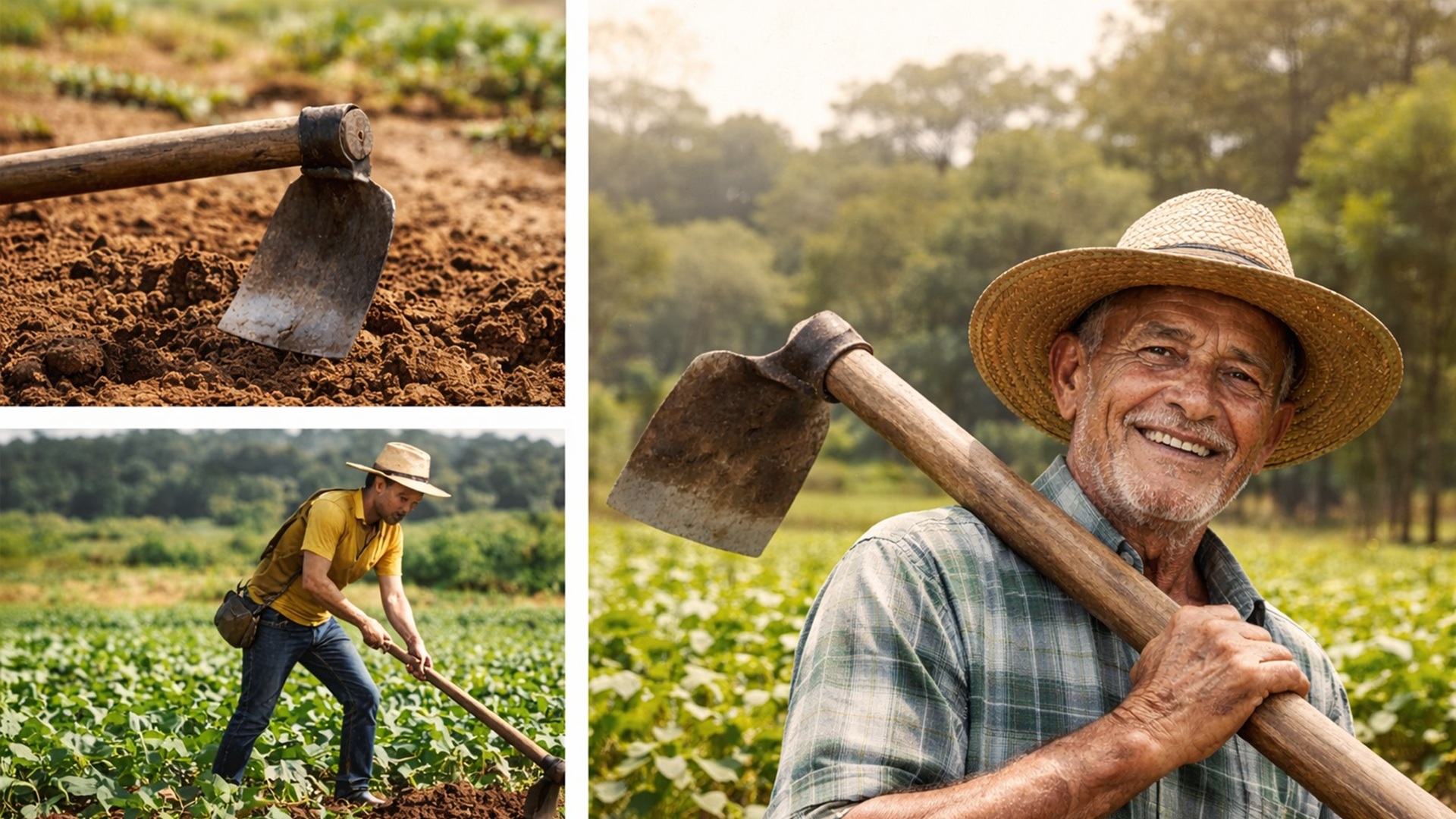


Although it is one of the oldest agricultural tools in human history, the hoe remains widely used in rural Brazil in 2026, especially in family and subsistence farming, revealing how manual practices cross centuries despite the mechanization of the fields and the growing distance between urban and rural areas.
The hoe is one of the oldest and most essential manual tools in human agriculture — and it is still used today in many rural regions of Brazil, especially on small farms, family gardens, and in subsistence agriculture.
Despite its simple appearance, its history is intertwined with the very evolution of agricultural cultivation, going through millennia of use, regional adaptations, and integration with cultural practices.
For many urban Brazilians, especially in large cities, the hoe may seem like a distant or even unknown object — which reveals not only technological transformations in modern agriculture but also the growing distance between city and countryside.
-
Bangladeshi Farmers Use Bamboo Levers to Pump Thousands of Liters of Water Daily Without Engines or Electricity

-
Brazilian Forests Could Expand by an Area Twice the Size of Switzerland by 2035, but Agricultural Sector Holds the Key, Study Finds

-
Brazilian Student Develops Solar-Powered Agricultural Machine Capable of Processing 250 Kilograms per Hour

-
Brazilian Farmer’s Viral Video on Onion Prices Opens New Income Opportunities Online


A Brief History of the Hoe
The exact origin of the hoe is lost in history, but archaeologists have found similar tools in various ancient civilizations.
Before the advent of metal tools, prehistoric peoples already used variations of hoes made of wood, bones, or flint to turn the soil and plant seeds.
With the development of metalworking, especially bronze and iron, these tools evolved into more resistant and effective blades.
In traditional agriculture, the hoe was used not only to make planting furrows but also to control weeds, incorporate fertilizers into the soil, and prepare land where animal traction could not be used.
In many cultures in Africa, Asia, and Latin America, the hoe became indispensable due to its versatility and low production cost.
The Hoe Came to Brazil with the Colonizers
In Brazil, the hoe was introduced by Europeans during the colonial period in the 16th century. From then on, it was quickly adopted in both subsistence plantations and commercially important crops, such as sugarcane and cassava.
Over the centuries, different Brazilian regions developed variations of the tool, adapted to local soil conditions and the type of agricultural work.
In the rural areas of the Northeast, for example, the hoe is often associated with family agriculture in harder, stony soils, where access to larger agricultural machinery is limited.
In the South and Southeast, small properties also historically depended on the hoe for vegetable crops and small production areas.
The importance of the hoe in Brazilian rural communities has exceeded its merely functional role: it has come to be present in cultural expressions, folklore, and literature.
Writers and popular chroniclers have utilized this image to illustrate the hardship and dignity of rural work, painting a picture of rural life that many urban Brazilians are unaware of.
How the Hoe Is Used Today
Even with the modernization of the countryside and the growing agricultural mechanization in Brazil — with tractors, motorized plows, and harvesters — the hoe continues to be present in agricultural work, especially in contexts of family farming, permaculture, and organic cultivation.
Main Functions of the Hoe
Weeding and Weed Control: The hoe is ideal for removing unwanted plants that compete for nutrients and water with the main crops, especially in small areas or between planting rows.
Soil Preparation: Before sowing or transplanting seedlings, the hoe is used to loosen the soil, break clumps, and create a more favorable environment for plant growth.
Forming Furrows: For some crops such as beans, corn, and cassava, making planting furrows with the hoe is still a common practice on small properties.
Incorporating Natural Fertilizers: Fertilizing the soil with organic compost or manure can be facilitated by using the hoe to mix these materials into the soil.
Techniques and Ergonomics
Using the hoe correctly requires technique: the handle should be held firmly, the movement should be controlled to avoid excessive strain on the back or shoulders, and the angle of the blade should be adjusted according to the type of soil.
Experienced farmers develop a “sense” of rhythm and technique that makes the work more efficient and less tiresome.
The Hoe as a Tool of Resistance and Autonomy
In a continental-sized country like Brazil, small family properties are still responsible for a significant share of basic food production — vegetables, beans, cassava, fruits, and other subsistence products.
For many low-income farmers, the hoe represents productive autonomy: it is an accessible tool, easy to maintain, and does not depend on fuel or heavy equipment.
Social organizations and movements linked to family farming often promote training in the use of manual tools like the hoe, both to preserve traditional techniques and to encourage sustainable farming practices.
Curiosities About the Hoe
Name and Regional Variations: The word “hoe” has its origin in Latin ascia, which means “cutting tool.” In Brazil, in some regions, the hoe may be referred to as “cutting spade” or “ground spade,” although these variations are less common.
Diversity of Forms: There are various types of hoes adapted to different tasks — some with wide blades for superficial weeding, others with narrower blades for deeper work in the soil.
Cultural Symbolism: In some popular festivals and folkloric manifestations, the hoe may appear in dances, songs, or narratives that refer to rural work and countryside ancestry.
A Simple Tool, But Full of Meaning
It may seem surprising that in the year 2026 there are still people who have never seen a hoe — especially in urban areas, where images of tractors and agricultural machinery dominate the perception of the countryside.
However, this knowledge gap reveals how technology and urbanization have transformed our cultural references and reduced direct contact with basic agricultural practices.
The hoe remains a bridge between the past and the present, connecting generations of farmers to the origins of human cultivation.
Even in an increasingly mechanized world, its presence in the fields — especially in sustainable and family farming practices — reinforces that, beyond modern machines, simple tools still play an essential role in food production.