





 Portuguese
  English
  Spanish
  3 min of reading
  4 comments




The PRF Is Using Advanced Technology to Fine Drivers on Federal Highways, with Amounts Reaching R$ 293.47. Discover How This Technology Works and What to Avoid to Not Be Penalized!
The new radars, which can fine drivers from up to 100 meters away, are already changing the way Brazilian highways are monitored. In recent months, the Federal Highway Police (PRF) has been using drones to monitor and penalize violations.
The new technology can identify drivers who use their cell phones while driving, do not wear seat belts, or make illegal overtakes, bringing more rigor and precision to highway enforcement.
The Federal Highway Police (PRF) of Minas Gerais recently shared a video on its Instagram account that shows enforcement on the BR-262 being carried out through a drone.
-
Less than a Tera TSI, up to 710 km of range and charging in 9 minutes: the new BYD Song Ultra expands the Chinese brand’s bet on increasingly faster, more technological, and competitively priced electric SUVs.

-
With a 1.0 engine producing 75 hp and costing less than R$ 70,000, Fiat’s car returns to the podium as the cheapest in the country; a temporary promotion for the 2026 Like version reduces the price of the Fiat Mobi.
-
With a mild hybrid system of 48 V, 176 hp and a price of R$ 175,990 in the Sahara version, the new Jeep Renegade changes mostly on the inside, improves slightly in fuel consumption, and remains almost the same car.
-
With a 293.5 cm³ engine and a range of up to 400 km with a 14.1-liter tank, the Honda CB 300F Twister 2026 has up to 24.7 hp, an initial price of R$ 25,150, and already exceeds R$ 29,000 in the Fipe Table.

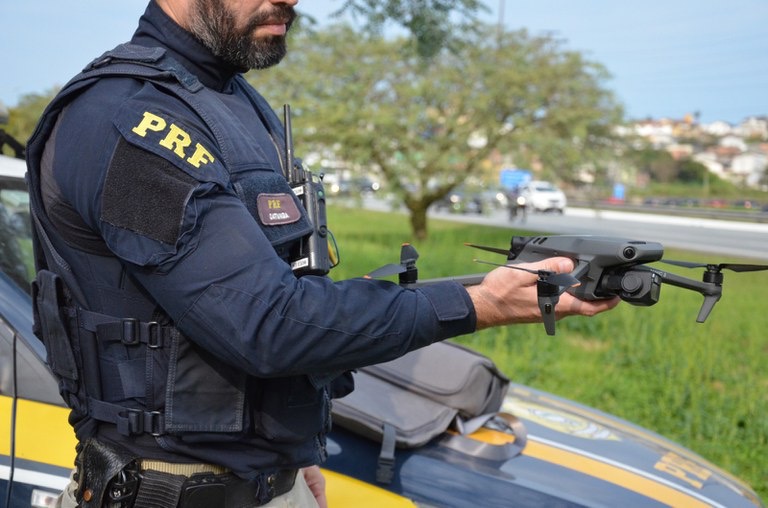
These drones, deployed at the end of August, are already operational in Minas Gerais and Santa Catarina, providing what the PRF describes as “more effective and discreet aerial surveillance”.
Where Are the PRF Drones Operating?
In Minas Gerais, the drones are operating on the BR-262, especially in the Araxá stretch, in the Triângulo Mineiro. In Santa Catarina, the technology has been deployed on the BR-282, known as Via Expressa, and on the BR-101, in areas of the metropolitan region of Florianópolis, covering cities like São José and Palhoça. These highways are strategic points due to the high flow of vehicles and the elevated rate of violations.
The drones are equipped with cameras that have up to seven times zoom, allowing a detailed view of violations from altitudes between 10 and 20 meters.
This strategic altitude allows police to monitor more broadly and accurately, without drivers noticing the presence of the drones, which reduces the chance of inappropriate behaviors being corrected only upon seeing the patrol.
What Violations Are Targeted by Drone Enforcement?
The main focuses of enforcement with drones include:
The traffic violations related to the lack of seat belts, use of cell phones while driving, and the circulation of trucks in the left lane are clearly defined in the Brazilian Traffic Code (CTB), each with its respective penalties.
1. Lack of Seat Belt:
- Violation: Failure to wear a seat belt.
- Classification: Serious.
- Penalty:
- Fine: R$ 195.23.
- Points on License: 5 points.
- Observation: The requirement to wear a seat belt applies to all vehicle occupants.
2. Use of Cell Phone While Driving:
- Violation: Driving while using a cell phone.
- Classification: Very Serious.
- Penalty:
- Fine: R$ 293.47.
- Points on License: 7 points.
- Observation: The violation is characterized when the driver is caught holding or handling the cell phone while driving. Even the use of earphones connected to the cell phone is considered a violation.
3. Trucks in the Left Lane:
- Violation: Driving a truck in the left lane on multi-lane roads.
- Classification: Medium.
- Penalty:
- Fine: R$ 130.16.
- Points on License: 4 points.
Is Drone Enforcement Allowed by Law?
A common question is whether the use of drones for enforcement is permitted under Brazilian legislation. The answer is yes. Resolution 909 of the National Traffic Council (Contran) authorizes the enforcement and issuing of fines through video monitoring, as long as the location is properly signposted.
Warning signs are mandatory to inform drivers that the road is subject to video monitoring, ensuring transparency and compliance with the law.
However, there are some restrictions. On single-lane highways with many curves, construction areas, or places without a shoulder, the use of patrol vehicles for enforcement may become unfeasible. In these situations, the PRF adopts alternatives to ensure the safety of drivers and the efficiency of monitoring.
With the use of drones and long-range radars, the enforcement of Brazilian highways is undergoing a true revolution through the PRF. The new technology, already in operation in Minas Gerais and Santa Catarina, promises to reduce violations and bring more safety to those driving on the country’s roads.








Mas duplicar as rodovias com trafego intenso e que faz vitimas fatais quase todo dia, Ah isso não dá pra fazer pra mim isso sim seria essencial salvaria muitas vida,como nessa BR 262 mesmo tanto em Minas quanto no MS que liga Três Lagoas á capital Campo Grande, detalhe com o início das atividades da Suzano em Ribas do Rio Pardo que hj é a maior fábrica do mundo de celulose e papel. O trafico que já era intenso agora piorou de vez com as centenas de caminhões de madeira e são todos Tri-Trens
AH MAS ISSO NÃO DÁ PRA FAZER , NUNCA TEM DINHEIRO NÉ
fiscalização é necessário sim, mas tem coisas mais importantes para salvar vidas
Essa é minha opinião
Ah vão lá pra dar uma olhadinha nessa 262 e aproveitam e vê também a BR 153 no trecho de Fronteira até a cidade do Prata MG. E me faz um favor faz um levantamento de quantos acidentes e vitímas fatais aconteceu nesses últimos anos nesses trechos dessas rodovias que eu comentei vcs vão se assustar
Agora como gastam com radares e camêras e agora drones
Pra isso tem dinheiro de sobra pq é um absurdo as quantidades de camêras e radares, pq isso não é barato, acho que tem que ter sim mas está um exagero
Um detalhe interessante. Arrecadar com vídeo pode. Agora condenar um **** não pode … Pura ironia esse Brasil.
Esse Brasil infelizmente é uma piada, vc falou td com poucas palavras
Não seria melhor proibir todo mundo de dirigir, ficaria bem mais facil, melhor doque ficar inventando leis pra arrancar dinheiro do povo, ou pensa que o povo é ****.