





 Portuguese
  English
  Spanish
 3 min of reading
  0 comments


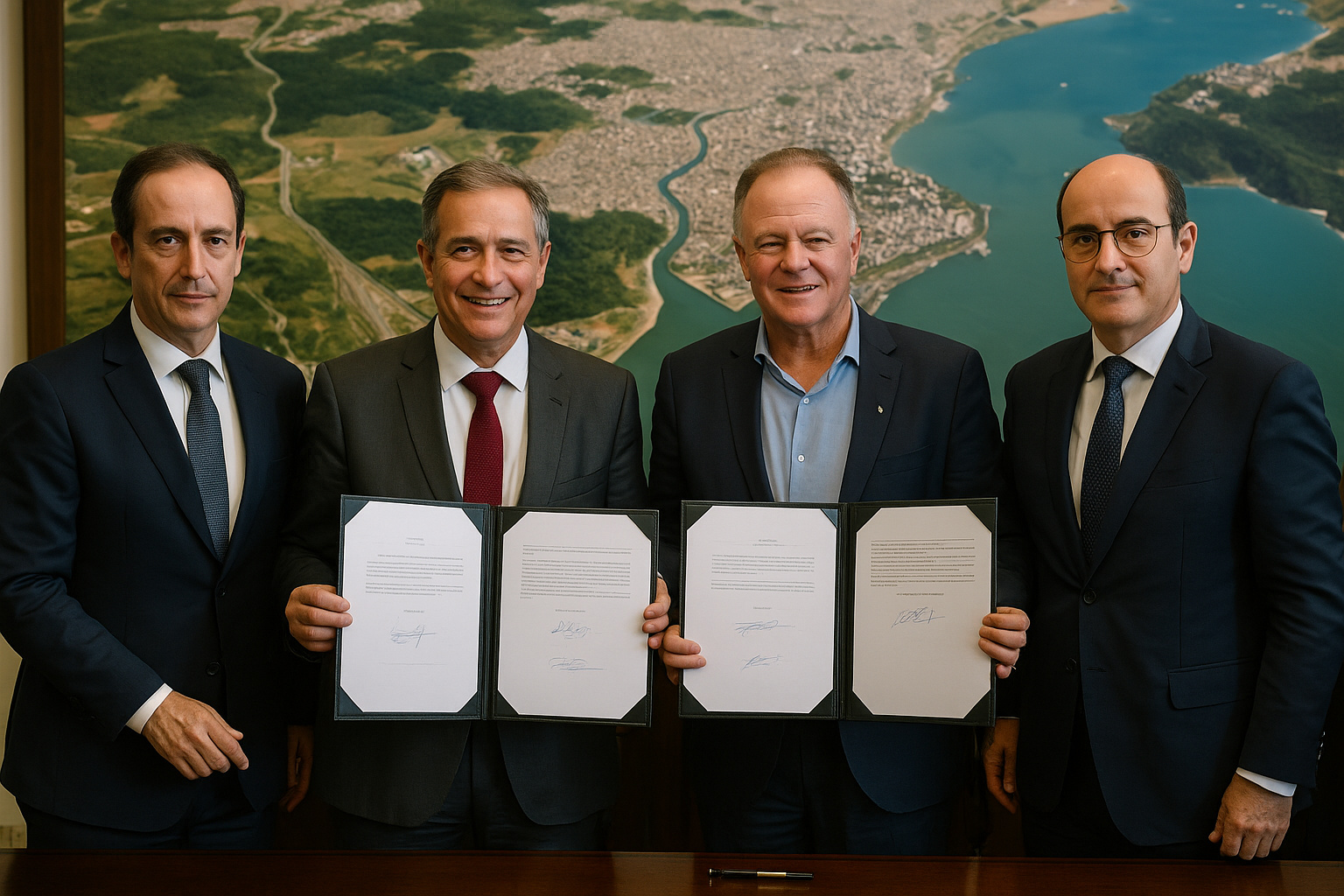
On October 8, 2025, the government of Espírito Santo signed Public-Private Partnership contracts with the multinationals GS Inima and Acciona, both based in Spain.
These agreements will allow the operation of sewage systems in 43 municipalities, with a total estimated investment of R$ 7 billion over 25 years.
Thus, the state advances significantly towards universal sanitation, in accordance with the goals of the Sanitation Legal Framework, which mandates compliance by 2033.
Contract Structure and Scope of Investments
The tender determined that the GS Inima / Forte Ambiental Consortium would take on Lot A, while Acciona Água S.A.U. will be responsible for Lot B.
Together, the two lots total R$ 7.133 billion in investments and operational costs.
The deadlines vary between 24 years and 7 months for Lot A and 22 years and 10 months for Lot B.
Additionally, the project foresees R$ 1.781 billion in direct infrastructure investment, which will benefit 966 thousand residents.
The contracts were signed at the Anchieta Palace in Vitória, with the presence of Governor Renato Casagrande, Vice Ricardo Ferraço, and representatives from Cesan.
Authorities Highlight Social and Environmental Impact of the Project
During the ceremony, Renato Casagrande described the event as significant and historic for Espírito Santo.
He stated that the investment represents a decisive advance for sanitation, the environment, and the quality of life for residents.
The governor emphasized that the state solves a historical problem and contracts a lasting solution for the future of the population.
Additionally, Casagrande underscored that the chosen companies have recognized international experience, which will bring efficiency and safety to the process.
According to him, Cesan will coordinate the initial assisted operation phase of six months before the full transition.
-
Families have been living for over 30 years under a bridge in Mato Grosso, revealing a housing deficit, irregular occupation in APP, and dependence on fishing as the main source of income.

-
What Changed at Florianópolis Beaches? New Rule Surprises Pet Owners and Restricts Dogs on the Sand at Specific Times

-
Economic Diversification Accelerates in Itatiaiuçu to Reduce Mining Dependence

-
Extreme Rains: Cold Front, Supercell, and Atmospheric Trough Cause Tragedy in MG

Vice Governor and Cesan Reinforce Gains for Health and Economy
The Vice Governor Ricardo Ferraço highlighted the economic and social impact of the measure.
He reminded that, according to the World Health Organization, every real invested in sanitation saves five reais in public health.
Ferraço stated that the government’s decision was a great achievement, as it accelerates the goals of universalization and attracts companies with international reputation.
The president of Cesan, Munir Abud, called the moment historic.
He highlighted that Espírito Santo is leading the national race for the universalization of sanitation.
After the signing, GS Inima and Acciona will begin the assisted operation phase, developing the investment plan and prioritizing urgent actions.
Companies Promise Technology and Efficiency in Contract Execution
The director of Acciona Brasil, André de Angelo, reaffirmed the company’s commitment to meeting deadlines and delivering excellent results.
He recalled that the company has been in Brazil for 27 years, working on major infrastructure projects.
According to the executive, the Espírito Santo project will be conducted with technical rigor and sustainable innovation.
The CEO of GS Inima, Marta Verde Blázquez, also emphasized the role of technology in advancing sanitation.
She stated that the company will apply the best solutions available on the global market to achieve its objectives.
Marta explained that GS Inima operates in 13 countries and has over 30 years of experience in Brazil, combining local and international knowledge.
Structural Transformation and Perspectives for the Future of Espírito Santo
With the signing of these contracts, Espírito Santo consolidates a public policy for long-term sustainable development.
The plan foresees job creation, strengthening of infrastructure, and reduction of environmental impacts throughout the served region.
According to the state government, the advancement of sanitation will improve public health, boost tourism, and increase economic competitiveness.
Thus, the state bets on universal sanitation as a strategy for social and environmental transformation, with direct impacts on the quality of life of the population.










Seja o primeiro a reagir!