





 Portuguese
  English
  Spanish
  5 min of reading
  5 comments


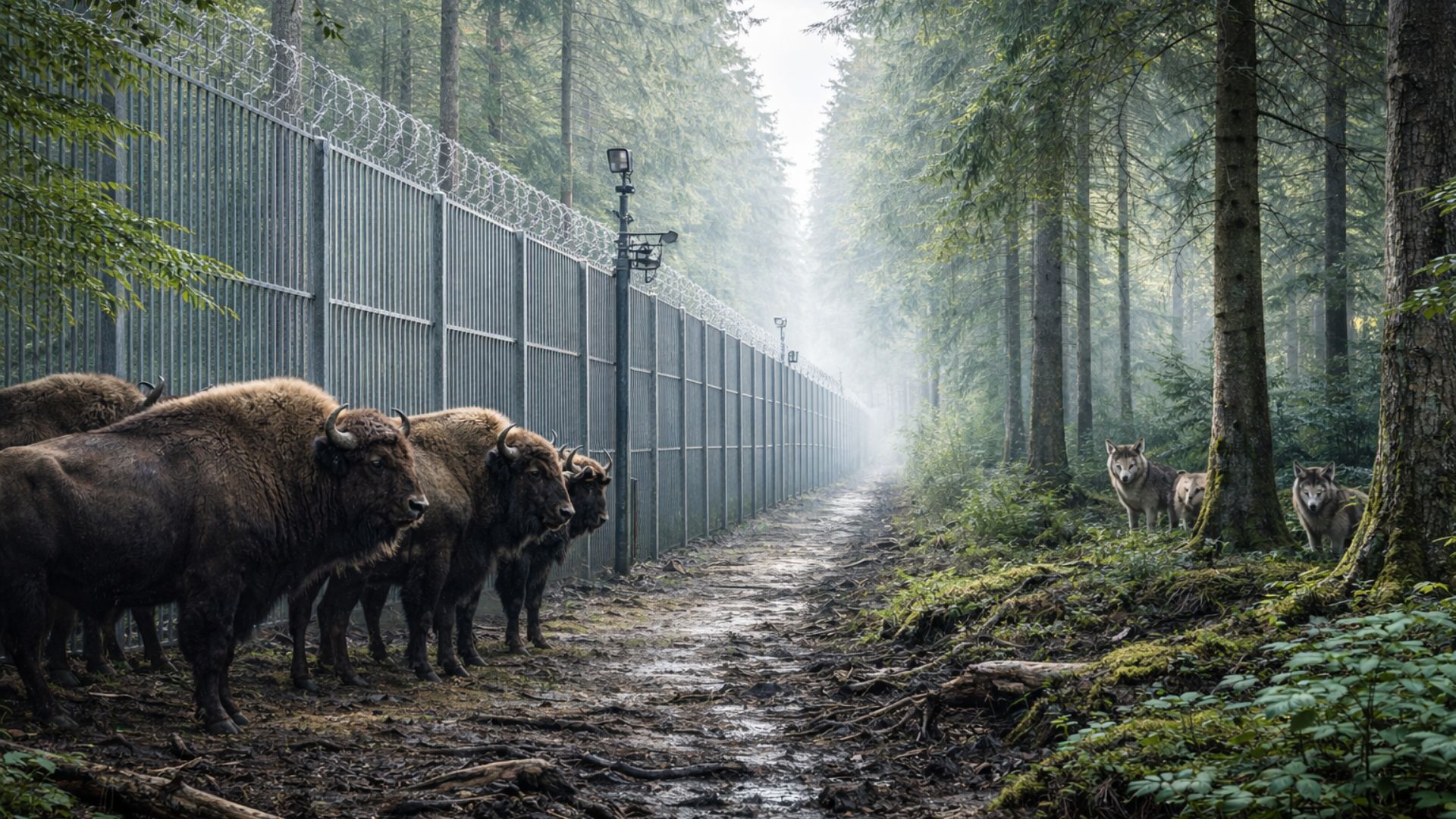


Wall At The Border Between Poland And Belarus Became An Environmental And Humanitarian Divide In Białowieża, Impacting The Movement Of Bison, Wolves, And Lynxes, As Well As Changing Migrant Routes.
An 186-kilometer steel barrier erected at the border between Poland and Belarus has come to divide the Białowieża Forest, one of the rare patches of ancient forest preserved in the plains of mainland Europe.
The wall, planned by the Polish government as a response to the migration crisis in the region, was accompanied by barbed wire, camera surveillance, and a service road with constant movement of agents and vehicles, altering an area where wildlife roamed without such physical interruption.
At the same time, the structure has become part of the risky scenario faced by migrants and asylum seekers attempting to cross the border through dense forest and flooded areas.
-
He started running at 66 years old, broke records at 82, and is now a subject of study for having a metabolic age comparable to that of a 20-year-old, in a case that is intriguing scientists and inspiring the world.

-
Oldest tree on the planet reappears after 130 years of searches: Wattieza, 385 million years old, was 10 meters tall and had no leaves or seeds; Gilboa fossils in New York solved the mystery in 2007.

-
A 48-square-meter house assembled in hours with 4,000 bricks made of recycled plastic that does not absorb moisture, has natural thermal insulation, and costs less than 90,000 reais in a complete kit.

-
Luciano Hang revealed that Havan’s air fleet has already accumulated more than 20,000 landings, 10,000 flight hours, and 6 million kilometers traveled, and he says that without the planes, the company would never have grown so quickly.


Humanitarian and human rights organizations have reported deaths and disappearances throughout the crisis, in a context of containment policies and forced returns in the region.
Białowieża Forest And UNESCO Heritage
Białowieża is a large forest complex that spans both countries and has been on the UNESCO World Heritage list since 1979, with subsequent expansions to include areas in Belarus and an extension of the protected area.
The organization describes the site as a set of floodplain forests where natural processes continue, with a significant presence of deadwood and high associated diversity, which helps explain the scientific interest and international pressure for protection.

While the original text refers to the territory as “the last virgin forest in Europe,” different sources often use similar formulations, such as “one of the last” and “one of the largest” ancient floodplain forests on the continent.
Still, the consensus is that it is an exceptional environment for maintaining rare characteristics of ecological continuity on a European scale.
Wall At The Poland–Belarus Border And The Migration Crisis
The official justification for the wall’s construction was linked to an increase in irregular crossings from 2021, when Poland and the European Union accused Belarus of encouraging people from other regions to pressure the external border of the bloc.
The work gained momentum in early 2022 and was announced as a large-scale investment, with sensors and thermal cameras along the route.
From then on, the forested section faced a practical contradiction: the attempt to “harden” the border in a corridor recognized for its ecological importance.
Researchers and conservation organizations warned that habitat fragmentation reduces connectivity between populations, with potential impacts on reproduction, dispersal, and genetic diversity in species that depend on large, continuous areas.

Habitat Fragmentation And Pressure On Wolves And Lynxes
The impact is not limited to large herbivores.
Reports and studies cited by international media describe a change in pattern: animals are starting to avoid the immediate zone of the wall, with reduced presence records and altered movement dynamics near the barrier.
The problem worsens when it comes to wide-ranging predators, such as the Eurasian lynx, whose population in the area is already considered sensitive to reproductive bottlenecks.
In a report associated with monitoring in the region, researcher Katarzyna Nowak from the Mammal Research Institute of the Polish Academy of Sciences stated that she did not foresee the diversity of effects observed over time, in a summary that reflects the cumulative type of impact generated by permanent infrastructure and militarization of the surroundings.
In addition to the physical barrier, there is a less visible but equally relevant layer: human sounds and signals advancing into the forest.
Records mentioned in a report point to vehicle noise, constant presence, and accumulated trash nearby, a type of disturbance that can alter routes and activity schedules, as well as attract domestic and opportunistic animals to a sensitive area.

European Bison In Białowieża And Genetic Isolation
The Białowieża Forest is one of the main strongholds of the European bison, the largest land mammal on the continent.
Counting data reported in Poland indicates that the Polish part of the complex housed more than 800 bison, with estimates around 829 individuals in a survey cited by a Polish public outlet, in addition to references to hundreds on the Belarus side as well.
In this scenario, territorial fragmentation tends to create more isolated subgroups, hindering individual exchange between areas and increasing the risk of reproduction within the same reduced set.
Although the species has recovered from a history of decline and reintroductions, experts are closely monitoring genetic variability as a factor for resilience to diseases, environmental changes, and extreme events.
The original text also states that 880 bison would be “isolated” and that this contingent would represent “one in every four bison in the world.”
The first figure appears close to what some reports use to refer to the local magnitude, but in the sources consulted here, the publicly confirmed number for Białowieża in Poland was presented as 829 in a specific count; the global proportion cannot be securely sustained solely from this regional cut.
Risk To Migrants And Security Dispute
The construction of the wall and the intensification of surveillance have not eliminated attempts at crossing, but have changed the conditions under which they occur.
Over the past few years, monitoring organizations and international entities have pointed to a dangerous scenario in forest and swamp environments, with reports of violence, prolonged exposure to the cold, and lack of quick access to rescue.
A count released by a civil society group cited by Human Rights Watch recorded 87 deaths near the border, on both sides, between September 2021 and October 2024, highlighting that circumstances are not always fully documented.
At the same time, journalistic surveys in the region also discuss disappearances, which increases the difficulty of accurately measuring the human cost.

Meanwhile, the forest remains at the center of a dispute where infrastructure, security, and conservation collide in the same geographical corridor.
The wall that seeks to block people imposes a permanent barrier to species that crossed this political limit without recognizing borders, creating a division that, in practice, reorganizes the territory for all who depend on it.








Well done Poland.
We salute you
How few ancient forests remain! Surely there could be developed monitored pathways for wildlife. Having traveled in both countries in more peaceful times, it is clear that both countries value wildlife protection.
It is always interesting to me, to see the perspective of the story being told. With the emphasis on the wall, there is little attention paid to the root cause of the problem. I.E. the unfettered illegal migration into Belarus, and their encouragement of illegals to continue their journey, through the forest, into Poland. Which is one of the few countries in the world trying to protect their sovereign border. Were Belarus protecting their own border against the influx of illegals, there would be no need for the fence. But, were there no fence today, my bet would be the forest environment would be severely damaged by the actions of the illegals, to plant and **** alike. We can all be for the protection and encouragement of threatened species, but let’s approach the cure from the point of attacking the root cause of the problem, and make the secondary impediments like the fence unnecessary.
I came here to say basically the same thing. No one wants to talk about the problems with mass immigration.