





 Portuguese
  English
  Spanish
  3 min of reading
  40 comments


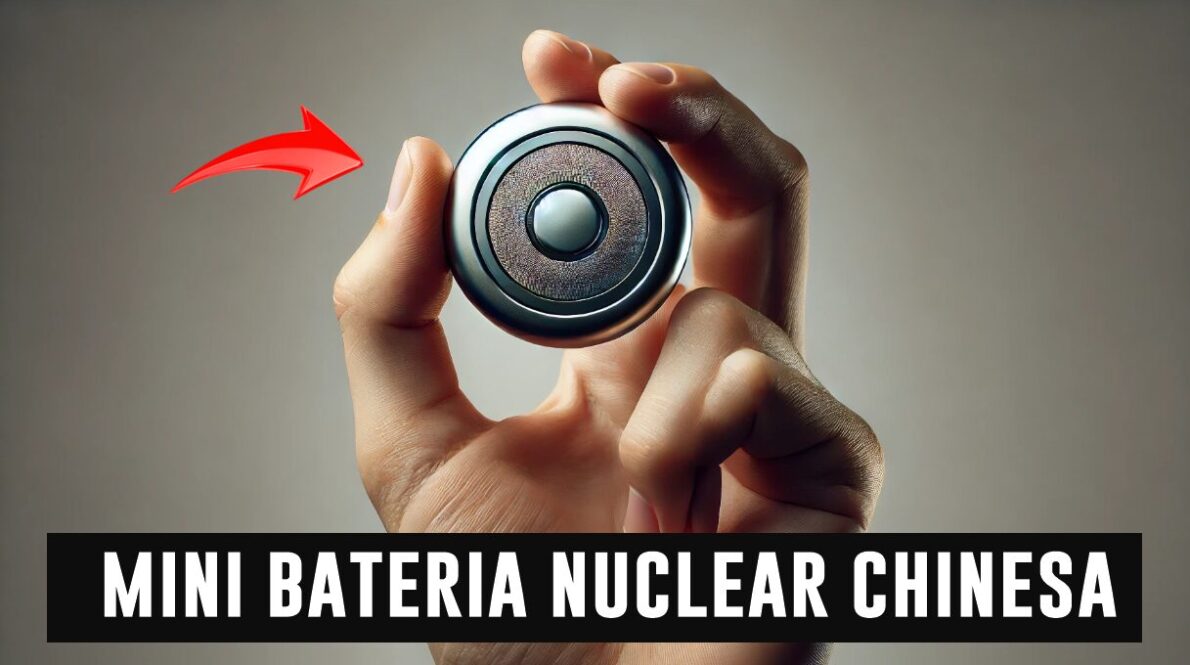

Chinese Scientists Create A Mini Nuclear Battery That Can Last Up To 7,000 Years, Promising To Revolutionize The Future Of Energy Sources With This Impressive Innovation.
Batteries, in general, are essential for the energy transition as they provide power for a variety of devices and technologies, from the simplest to the most complex. Thus, the search for more efficient, durable, and eco-friendly batteries is a priority for scientists around the world. The invention of a mini nuclear battery that can last over 7,000 years represents a significant advance in the field of energy technology.
The development of this mini nuclear battery, resulting from research conducted by a team of Chinese scientists, is a promising example of how this search can yield innovative solutions.
A Chinese Technological Advance
The Chinese researchers, associated with various renowned institutions such as Soochow University and Xi’an Technological University, created an innovative micronuclear battery project.
-
Goodbye clothes with odors from use: Samsung’s device uses high-temperature steam, eliminating up to 99.9% of bacteria, removing dust mites, and neutralizing odors directly in the wardrobe without the need for washing.
-
Embraer arrives in Mexico with 7 new E190-E2s in 2026, after 5 jets have already been delivered, while Mexicana surpasses 1 million passengers, plans a fleet of 20 aircraft, and expands strategic routes across the country.

-
China is not joking around and is secretly expanding its nuclear weapons infrastructure: a giant dome the size of 13 city blocks, 600 warheads, destroyed villages, and a modernized military network in record time in China, says CNN.

-
Goodbye iron and wrinkled clothes: LG’s smart wardrobe uses TrueSteam vapor, hangers that vibrate up to 180 times per minute, and cycles of 20 to 30 minutes to remove odors and reduce wrinkles without washing.

The goal of this team was to develop a battery that was not only incredibly small but also capable of lasting for thousands of years, utilizing radioactive decay to generate energy on a small scale.
Quick Explanation: Radioactive decay, also referred to as radioactive disintegration, is the natural process by which the unstable nucleus of an atom loses energy by emitting radiation.
Radioactive decay produces energy because, during the process, matter is converted into energy according to Einstein’s famous equation, E=mc2E = mc^2E=mc2. This means that small amounts of mass are transformed into a large amount of energy.
The basis of this advance lies in a structural design concept that combines actinides, elements known for their radioactivity, with lanthanides, which have luminescent properties.
This combination created a molecular-level architecture that allowed the conversion of energy from radioactive decay into light, and then into electricity. According to scientists, this new battery is up to 8,000 times more efficient than any previous technology in the field of nuclear batteries.
Operation Of The Mini Nuclear Battery
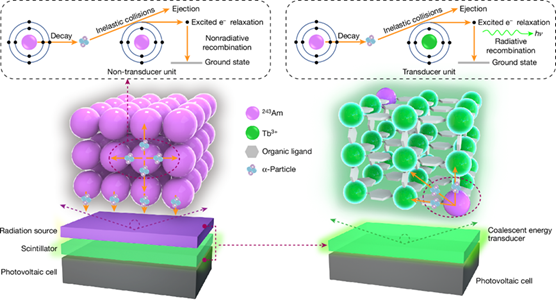
The micronuclear battery developed by this team utilizes energy generated by the decay of radioisotopes.
This radioactive decay process generates a small amount of electricity, in the range of nanowatts to microwatts, but it is extremely stable and long-lasting.
One of the major differences between micronuclear batteries and traditional chemical ones is their longevity, which directly depends on the half-life of the radioisotope used. In other words, these batteries can last for decades or even millennia, depending on the type of radioactive material used.
Another interesting aspect is that micronuclear batteries are immune to environmental factors that affect other technologies, such as temperature, pressure, or magnetic fields.
This makes them extremely suitable for extreme scenarios, such as space missions or devices implanted in hard-to-reach locations, where battery replacement is practically unfeasible.
Potential Future
Although the development of these micronuclear batteries represents a remarkable advance, there are still considerable challenges to overcome before this technology can be widely applied. Currently, the amount of energy generated by these batteries is too small to power common devices.
One example cited by the Chinese scientists is that approximately 40 billion micronuclear batteries would be needed to generate enough electricity for a 60-watt device, such as a household lightbulb.
Even so, the longevity of these batteries makes them ideal for specific applications, such as in long-duration space missions. Imagine a probe sent into deep space, where maintenance is impossible, and solar power may not be a viable option.
In this scenario, a nuclear battery with a potential lifespan of over 7,000 years could be the perfect solution to power small electronic devices.
The invention of the mini nuclear battery that can last thousands of years is a landmark in the development of sustainable and long-lasting energy sources.
Although there are still practical limitations to be overcome, especially in terms of energy capacity, this technology opens doors to a future where durable and stable batteries can be used in a wide range of applications, from space missions to tiny electronic devices. The research was published in the journal Nature.








É mais eu acho que tudo vai depender da flexibilidade da cauda do Jacaré
Só de ja er uma bateria estável de longa duração , um pequena semente foi plantada e está germinando, agora e superar os obstáculos , só para vcs verem as história das baterias existentes e funcionais comecaramde formas parecidas, a minha dúvida é, são micro baterias nucleares,, e provavelmente será uado de forma associada para obter tensão e corrente elétrica maiores, mas teremos mais irradiação nuclear também,
https://revistapesquisa.fapesp.br/centro-de-pesquisa-brasileiro-desenvolve-prototipo-de-bateria-nuclear/