





 Portuguese
  English
  Spanish
  4 min of reading
  0 comments


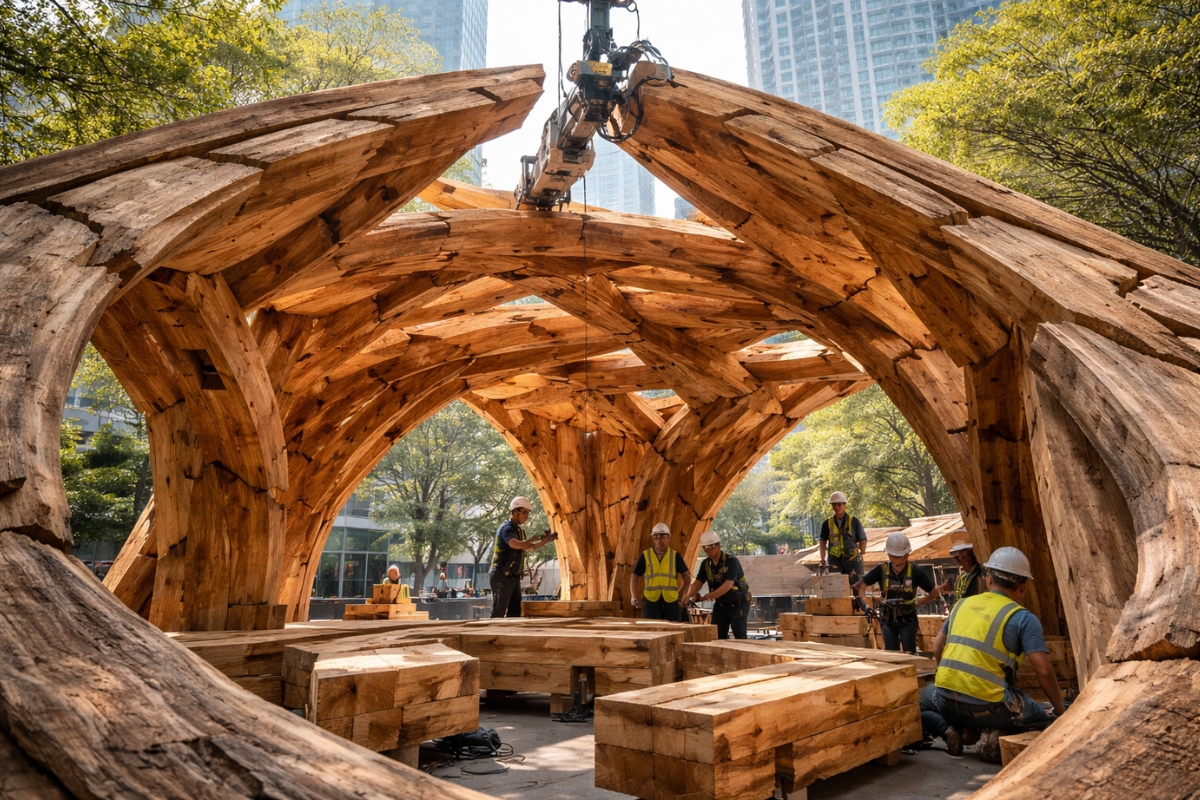
Developed in China, the Innovation Maps the Natural Shape of Each Tree, Rearranges the Pieces Like a Large Structural Puzzle, and Drastically Reduces Waste in Industrial Manufacturing
The construction industry faces an urgent challenge. Concrete alone accounts for about 8% of global CO2 emissions. In this scenario, engineered wood emerges as a more sustainable and efficient alternative.
Now, a new step has captured attention in the sector. A technology based on Artificial Intelligence promises to drastically reduce wood waste, preserve the natural shape of trees, and improve the structural performance of panels.
What seemed impossible in standardized industrial production has gained a technological solution that could change the way buildings are designed, manufactured, and assembled.
-
The lack of welders, electricians, and operators becomes a structural threat in 2025, with the construction industry and manufacturing already suffering from delays, cost pressures, and labor shortages in Brazil.
-
Brazil and Paraguay are just 46 meters away from a historic union on the bioceanic bridge that promises to revolutionize trade between the Atlantic and the Pacific.

-
With 55 km over the sea, a cost of US$ 20 billion, and enough steel to build 60 Eiffel Towers, China’s largest project has connected Hong Kong, Zhuhai, and Macau in a colossal bridge that defies the logic of engineering.

-
A trick with joint compound transforms a Styrofoam ceiling into a plaster-like ceiling: leveled panels, wires and mesh at the joints, sand, paint, and change the environment while spending little today.


AI Timber Technology Transforms Natural Logs into Smart Panels with Precise Fitting
The project called AI Timber was developed by Maestro, a startup created by CRA Carlo Ratti Associati in partnership with researchers from MIT and Tongji University.
The proposal is simple in theory and complex in practice. Instead of cutting logs into standardized boards, the system scans each raw log using LiDAR technology.
Then, Artificial Intelligence algorithms calculate the best possible fit between the pieces, as if they were parts of a large structural puzzle.
The detail that caught the most attention was the preservation of the natural outline of the tree, reducing unnecessary cuts and keeping the fibers intact.
Waste Can Reach 60% in the Traditional CLT Model
In the conventional production of CLT panels, estimates indicate that up to 60% of the cut wood can become waste, organic matter, or even be destined for incineration.
This happens because trees have unique shapes. Each one grows under the influence of climate, wind, and position in the forest.
When these logs are transformed into uniform panels, a large portion of the material is discarded for not fitting the industrial standard.
The new method changes this scenario by utilizing every available piece, significantly reducing the volume of loss and increasing the use of raw material.
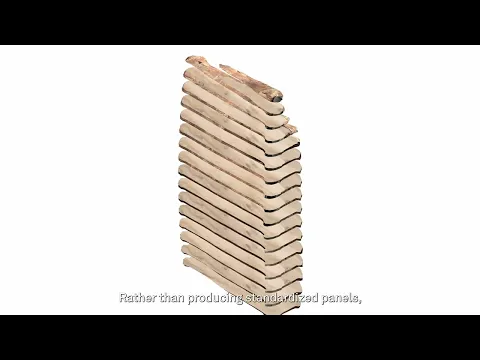

System Integrates Digital Scanning, AI, and CNC Machines for Custom Production
Maestro has developed a complete system that connects digital imaging, algorithms, and CNC machines.
This algorithm minimizes the loss function associated with the volume of wood that needs to be removed to form the CLT layers.
In practice, this allows for generating customized instructions for sawmills and industrial equipment, combining industrial speed with artisanal precision.
According to the developers, without Artificial Intelligence, this manufacturing would simply not be viable.
Interwoven Structure Improves Resistance and Can Reduce Use of Adhesive
In addition to saving wood, the model creates interwoven laminates within the panels.
This shape acts against shear forces and increases the structural performance of the assembly.
The impact is twofold. Less waste and the future possibility of reducing the amount of adhesive used in the manufacturing of CLT.
When the original outline of the tree is respected, the result also achieves a distinctive aesthetic. Each panel presents a unique and natural shape.
Prototype Was Built in Shanghai During DigitalFUTURES Conference
The first prototype of AI Timber was produced in Shanghai during the DigitalFUTURES conference organized by Tongji University.
Over a week, an international team of researchers used Artificial Intelligence to construct a small interactive triangular pavilion as proof of concept.
The structure demonstrated in practice that the system works and can be applied on a larger scale.
Construction Model Can Reduce Construction Time and Costs On-Site
The Maestro proposal goes beyond the material.
The designs are created digitally and sent to a network of European factories that produce customized parts.
Then, the components are transported in a flatpack model and assembled at the final destination.
The prefabrication eliminates much of the time and costs of a traditional construction site. The final assembly becomes practically a fitting process.
If the technology advances as expected, construction could become cheaper, more ecological, and faster than current methods.
The combination of engineered wood and Artificial Intelligence shows that it is possible to reduce emissions, decrease waste, and transform the construction industry on a global scale, something that is already beginning to take shape in Shanghai and could expand to other countries in the coming years.
Do you believe that AI wood can replace concrete on a large scale? Leave your opinion in the comments.










-

2 pessoas reagiram a isso.