





 Portuguese
  English
  Spanish
  4 min of reading
  1 comment


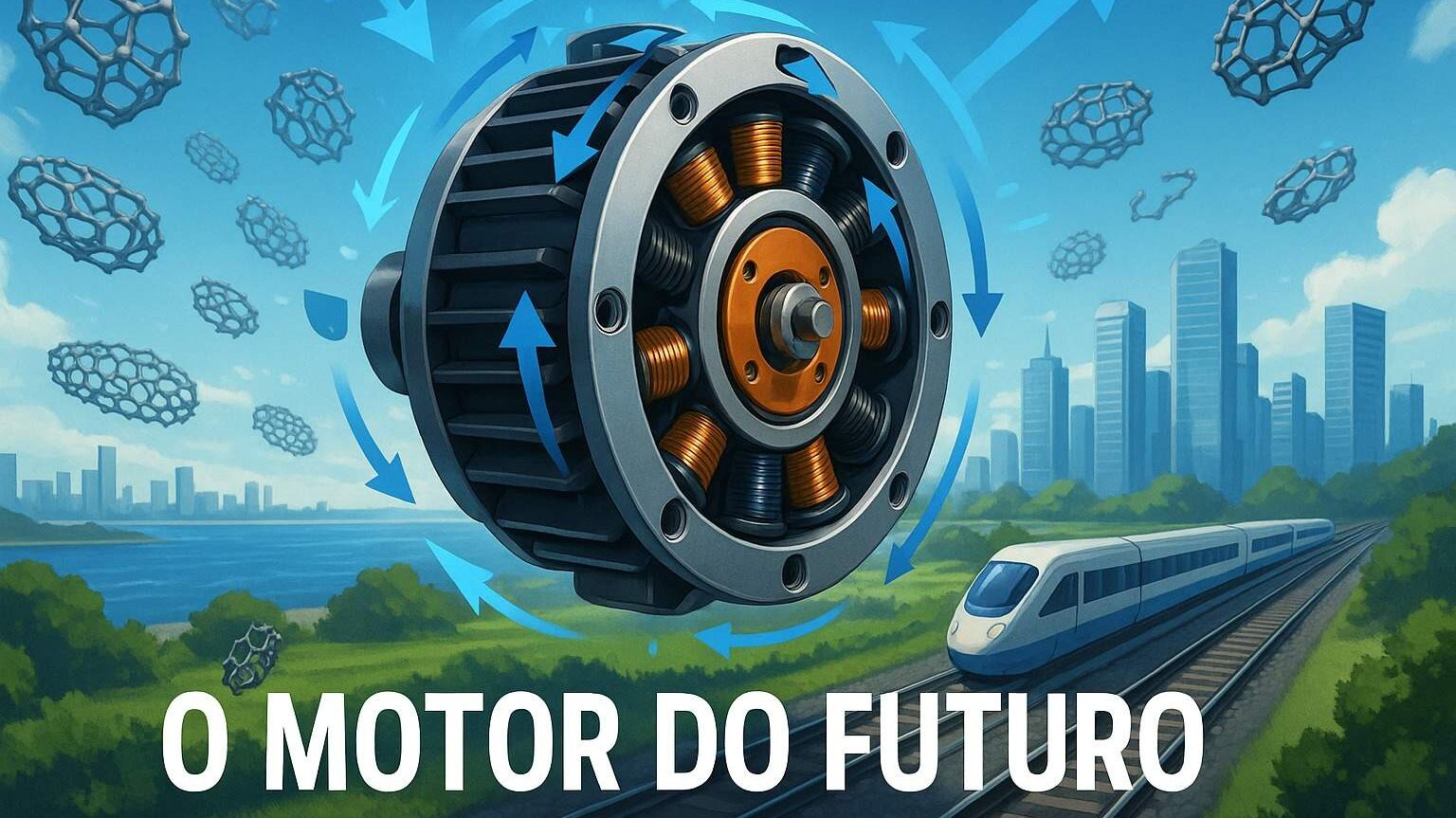


Korean Researchers Took a Bold Step Toward the Future of Electric Motors by Replacing Traditional Copper with Carbon Nanotubes. Lighter, More Efficient, and Sustainable, These New Cables Could Completely Transform the Electric Vehicle Industry and Other Advanced Technologies.
Researchers at the Korean Institute of Science and Technology (KIST) developed an electric motor that completely dispenses with the use of copper. Instead of metal, the new design uses cables made of carbon nanotubes (CNTs), paving the way for lighter, more efficient, and sustainable motors.
Copper is widely used in the electrical industry, especially in motor and battery cables. However, its extraction and refining result in considerable environmental impacts. Therefore, the replacement with CNTs could represent an eco-friendly and viable alternative.
Moreover, the nanotubes can reduce vehicle weight, improving energy efficiency and increasing range.
-
With a cost per shot close to zero, the DragonFire laser could change naval warfare in 2027 and provide British ships with nearly unlimited defense against drones.

-
A British startup creates tires that generate electricity in electric vehicles when passing over potholes, speed bumps, and cracks.

-
Scientists have created robots made with living cells that have their own nervous system, swim on their own, explore the environment, and self-organize without any genetic engineering, and now they want to do the same with human cells.

-
Students create a solar-powered ambulance that operates without a plug, without fuel, and still keeps medical equipment running in remote areas.


Tests also indicate that CO₂ emissions during manufacturing decline significantly.
Understand What Carbon Nanotubes Are
Carbon nanotubes are microscopic structures formed by rolled graphene sheets. Despite their tiny size, these tubes possess extraordinary properties.
Researchers at KIST have managed to transform the nanotubes into a usable powder for industry. The resulting material has tensile strength up to 100 times greater than that of steel and conductivity similar to copper.
In practice, when grouped in core-sheath (CSCEC) cables, CNTs can carry current densities of up to 10⁹ A/cm².
This is far superior to what copper can handle, with the additional benefit of weighing much less.
These characteristics make CNT cables ideal not only for vehicles but also for satellites, airplanes, and other technologies that require efficiency, lightness, and durability.
Promising Results in International Tests
Researchers at MIT and Rice University have already tested CNT cables and observed superior performance in terms of energy transmission.
The cables also showed less loss and greater resistance to heat.
Another positive aspect is durability. CNTs do not corrode like copper and can withstand high temperatures without compromising performance.
This could increase the lifespan of components and reduce maintenance costs.
The lightness also catches attention. With an elastic modulus that can reach 1 TPa, the cables are extremely flexible while also being strong.
Sustainability and Recycling of the Material
In Spain, researchers at the IMDEA Institute demonstrated that CNTs retain their properties even after being recycled. This contributes to creating a sustainable cycle.
One of the methods used is LAST (Liquid Crystal Assisted Surface Texturing). This technique aligns the nanotubes and removes metallic impurities without altering the elongated form of the material.
With LAST, conductivity of the nanotubes increases by more than 130%, and the weight of the electric motor can be further reduced.
It was with this technique that researchers designed a functional electric motor without copper wires. The motor powers a toy car with 2 to 3 volts and a power of 3.5 W. Although modest, the experiment proves the viability of the concept.
Application in Electric Vehicles
In electric cars, high-voltage cables are essential for transmitting energy from the battery to the motor. Aptiv, a supplier in the automotive industry, estimates that replacing copper with regenerated materials could reduce CO₂ emissions by up to 72%.
Therefore, CNTs, being lighter and more efficient, could further enhance this carbon saving.
Companies like LG Chem are already investing in nanotubes to improve battery efficiency. By using CNTs as conductive additives, it is possible to obtain more energy with less material.
Challenges in Industrial Scale Production
Even with so many benefits, large-scale adoption of CNTs still faces obstacles. One of the biggest challenges is the loss of conductivity when the tubes are gathered into larger fibers. The junctions between them complicate the flow of current.
Production techniques, such as CVD, HiPCO, and laser ablation, also require strict control and are very sensitive to impurities. Additionally, the processes use aggressive chemicals, such as chlorosulfonic acid, which generate toxic waste.
Another barrier is performance. A motor based on CNTs reached only 3,420 RPM, while a copper motor achieved 18,120 RPM. This shows that there is still a long way to go to match the performance of traditional motors.
The cost is another limiting factor. Manufacturing 1 kg of CNT cable costs between US$ 375 and US$ 500, compared to only US$ 10 to US$ 11 for copper. This would require complete redesign of the motors.
Future Paths and Perspectives
Despite the challenges, the sector already has real prototypes. In 2011, Rice University presented a transparent CNT cable with conductivity close to that of copper.
In South Korea, the KERI institute seeks to patent CNT production for scaling up. The goal is to enable the use of these materials in the automotive industry and other high-tech applications.
In Europe, parallel projects are experimenting with materials like superconducting ceramics. Nonetheless, CNTs continue to attract attention for their versatility and compatibility with current electric vehicles.
Thus, although the use of CNTs still faces technical and economic limitations, recent advances indicate that copper-free electric motors could indeed be part of the future of clean mobility.








موسم مزاد التمور الأحساء مفيد جدًا مواسم التمور الأحساء يعكس التراث الثقافي سلسلة زراعية الأحساء يعكس التراث الثقافي تاريخ مسجد جواثا تجربة رائعة تاريخ مسجد جواثا مفيد جدًا Ghar جزء من تاريخ الأحساء Ghar يعكس التراث الثقافي مواسم التمور الأحساء له تأثير كبير شهر راطب الأحساء يمثل جوهر المنطقة تمر عجوة تجربة رائعة سلسلة زراعية الأحساء جزء من تاريخ الأحساء مواسم التمور الأحساء جزء من تاريخ الأحساء Ghar هذا الموضوع مهم تاريخ مسجد جواثا يستحق المتابعة Ghar يثير الفضول مواسم التمور الأحساء يمثل جوهر المنطقة تاريخ مسجد جواثا تجربة رائعة شهر راطب الأحساء يستحق المتابعة موسم مزاد التمور الأحساء يستحق المتابعة تاريخ مسجد جواثا له تأثير كبير مواسم التمور الأحساء يثير الفضول سلسلة زراعية الأحساء له تأثير كبير موسم مزاد التمور الأحساء مفيد جدًا شهر راطب الأحساء يثير الفضول مواسم التمور الأحساء هذا الموضوع مهم موسم مزاد التمور الأحساء يعكس التراث الثقافي تاريخ مسجد جواثا يعكس التراث الثقافي سلسلة زراعية الأحساء جزء من تاريخ الأحساء Ghar الكثير من الناس يهتمون به شهر راطب الأحساء له تأثير كبير شهر راطب الأحساء يستحق المتابعة شهر راطب الأحساء يعكس التراث الثقافي تاريخ مسجد جواثا يثير الفضول تمر عجوة يمثل جوهر المنطقة شهر راطب الأحساء الكثير من الناس يهتمون به موسم مزاد التمور الأحساء جزء من تاريخ الأحساء شهر راطب الأحساء تجربة رائعة تاريخ مسجد جواثا هذا الموضوع مهم موسم مزاد التمور الأحساء يعكس التراث الثقافي تمر عجوة يمثل جوهر المنطقة شهر راطب الأحساء الكثير من الناس يهتمون به شهر راطب الأحساء الكثير من الناس يهتمون به سلسلة زراعية الأحساء هذا الموضوع مهم تاريخ مسجد جواثا هذا الموضوع مهم سلسلة زراعية الأحساء يعكس التراث الثقافي سلسلة زراعية الأحساء له تأثير كبير شهر راطب الأحساء يثير الفضول تاريخ مسجد جواثا الكثير من الناس يهتمون به Ghar مفيد جدًا موسم مزاد التمور الأحساء يمثل جوهر المنطقة