





 Portuguese
  English
  Spanish
  4 min of reading
  0 comments


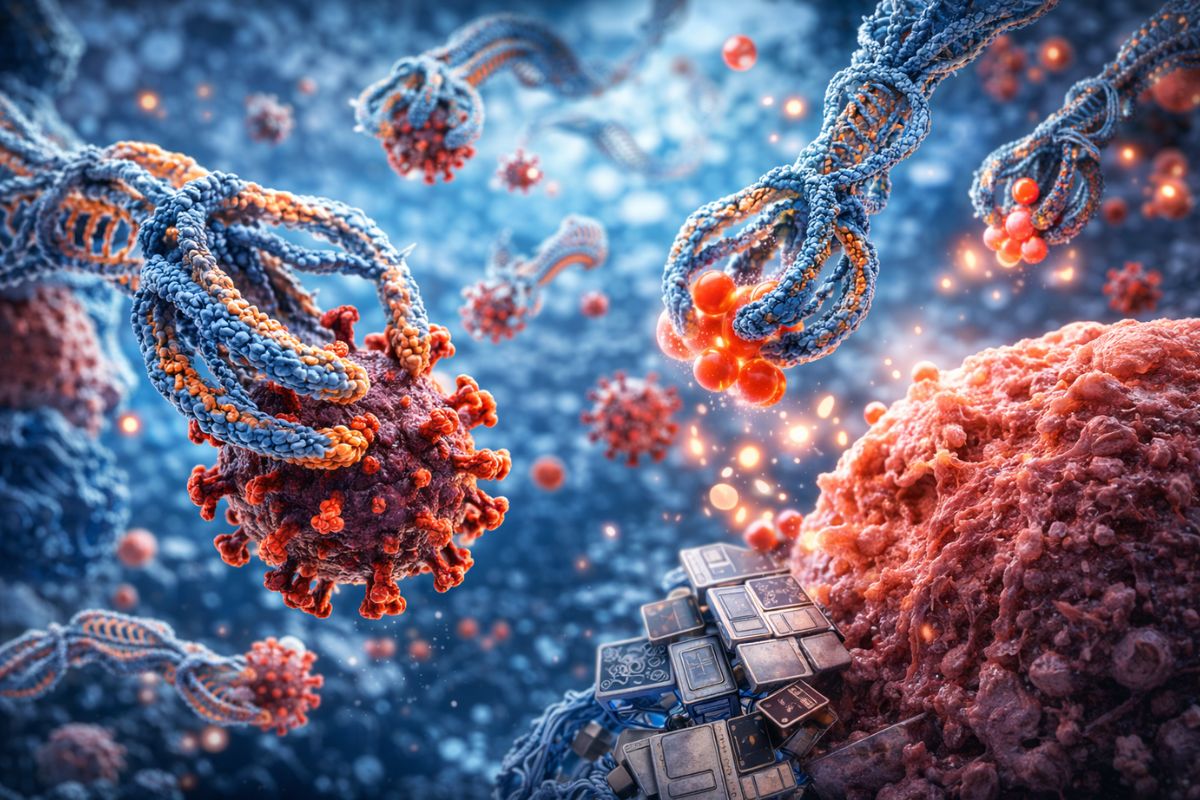
In 2026, DNA robots made from DNA origami show programmable fingers that recognize targets such as the spike protein and can be reprogrammed for viruses and even for cancer therapy.
Imagine a robot so small it fits inside a cell in your body. In 2026, DNA robots shaped like a “hand” with articulated fingers emerge as a real laboratory technology, built from a single strand of DNA folded like molecular origami.
The proposal goes beyond “seeing” the virus. The idea is to grab a specific target, such as the spike protein of COVID-19, and physically block entry into the cells. And, along the same lines, these systems can be programmed to seek out cancer cells and deliver drugs directly to the tumor, always within what the base describes as tests and demonstrations in a controlled environment.
What are DNA robots and why does DNA become “engineering material”
When talking about robots, many people imagine metal, motors, and rigid parts. DNA robots are a different category: machines built with DNA molecules used as structural material, not as “genetic information”.
-
Satellites capture an impressive scene in South America, where snow advances over arid lands, creating an unusual landscape alongside glacial lakes and revealing the power of an extraordinary storm.

-
Pocket-Fab: USP places semiconductors at the center of the national strategy by developing portable factories that promise to increase production, generate skilled jobs, and strengthen Brazilian technological autonomy.
-
Casiquiare, a river that connects the Orinoco and Amazon, has challenged hydrology for centuries; cartographers created fictitious mountains to deny its existence, and Humboldt traveled 1,725 miles through the jungle in 1800 to prove that the maps were wrong.

-
At a depth of 2,900 km, Tuzo and Jason form two colossal structures buried beneath Africa and the Pacific that have challenged science for decades, and a new study suggests that these gigantic structures may have originated from material exchanges between the core and the mantle in the early days of Earth.

The key point is programmability. DNA sequences can be designed to fold in a specific way, fit into specific targets, and perform specific functions, transforming DNA into a type of “buildable material” on a nanometric scale.
DNA origami: folding a strand of DNA until it becomes a functional structure
The technique mentioned in the base is DNA origami. The logic is similar to traditional origami, but instead of paper, there is a long strand of DNA that is folded and refolded until it forms a three-dimensional structure.
This method allows for the creation of fixed and movable parts within the same construction. The result is a unique piece with embedded “mechanics”, without the need to assemble multiple separate parts as in traditional engineering.
NanoGripper: the “hand” with four fingers and three joints

The most notable structure is the NanoGripper, described as a nanoscopic hand with a palm and four fingers. Each finger has three joints, in a design reminiscent of a miniature human hand.
According to the base, the NanoGripper was developed by a team led by Professor Ting Wang from the University of Illinois in the United States and published in Science Robotics.
The construction uses a single folded strand of DNA to form both fixed and movable parts in one step, which draws attention for the level of control over shape and function.
How the NanoGripper “recognizes” the virus and blocks infection
The described mechanism involves regions called DNA aptamers, programmed to recognize specific molecular targets. In the first test mentioned, the target was the spike protein of the COVID-19 virus.
When the NanoGripper encounters the target, the aptamers activate the closing of the fingers. The hand folds and “grabs” the spike, blocking the virus’s entry into the cell.
The base also compares the sensitivity of detection to what is seen in PCR tests, in the sense of recognizing the target at the molecular level, within the laboratory context.
Reprogrammable: from COVID to flu, HIV, and hepatitis
A strong point of the concept is the possibility of reprogramming. The base states that by swapping the aptamers, the same NanoGripper can target other targets, citing flu, HIV, and hepatitis B as examples.
This does not mean a product ready for immediate clinical use. It means that the architecture of the robot can be redesigned to “fit” different targets, while maintaining the same basic body.
DNA robots “machineries” and “computational”: two categories mentioned in 2026
The base mentions a review published in March 2026 by a technology institute in China, in the journal Smartbot, which organizes DNA robots into two categories.
The first are DNA machinery robots, which perform actions based on pre-programmed physicochemical interactions, such as “found a certain molecule, does a certain thing”.
The second are computational DNA robots. Here, the base describes the use of logic gates made of DNA, allowing for information processing, evaluating conditions, and deciding whether to act.
The combination of “processing” and “action” is presented as a fusion of molecular computing with molecular engineering, with potential for more complex tasks.
Application in cancer: delivering medicine directly to the tumor
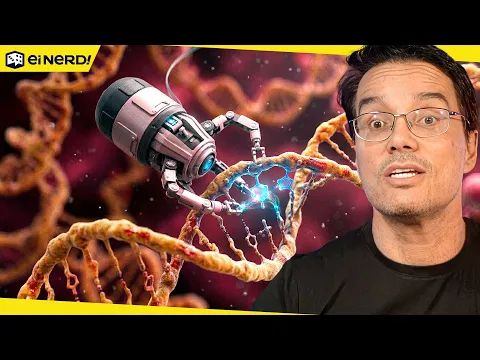

In addition to viruses, the base cites a scenario of use in cancer: DNA robots capable of navigating, finding a sick cell, assessing if it is a target, and delivering medication directly to it, with the promise of reducing damage to surrounding healthy cells.
This section should be read as a vision and research direction, not as available therapy. The base text emphasizes that the focus is still on research and development, pointing to a possible future.
The obstacles in the human body: enzymes, immune system, and stability
The base also highlights that there are significant challenges to leaving the laboratory and functioning in the human body. The biological environment is described as chaotic: there are enzymes that can degrade DNA, immune cells that can attack the structures, and fluids that can destabilize the robot’s shape.
Therefore, making these robots survive long enough to complete a mission is pointed out as one of the biggest challenges. Still, the indicated direction is towards increasingly “on-site” treatments, with less side effects and more precision.
Would you let DNA robots operate in your body to neutralize viruses or deliver medicine to the tumor, or would you prefer to wait for more evidence before trusting this technology?






Seja o primeiro a reagir!