





 Portuguese
  English
  Spanish
  6 min of reading
  0 comments


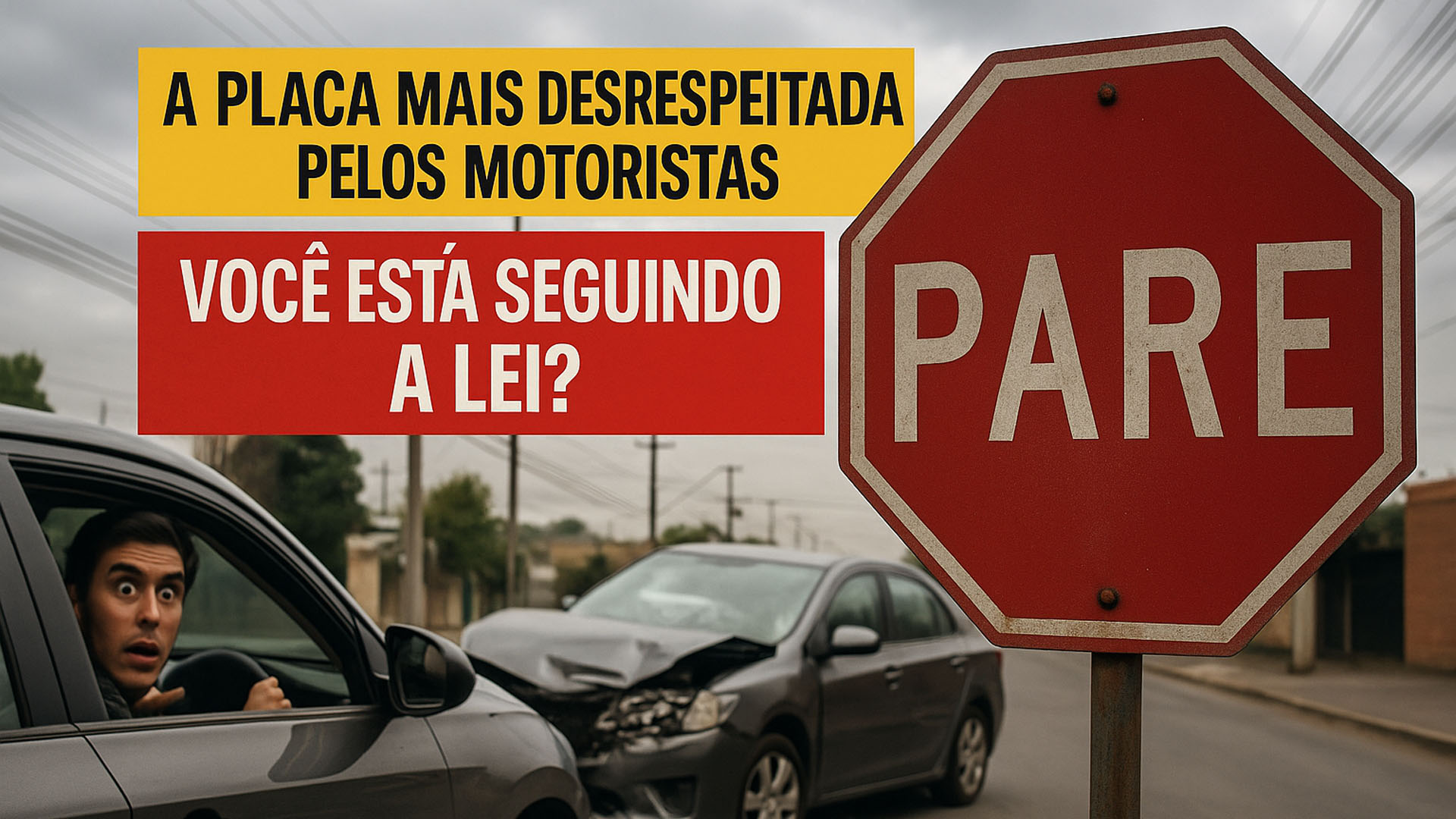
Even on an Empty Street, the Stop Sign Requires Drivers to Completely Halt the Vehicle. Understand What the Traffic Code Says, How Much the Fine Costs, and Why This Violation Is So Common in Brazil.
To stop or not to stop in front of the STOP sign when there are no cars or pedestrians around is a frequent doubt among drivers. Many believe that simply reducing speed, giving a quick look, and moving on is sufficient. However, this interpretation is not supported by traffic legislation.
The Brazilian Traffic Code (CTB) treats the mandatory stop as a clear and objective command. The STOP sign, classified as signaling R-1, does not suggest a mere reduction of speed: it requires the complete immobilization of the vehicle before proceeding through the intersection.
This rule was created with dangerous intersections in mind, where visibility is low or there is high vehicle flow. In these spots, a few extra meters or seconds of distraction can mean the difference between a safe crossing and a serious side collision.
-
With over 14 million baskets of earth moved, an ancient North American metropolis built a monumental pyramid of 30 meters and established a city with 20,000 inhabitants nearly a thousand years ago.

-
A 1,900-year-old treasure emerges from a Roman house destroyed by fire and sealed since antiquity in Romania, with coins and metals fused among the ashes.

-
The Brazilian colonial city that stopped in time and shares territory with a rocket launch base.

-
79-year-old woman challenges limits, visits 193 countries in the world after 56 years of planning and reveals the behind-the-scenes of a global journey that few have managed to accomplish.


In practice, therefore, even if the street seems empty, the law’s response is straightforward: saw the STOP sign, you have to stop. Ignoring this obligation is an infraction provided for in Article 208 of the CTB, and it can have important financial consequences and affect the driver’s points on their CNH.
What the Law Says Exactly About the STOP Sign
The STOP sign is a type R-1 regulatory signaling. According to the Brazilian Signaling Manual and Resolution Contran No. 180/2005, it indicates that the driver must stop the vehicle before entering or crossing the roadway, in places where the simple reduction of speed is insufficient or dangerous to ensure safety.
Article 208 of the Brazilian Traffic Code states that “failing to stop at the red traffic signal or at a mandatory stop” is a traffic violation.
This means that disregarding the STOP sign by not immobilizing the vehicle where stopping is mandatory is, legally speaking, the same as running a red light.
The law does not differentiate between “busy street” and “empty street.” The duty to stop is objective: whenever there is mandatory stop signage, the vehicle must be completely immobilized. Merely reducing speed, glancing quickly, and proceeding does not meet the demands of the CTB and can be recorded as a serious violation by enforcement agents or electronic systems.
There are specific exceptions provided in the CTB itself, such as the possibility of free right turns at certain intersections with traffic signals, where there is specific signaling authorizing the maneuver. Even so, this rule is related to the red traffic signal, not the STOP sign, and only applies when there is a clear indication allowing the turn.
Fines, Points on the CNH, and Consequences of Running the STOP Sign
According to Article 208 of the CTB, failing to stop at a mandatory stop sign is classified as a serious infraction. This conduct is treated with strictness because it significantly increases the risk of collisions at intersections, especially on the sides of vehicles, which are more vulnerable to impacts and serious injuries to occupants.
The fine amount is defined by Article 258 of the CTB itself. The serious infraction carries a penalty of R$ 293.47 and generates 7 points on the National Driver’s License, which will be included in the driver’s record and count towards any eventual process for suspension of the right to drive if the points limit is exceeded during the period stipulated by law.
As a rule, running a mandatory stop does not, by itself, result in immediate retention of the CNH or removal of the vehicle. However, if the infraction is accompanied by other irregularities—such as driving without a license, signs of intoxication, or involvement in an accident with victims—the driver may face more severe administrative and criminal consequences.
Besides the financial impact and points, a history of serious infractions can increase insurance costs and harm professional drivers who rely on a good record to work. In comparison, spending a few more seconds stopping properly at the STOP sign is infinitely cheaper than dealing with fines, administrative processes, and, most importantly, the risks of an accident.
Why So Many Drivers Ignore the Mandatory Stop
Even with clear rules, the STOP sign is among the most disregarded traffic signals in Brazil. Surveys cited by traffic agencies, such as the former Denatran and state departments, show that this type of signaling frequently ranks among the top for violations at urban intersections.
One reason is the so-called “culture of haste.” Many drivers see any stop as a waste of time and end up treating respect for traffic laws as an obstacle to getting there faster. In this dangerous logic, “just reducing a bit” at the STOP sign becomes an apparently harmless habit.
Another factor is the false sense of security. If the driver looks and sees no one approaching, they believe there is no real danger. The problem is that, in intersections with limited visibility, another vehicle might appear just as the maneuver has begun, leaving little room for reaction and increasing the likelihood of side collisions.
The lack of constant enforcement also plays a role. On roads with few agents or electronic equipment, many drivers have the impression that “nothing happens” when they run the STOP sign. As they pass through the location several times without being fined, they reinforce the risky behavior until one day they are involved in an accident or receive an unexpected ticket.
Urban mobility experts also point to flaws in traffic education. There are drivers who memorize answers for the theoretical CNH test but do not grasp the practical meaning of the STOP sign and the rules of precedence. The result is high-risk behavior disguised as shortcuts, fueled by haste, overconfidence, and little enforcement.
STOP Is Not a Detail, It’s a Public Safety Rule
From a road safety perspective, the STOP sign goes well beyond a formality. Data from traffic police and Detrans indicate that a large portion of accidents at intersections is linked to the disregard for precedence or mandatory stopping, particularly highlighting side collisions, which are among the most dangerous in urban environments.
Respecting the STOP sign also connects to other fundamental rules, such as prioritizing pedestrians at crosswalks and the need to reduce speed in residential and school areas. When drivers comply with the mandatory stop, traffic becomes more predictable, which reduces conflicts and improves the protection of all users of the road.
For the average driver, the rule remains simple and straightforward: saw the STOP sign, come to a complete stop, even if there are no other vehicles apparent. Immobilize the car at the stopping line or before the crosswalk, check movement in all directions, and then proceed calmly. This attitude demonstrates respect for the law, care for one’s own life, and responsibility for those who share the road.
And you, do you really stop your car every time you see a STOP sign, or do you admit that sometimes you “just reduce” when the street is empty? Leave your comment, share your experiences, and say whether you believe that the biggest problem is the lack of enforcement or the culture of disrespect for traffic rules in Brazil.







Seja o primeiro a reagir!