





 Portuguese
  English
  Spanish
  4 min of reading
  0 comments


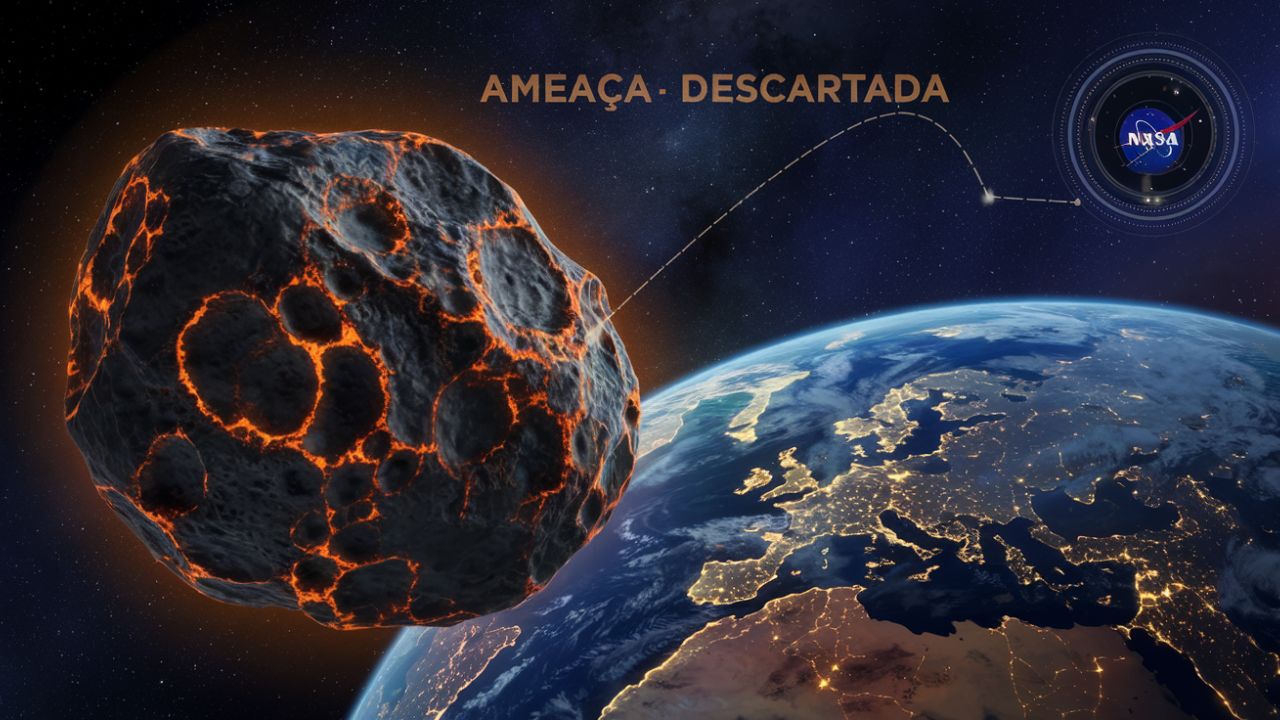
After Reaching The Highest Impact Chance Ever Recorded For An Asteroid Of This Size, 2024 YR4 Was Finally Discarded As A Threat By NASA. New Calculations Reduced The Probability Of Collision With Earth From 3.1% To Practically Zero.
For a brief moment, the world held its breath: an asteroid with one of the highest impact probabilities ever recorded by NASA could be heading our way. But rest assured, the threat has been officially dismissed. The space agency announced that the chances of collision for asteroid 2024 YR4 have fallen to practically zero after new calculations.
But how did science manage to turn a worrying risk into a global relief? And what would happen if this asteroid actually hit Earth? Let’s understand better.
Asteroid 2024 YR4: A Danger That Never Materialized
The asteroid 2024 YR4 was first detected on December 27, 2024. With an estimated diameter between 40 and 90 meters, it was large enough to cause catastrophic damage if it collided with Earth.
-
(VIDEO) Cameras from an astronomical observatory captured two meteors falling over Santa Maria in Rio Grande do Sul with only a one-minute difference and such close trajectories that scientists are now investigating whether the two objects have the same origin.

-
Fireballs shoot across the skies of the USA and meteor explosions draw attention: what is causing this mysterious wave of sightings?
-
Brazil has quietly developed an electric tactical drone that takes off and lands vertically without needing a runway, flies at 140 km/h in a fully autonomous manner, and can operate in forests, conflict zones, and remote areas.

-
Novo drone Guardian debuts in the United States with an 8-mile range, robotic battery swapping, and Starlink connectivity for continuous response.


In the initial calculations, the chances of impact were relatively small, just above 1%. However, as more data was collected, that number began to rise, reaching a concerning peak of 3.1% on February 20, 2025. For context, this was the highest risk recorded by NASA for an asteroid of this size.
A game of roulette where the ball needs to land exactly on the same number to hit Earth. As scientists collected more data, the “board” became clearer, and they realized that the ball was actually far from our number.
According to InfoMoney, initially, calculations indicated that impact could occur in 2032. However, with the refinement of analyses, NASA was able to discount that possibility: the chances of impact fell to 0.004% (or 1 in 25,000). Soon after, new projections reduced that probability even further to only 1 in 59,000.
How NASA Dismissed The Threat?
If you’ve ever tried to hit a target from a distance, you know that a small deviation at the start can result in a huge error at the end. That’s exactly what happens in astronomy: small uncertainties in calculations can generate very different predictions about an asteroid’s trajectory.
As astronomers observed 2024 YR4 from different points on Earth, they refined its path and reduced the uncertainties. This led to the conclusion that it simply won’t hit us.
To reach this conclusion, NASA used advanced telescopes, such as the Lowell Discovery Telescope in Arizona and the Nordic Optical Telescope in the Canary Islands. These tools provided crucial new data, allowing them to refine predictions.
But now there’s a problem: the asteroid has moved out of our line of sight and won’t be observed again until 2028. Nevertheless, scientists assure that there is no more reason for concern.
What Would Have Happened In The Event Of Impact?
Although 2024 YR4 is not a giant asteroid like the one that wiped out the dinosaurs, it would have enough force to destroy an entire city. If it hit the ground, it could generate an explosion with energy comparable to that of dozens of nuclear bombs.
If it exploded in the atmosphere, as happened with the Chelyabinsk meteor in Russia in 2013, the damage could be less severe but still significant, depending on the location of impact.
Among the simulated scenarios, some of the areas of possible impact included major cities like Mumbai (India) and Lagos (Nigeria). Fortunately, that risk has been eliminated.
What Happens Now?
Even with the threat of 2024 YR4 dismissed, NASA continues its constant vigilance over space. Currently, there are thousands of asteroids being monitored, and new discoveries are made regularly.
Programs like the DART mission, which recently successfully tested the possibility of diverting asteroids, show that humanity is already preparing for more dangerous scenarios in the future.
The case of 2024 YR4 proves that with technology and detailed observation, we can predict and eliminate uncertainties about space objects. NASA’s goal is to detect these threats decades in advance, ensuring enough time to take action if a real danger arises in the future.






Seja o primeiro a reagir!