





 Portuguese
  English
  Spanish
  4 min of reading
  0 comments



NASA Is Creating An Airplane That Flies At 1.4 Times The Speed Of Sound And Is 1000 Times Quieter, Promising To Change The Future Of Aviation
Recently, NASA announced new advancements in the development of the supersonic X-59 airplane, which is part of its Quesst mission. The goal of this mission is to revolutionize supersonic flight, making it quieter and thus commercially viable on land routes.
The X-59 promises to fly at an impressive speed of 1.4 times the speed of sound, which is about 925 miles per hour (1500 km/h). Additionally, the airplane is designed to be 1000 times quieter than current supersonic aircraft, reducing the nuisance of sonic booms.
The X-59 is a centerpiece of NASA’s strategy to provide data that helps regulators reconsider the bans on commercial supersonic flights over land areas. For more than 50 years, these flights have been prohibited in the United States and in several other nations, due to the negative impact of sonic booms on communities. However, with the promise of a much gentler “sonic boom,” the X-59 may pave a new way for supersonic aviation.
-
Historic bankruptcy of Centauro shocks the market, and the century-old company puts more than 500,000 products, machines, and complete infrastructure up for online auction.

-
New shoe factory in Ceará is expected to create 400 jobs and strengthen the local economy.

-
No one imagined it, but a mixture of sawdust with a mineral that fights fires surprises scientists with a result that changes the course of fire-resistant construction.

-
From empty land to a high-end house, wooden construction uses a lightweight system, metal structure for the foundation, ventilated ceramic cladding, and special windows to create an efficient and comfortable living space throughout the year.


What Changes With The X-59
Currently, commercial flights are extremely fast compared to the past. Looking back to the 1950s and 1960s, traveling from England to Australia could take almost a week. Today, that journey can be made in less than a day. However, in recent decades, advancements in the speed of commercial airplanes have stalled, mainly due to the problem of sonic booms.
When an aircraft exceeds the speed of sound, it creates shock waves that result in a sonic boom. These booms are more than just annoying noises. They can cause damage to buildings, shatter windows, and even disturb wildlife. To avoid these issues, the Federal Aviation Administration (FAA) of the United States has imposed strict rules that restrict supersonic flights over land areas.
As a result, commercial supersonic flights are limited to routes over the ocean, where the booms do not affect populated areas. However, with the success of the X-59, this reality may change, allowing supersonic flights to operate freely over land, transforming the future of aviation.


X-59 Aircraft Changes Supersonic Flights
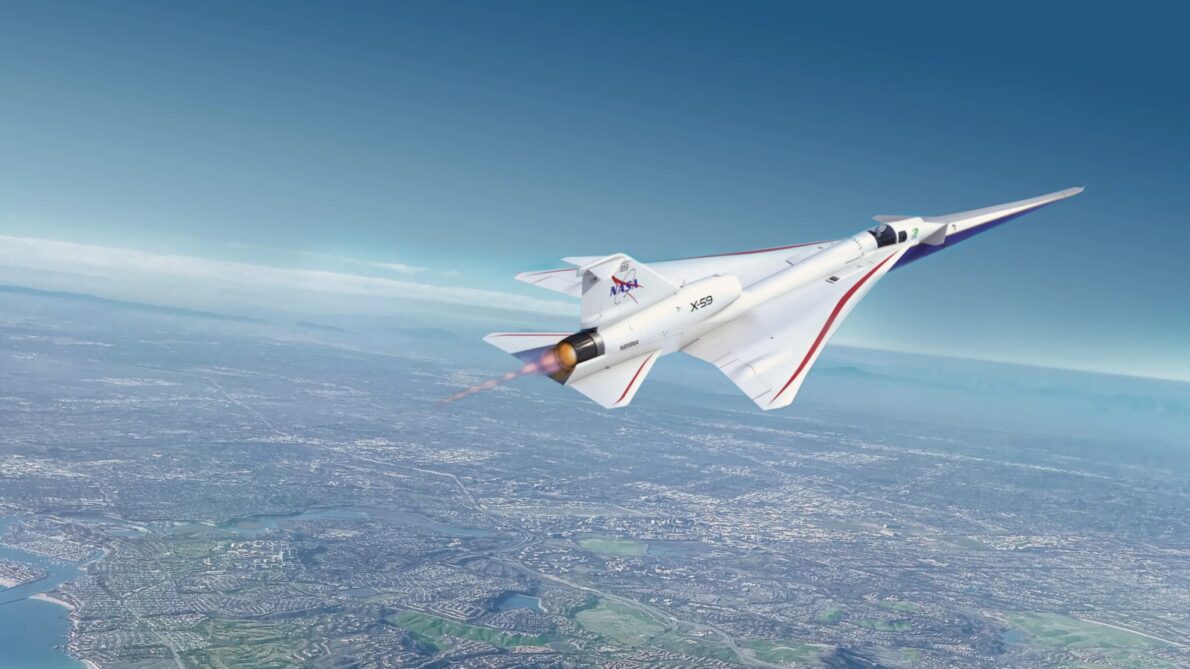
The NASA Quesst mission aims to demonstrate the viability of quiet supersonic flights. Lockheed Martin, NASA’s partner, revealed the X-59’s innovative design in January 2024. The aircraft features a long, slender fuselage, an elongated nose, and wings designed to minimize shock wave merging, avoiding the typical sonic boom.
Instead of a boom, the X-59 is expected to produce a sound resembling a distant thump, compared to the noise of a car door closing. This new “sonic thump” has the potential to change perceptions and regulations regarding supersonic flights.
Bob Pearce, associate administrator for aeronautics research at NASA, highlighted the importance of this mission: “NASA will share the data and technology we generate from this unique mission with regulators and the industry. By demonstrating the possibility of quiet commercial supersonic travel over land, we aim to open new commercial markets for U.S. companies and benefit travelers around the world.”
Technological Advancements From NASA
NASA is still conducting rigorous tests to ensure that the X-59 meets its objectives. These tests are crucial for verifying the structural integrity of the aircraft and how it will perform in flight. Walt Silva, senior research scientist at NASA’s Langley Research Center, explains: “The tests tell us how structurally sound the aircraft is and what kind of forces it can withstand when in the air.”
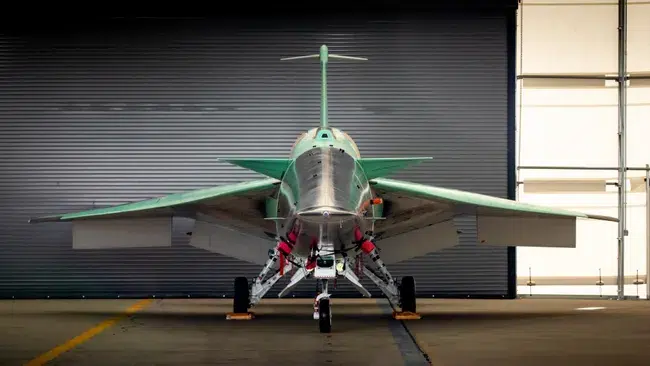
The main components of the aircraft, such as flaps, rudders, and ailerons, have already undergone intense testing. In 2022, engineers conducted a proof test, and this year, they installed and tested the ejection seat, a crucial safety measure for test pilots.
With a length of 30 meters and a wingspan of 9 meters, the X-59’s design incorporates technological innovations that will enable quiet supersonic flight. The conical nose of the aircraft, responsible for almost one-third of its length, is designed to break the shock waves, preventing the sonic boom.
Another innovative aspect of the X-59 is the absence of a front window in the cockpit. Instead, pilots will rely on the eXternal Vision System, which uses high-resolution cameras to relay images to a 4K monitor inside the cockpit. This allows for a clear view of the exterior, even without the traditional front window.
With the X-59, NASA is on the verge of redefining supersonic aviation. If the Quesst mission achieves its goals, we may witness the emergence of fast and quiet commercial supersonic flights over land. This would not only revolutionize the aviation sector but also benefit millions of travelers around the world.









-

-

3 pessoas reagiram a isso.