





 English
  Francês
  Alemão
  Italiano
  Japonês
  Norueguês
  Portuguese
  Spanish
  7 min of reading
  0 comments


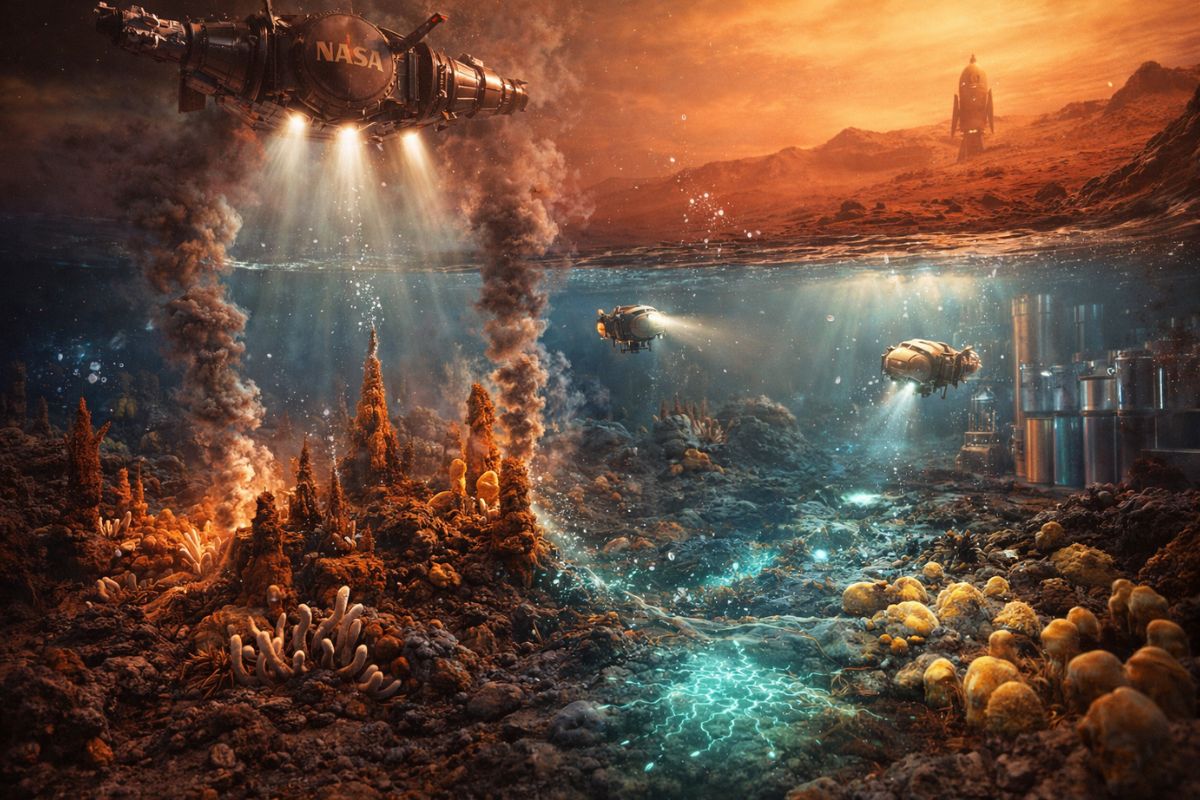
Data from the Mars Reconnaissance Orbiter revealed hydrothermal deposits over 400 meters thick at the bottom of an ancient Martian sea, the Eridania basin, indicating that the Red Planet gathered, billions of years ago, the same chemical and environmental ingredients that allowed the emergence of life on Earth.
Of all the places in the Solar System where science has searched for traces of conditions favorable to life, few compare to what has been found at the bottom of an ancient Martian sea. The Eridania basin, located in the highlands of Mars’ southern hemisphere, housed a colossal body of water about 3.8 billion years ago. This sea contained more than ten times the volume of North America’s Great Lakes and about three times the volume of the Caspian Sea. Data collected by NASA’s Mars Reconnaissance Orbiter (MRO) revealed, at the bed of this Martian sea, massive mineral deposits over 400 meters thick, formed in a deep hydrothermal environment. In simple terms: the same type of scenario that, on Earth, is considered one of the strongest candidates for the cradle of life.
The discovery, published in the journal Nature Communications and led by an international team of scientists with support from NASA, not only expanded the catalog of wet environments already identified on Mars, such as rivers, lakes, deltas, and hot springs, but created an entirely new category of astrobiological target on the Red Planet. The deposits found at the bottom of this Martian sea are contemporary with the oldest evidence of life on Earth, dating from the same period. And as the Earth’s crust, in constant recycling, destroyed almost all geological records from that time, it is Mars, not Earth, that may hold the best-preserved clues about how life began.
The most powerful eye ever sent to Mars

The Mars Reconnaissance Orbiter is, by far, the most productive data collection machine ever sent to the Red Planet. Since arriving in Martian orbit in 2006, the MRO has transmitted more information than all other missions to Mars combined.
-
Salaries of up to R$ 25,000, a shortage of professionals, and exploding demand in 2026 make the no-code automation specialist one of the most sought-after careers in Brazil, even without requiring a degree or programming knowledge.

-
The first commercial-scale hydrogen-powered brick factory will be established.
-
Goodbye to the noisy exhaust fan: silent and smart technology transforms modern kitchens with more comfort, design, and efficiency in everyday life.

-
At just 14 years old, a boy creates a system without energy, using steel pipes buried in the ground, that irrigates seedlings with moisture from the air, to combat the water scarcity threatening reforestation in northern China.

With over 60,000 completed orbits, the probe carries three cameras on board: the MARCI weather camera, which builds a daily global map of the planet’s atmosphere; the CTX context camera, which has covered about 99% of the Martian surface in high resolution; and the CRISM spectrometer, capable of identifying the mineral composition of rocks from orbit.
It was precisely the CRISM that allowed the identification of the composition of the deposits at the bottom of the Eridania basin. The instrument detected minerals such as saponite, iron and magnesium-rich serpentine, carbonates, and likely iron sulfide.
This is a mineral signature that, on Earth, is directly associated with deep hydrothermal environments, like those found around submarine hot springs in Earth’s oceans. This combination of data transformed Eridania from a simple geological depression into one of the most promising targets for Martian astrobiology.
What was at the bottom of the Martian sea of Eridania
The Eridania basin is located at the border between the regions of Terra Cimmeria and Terra Sirenum, one of the oldest portions of Mars’ crust. It is a closed basin, defined by topographic contours that indicate that water reached estimated depths between 500 and 1,500 meters. The total volume of water in this Martian sea exceeded that of all other closed lakes and seas identified on the planet, combined.
At the bottom of this basin, researchers found deposits over 400 meters thick, composed of minerals that show no stratification. This means they were not deposited in thin layers like common sediments but formed massively, consistent with underwater volcanic activity.
The most plausible hypothesis, according to the study published in Nature Communications, is that hot, mineral-laden water was pumped directly into the Martian sea from fractures in the crust, in a process very similar to what occurs at Earth’s mid-ocean ridges.
The Eridania region also exhibits evidence of strong remnant magnetism, which may suggest an early phase of crustal expansion, something that, on Earth, is associated with plate tectonics. Large volumes of lava from the Hesperian period found in the region confirm that there was significant volcanic activity within the basin, reinforcing the scenario of active hydrothermal springs at the bottom of that ancient Martian ocean.
Why this changes everything in the search for life beyond Earth

The importance of the discovery goes far beyond Mars. On Earth, submarine hydrothermal vents sustain entire ecosystems that do not depend on sunlight, with organisms that extract chemical energy directly from rocks.
Many scientists consider these environments to be the most likely scenario for the emergence of terrestrial life, about 3.7 to 3.8 billion years ago. The problem is that the Earth’s crust is in constant motion: tectonic plates recycle the ocean floor, and virtually no geological record from that primordial time has survived intact.
Mars, on the other hand, has a solid and geologically stable crust for billions of years. Erosion is minimal. This means that the deposits at the bottom of the Martian sea of Eridania may function as a time capsule, preserving conditions that on Earth have already been completely erased.
As Paul Niles, a planetary scientist at NASA’s Johnson Space Center, pointed out: even if no evidence of life is ever found on Mars, this location may reveal the type of environment in which life began here on Earth.
The discovery also has direct implications for the exploration of other worlds. Similar submarine hydrothermal environments may exist beneath the icy crusts of Europa, a moon of Jupiter, and Enceladus, a moon of Saturn. If the conditions found in the Martian sea of Eridania truly favored prebiotic chemistry, or even life, the chances of finding something similar on these icy moons increase considerably.
The largest waterfall in the Solar System and the end of the Martian sea

If the existence of a vast Martian sea with hydrothermal activity is already impressive, what happened afterward is equally spectacular. About 3.7 billion years ago, Mars underwent a drastic climatic transformation: temperatures plummeted, liquid water began to freeze and accumulate in the polar caps. At the same time, volcanic activity intensified in some regions, causing catastrophic floods.
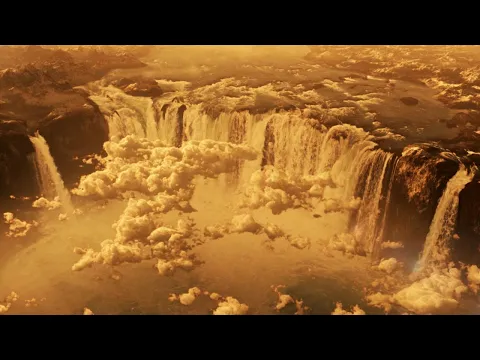
One of these floods sculpted one of the most dramatic landscapes in the entire Solar System: Echus Chasma, a canyon approximately 100 kilometers long and 10 kilometers wide, where waters cascaded down cliffs four kilometers high.
For comparison, Angel Falls, the highest waterfall on Earth, is just under one kilometer. Images captured by the Mars Express probe from the European Space Agency revealed the remnants of this colossal waterfall, considered the largest waterfall ever identified in the Solar System.
After the floods ceased, the water disappeared. The valley was subsequently covered by basaltic lava, sealing forever the record of that event. Today, Echus Chasma is a barren and silent reminder that Mars was once a watery planet, with oceans, deep seas, and waterfalls that would make any terrestrial formation seem modest.
Two planets, the same window for life
What makes the discovery of the Martian sea of Eridania so disturbing is not just the fact that Mars had water, as this was already known. What surprised researchers was the finding that, 3.8 billion years ago, Earth and Mars shared remarkably similar conditions: underwater volcanic activity, abundant water, geothermal heat, and a chemistry rich in essential minerals. On Earth, these conditions led to the emergence of life. On Mars, they existed for hundreds of millions of years before the planet lost its atmosphere and its water.
The question that remains is inevitable: if two neighboring planets had the same ingredients at the same time, could the process that generated life on Earth have been repeated in the Martian sea of Eridania? Science does not yet have that answer.
But the existence of such well-preserved hydrothermal deposits on Mars opens a concrete possibility: that one day, a robotic mission could drill into this ancient bed and find, or definitively rule out, the molecular traces of Martian life.
What do you think: Did Mars ever have life?
With each new discovery, the line between “Mars could have had life” and “Mars probably had life” becomes increasingly blurred. The Martian sea of Eridania is, so far, the most complete example of an environment that gathered all the necessary conditions: deep water, volcanic heat, reactive minerals, and enough time for something to happen. The question is no longer whether Mars had the ingredients. The question is whether the recipe worked.

With information from the BBC Earth Science Channel.
And you, what do you think about all this? Do you believe that life arose only on Earth, or do you think it is possible that the same process was repeated at the bottom of this ancient Martian sea? Leave your opinion in the comments. We want to know what the discovery of Eridania means to you.







Seja o primeiro a reagir!