





 Portuguese
  English
  Spanish
  3 min of reading
  1 comment


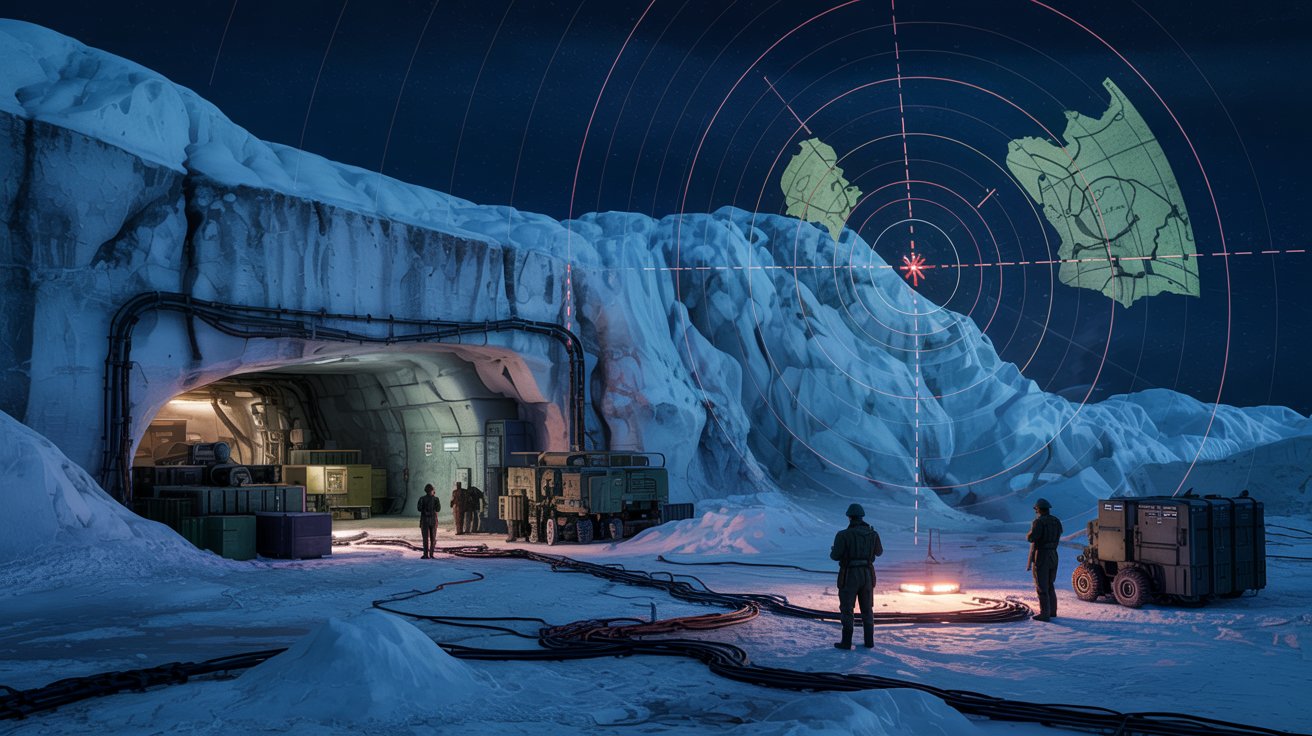

The Secret Military Base Buried Under the Ice of Greenland Hides Secrets of the Cold War and Environmental Risks, While Modern Technology Reveals Hidden Impacts That May Influence Geopolitics and the Future of the Arctic.
In a surprising discovery, NASA scientists identified, in April 2024, the remnants of the American military base Camp Century, buried under approximately 30 meters of ice in Greenland.
The base, built in 1959 during the Cold War, was officially presented as a scientific research center, but in reality, it was part of Project Iceworm, a secret plan by the United States to install nuclear missiles beneath the Arctic ice.
Abandoned in 1967 due to extreme weather conditions and ice instability, Camp Century remained forgotten until it was rediscovered through advanced radar technology.
-
These living root bridges and ladders are over 700 years old and help indigenous people survive in one of the rainiest regions in the world.

-
From sertanejo star to international investor: Ana Castela invests millions in a mansion in the USA, creates a themed accommodation in Orlando, and shows that the “boiadeira” also wants to grow away from the stage.

-
The 10 most stunning motorhomes in the world: a $3 million trailer with a rooftop nightclub and garage for a Ferrari, “palaces on wheels” with Italian marble, private cinema, and five-star hotel luxury for billionaires.

-
How the terraforming of Mars can transform the planet: artificial aerosols can increase the temperature by up to 35°C in 15 years, creating conditions for liquid water.



The Subterranean City of the Cold War
Camp Century was an engineering feat: a “city under the ice” composed of 21 interconnected tunnels, totaling about 3,000 meters in length.
The base housed laboratories, dormitories, a chapel, a barber shop, and even a small farm, supported by a portable PM-2A nuclear reactor.
The hidden objective was to create a network of tunnels for launching nuclear missiles against the Soviet Union, without the knowledge of the Danish government, as revealed by declassified documents in 1996.
Accidental Discovery and Cutting-Edge Technology
The rediscovery of Camp Century occurred during a NASA mission utilizing the UAVSAR radar mounted on a Gulfstream III plane to map the depth of the ice layer in Greenland.
Scientist Chad Greene led the team that, while analyzing the data, identified anomalous structures beneath the ice.
The images revealed the tunnels and remnants of the base’s infrastructure with impressive detail, providing a unique opportunity to study the effects of climate change and the waste left by the military installation.

Emerging Environmental Risks
Although the nuclear reactor was removed before the base was abandoned, Camp Century still contains hazardous waste, including about 200,000 liters of diesel, 240,000 liters of wastewater, pollutants such as polychlorinated biphenyls (PCBs), and low-level radioactive waste.
These materials were left under the assumption that they would remain frozen forever.
However, recent studies indicate that the melting of the ice, accelerated by climate change, may release these contaminants into the environment by the end of the 21st century.
Geopolitical and Legal Implications
The discovery reignites debates about the responsibility for cleaning up the waste.
Camp Century was built under Danish jurisdiction, but Greenland is currently an autonomous territory.
The 1951 treaty between the US and Denmark stipulates that American properties on Greenlandic soil remain under US ownership, but it does not clearly specify the responsibility for the waste left behind.
This legal ambiguity complicates efforts to address potential environmental risks.

The Importance of Continuous Monitoring
Experts emphasize the need for constant monitoring of the area to assess risks and develop mitigation strategies.
The situation at Camp Century serves as a reminder of the lasting consequences of human actions and the importance of considering the environmental impacts of military and scientific projects.
According to experts, the rediscovery of Camp Century by NASA not only unveils a hidden chapter of the Cold War but also highlights the environmental and legal challenges that arise when the waste of the past threatens the present.
As the ice in Greenland continues to melt, the international community faces the complex task of dealing with the legacies of an era marked by secrets and nuclear ambitions.
What do you think about the responsibility of countries to manage the waste left by secret past projects? Leave your opinion in the comments.







Se não for tomada providências de imediata, a população de todo (o mundo), poderá em breve dofrer consequências terríveis que jamais esperavam!!!