





 Portuguese
  English
  Spanish
  4 min of reading
  0 comments


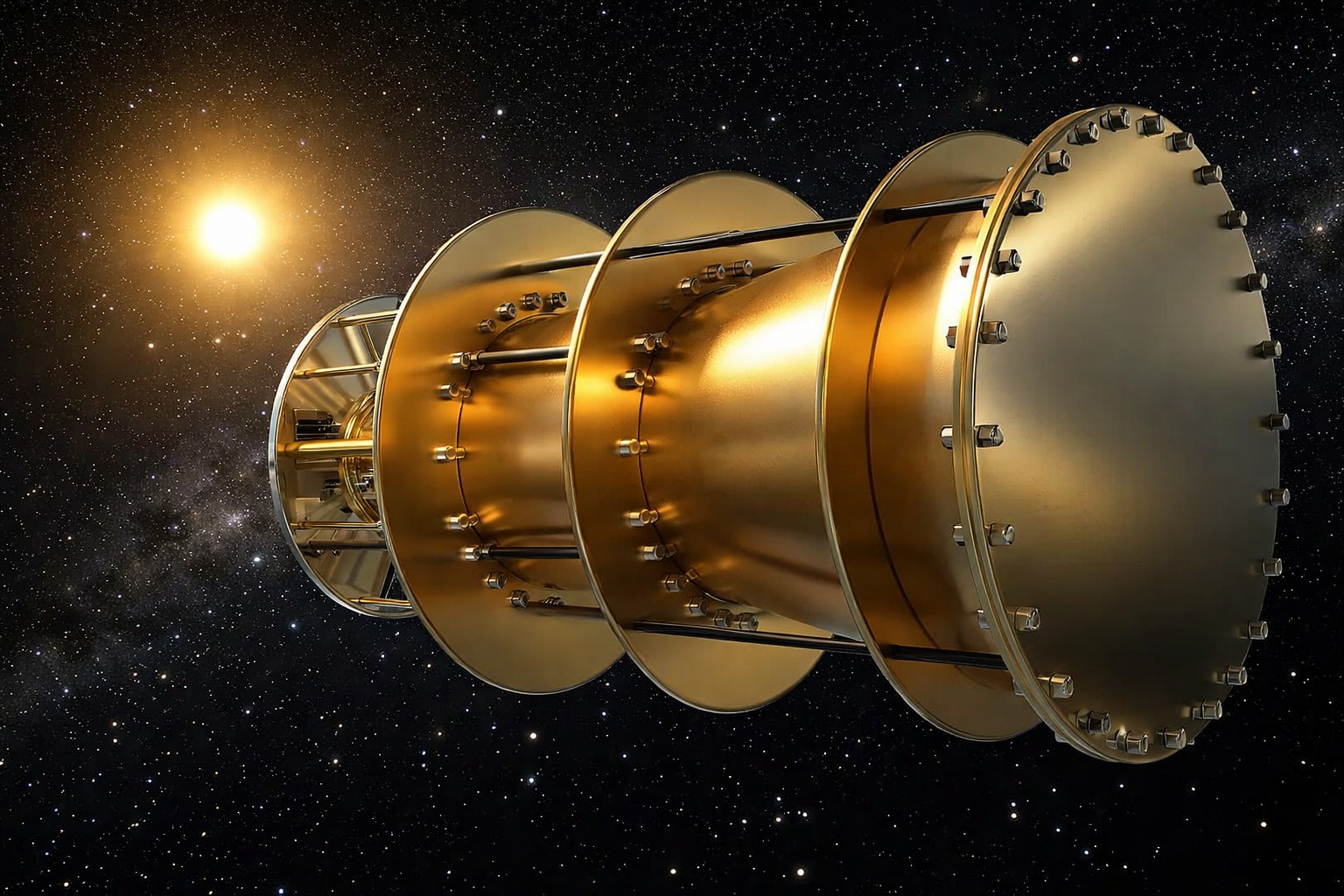
NASA engineer project proposes fuel-free engine capable of reaching the speed of light and could change the future of space travel
A NASA engineer has caught the attention of the scientific community by presenting a concept for a engine that, at least in theoretical terms, could allow a spacecraft to reach up to 99.99% of the speed of light. The proposal, which quickly gained global attention, reignites the debate about new forms of space propulsion, especially those that do not rely on conventional fuel.
Moreover, this study published in August 2019 stands out because it proposes an approach based on principles of relativistic physics, something that, while extremely complex, is already well-founded in modern science. Therefore, even though the project is far from practical application, it opens the door for new discussions about the future of space exploration.
One of Brazil’s most famous science communicators, Sergio Sacani, reignited discussions this April about the viability of the technology that could allow for longer space travel after the successful launch of the Artemis II rocket. Watch the video below on his YouTube channel (enable automatic audio dubbing for English, Spanish, or Portuguese versions)
-
Bahia becomes a key player in the new BRICS plan for a sovereign data center and brings Brazil closer to the competition for the future of cloud computing and AI.

-
Giant and invisible structure that has been around for decades emerges near the Solar System and could change what astronomy knows about the birth of stars.
-
Research gives new weight to the quipu and suggests that the Inca Empire developed an advanced method for organizing and processing data, with a structure of knots and strings that now brings the artifact closer to logics used in computing.

-
Scientists use artificial intelligence to create nearly indestructible steel that does not rust and could change the way industrial energy and oil parts are produced.



How the proposed helical engine works
According to the concept presented by David M. Burns, the system — called a helical engine — uses accelerated particles in a closed circuit shaped like a helix. In this way, the goal is to generate thrust without the need for propellant, something that is currently considered one of the greatest challenges in aerospace engineering.
Furthermore, the operation of the engine is based on an effect predicted by relativity: as a particle approaches the speed of light, its effective mass increases. Thus, this variation in mass could be used to generate continuous motion within the system.
On the other hand, the uniqueness of the project lies in how this process occurs. Instead of linear movements, the engine utilizes a continuous spiral cycle, which would allow it to accumulate momentum over time. Consequently, the spacecraft could reach extremely high speeds without relying on large amounts of fuel.
Speed of light: the limit the engine tries to reach
The speed of light, which is approximately 299,792 km/s, represents one of the main limits of modern physics. Therefore, any proposal involving reaching values close to this threshold requires extremely solid foundations.
According to the NASA engineer’s concept, the helical engine does not violate the known laws of physics. On the contrary, it attempts to work within these rules, exploring relativistic effects to generate thrust.
Moreover, if this technology were viable, the impacts would be enormous. For example:
- Travel to the Moon could take about 1.5 seconds
- Mission to Mars could last only 13 minutes
- Travel to Neptune would take approximately 4 hours
Thus, exploring the solar system would cease to be a lengthy process and would occur on extremely short time scales.
Technical challenges show the engine is still far from reality

Despite the enthusiasm, the study’s author acknowledges significant limitations. To begin with, the amount of energy required to generate minimal thrust is extremely high.
According to the data presented:
- A device of approximately 200 meters would be necessary
- Energy consumption of about 65 megawatts
- To generate only 1 Newton of force
In other words, in practice, the system is still highly inefficient. Additionally, testing in a terrestrial environment is complicated by gravity and external interferences.
For this reason, many experts point out that the technology is still in the theoretical realm and depends on significant advancements to become viable.

Scientific community reacts cautiously to the project
Although the concept has sparked curiosity, the scientific community maintains a cautious stance. This is because ideas for a propellant-free engine often face questions related to the conservation of momentum, one of the fundamental laws of physics.
Furthermore, the presented study has not undergone peer review, meaning it has not yet been validated by other experts in the field. Therefore, the NASA engineer himself emphasizes that it is an initial proposal.
Even so, the debate generated is considered positive. After all, new ideas can serve as a basis for future innovations, even if they are not immediately applicable.
Why ideas like this are still important for the future of space

Even with limitations, projects like the helical engine play an essential role in advancing science. This is because space exploration still faces significant challenges, especially related to cost, time, and efficiency.
Moreover, the dependence on fuel remains one of the main obstacles for long-duration missions. Therefore, any attempt to develop an alternative engine represents a relevant step.
According to experts, many current technologies emerged from concepts initially considered unfeasible. Thus, even if the engine proposed by the NASA engineer does not work as expected, it may inspire future solutions.
Finally, the debate about reaching the speed of light remains one of the most fascinating topics in modern science. And, in the meantime, proposals like this keep alive the search for faster and more efficient ways to explore the universe.









Seja o primeiro a reagir!