





 Portuguese
  English
  Spanish
  4 min of reading
  0 comments


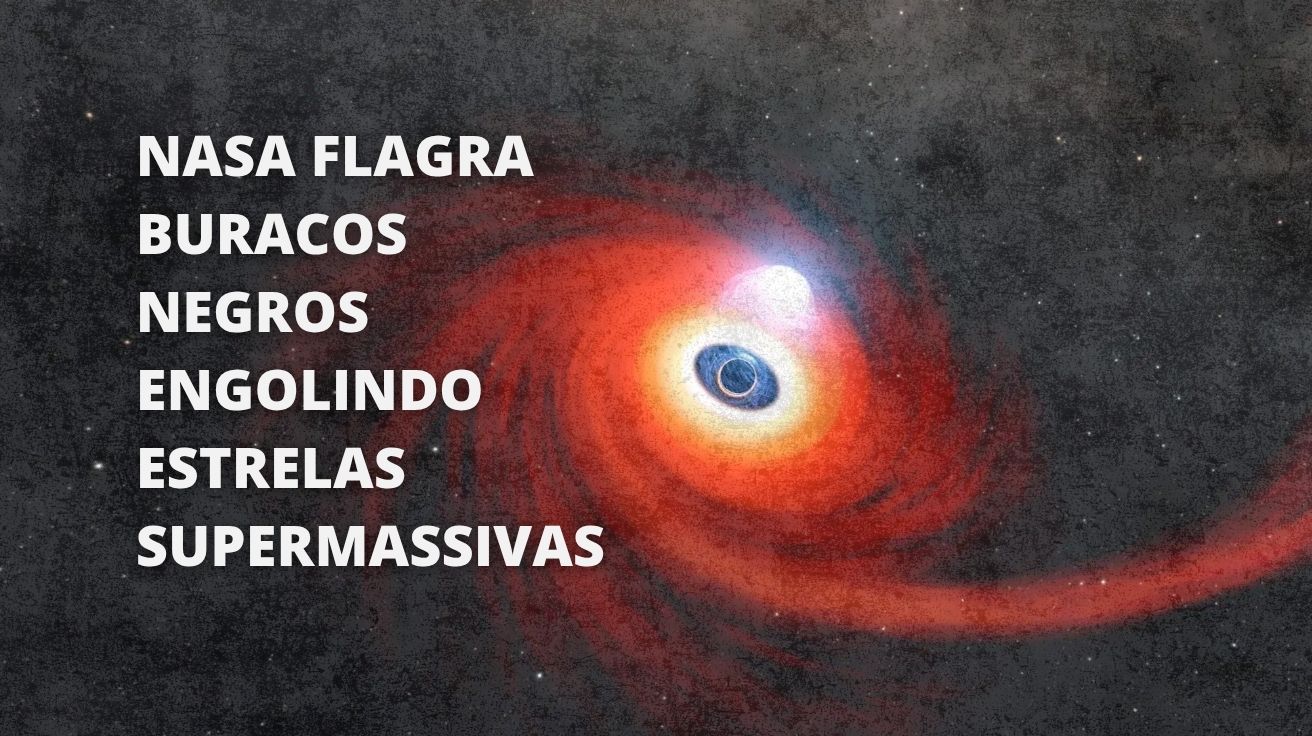
Rare Phenomenon Recorded Between 2016 and 2020 Reveals How Supermassive Black Holes, With Up to 10 Times the Mass of the Sun, Devoured Entire Stars and Released More Energy Than 100 Supernovae
NASA, in partnership with ESA and other institutions, revealed an extraordinary discovery: three supermassive black holes were caught devouring giant stars with a cosmic violence never seen since the Big Bang. These events occurred between 2016 and 2020, in distant galaxies, and each released more energy than 100 supernovae combined. The observations were confirmed by various telescopes and space satellites, such as Swift, WISE, and Gaia.
The destruction of the stars caused explosions that shone for months, releasing radiation so powerful that it affected the entire surrounding galaxy. The research, led by PhD student Jason Hinkle, was published in the journal Science Advances and represents a new class of cosmic events, known as “extreme nuclear transients,” NASA reported in a statement.
-
How the terraforming of Mars can transform the planet: artificial aerosols can increase the temperature by up to 35°C in 15 years, creating conditions for liquid water.

-
Scientists drilled nearly 8,000 meters into the ocean floor above the fault that caused the 2011 tsunami in Japan and discovered that a layer of clay 130 million years old was responsible for making the wave much worse than any model had predicted.
-
Thousands of years after causing the largest eruption of the Holocene, one of the world’s largest supervolcanoes is rebuilding itself beneath the sea south of Japan, receiving new magma and alarming scientists with its transformation.
-
China has activated a magnet 700,000 times more powerful than the Earth’s magnetic field that operates for over 200 consecutive hours while consuming little energy, and now the world wants to know what Beijing plans to do with this technology in 2026.

Credits: NASA/JPL-Caltech
What Are Extreme Nuclear Transients and How Do They Change Everything We Know About Black Holes
Black holes are known for their invisibility; they do not emit light and can only be detected by their gravitational effects. However, when a star comes too close, the intense gravity of the black hole tears it apart. This is what scientists call a “tidal disruption event.”

The three cases studied showed massive black holes that were inactive but suddenly became visible by destroying stars of up to 10 times the mass of the Sun. One of the events, nicknamed “Barbie” (ZTF20abrbeie), was detected by the Zwicky Transient Facility in 2020. The other two were observed earlier, in 2016 and 2018, by ESA’s Gaia satellite.
For months, telescopes tracked the rise and fall of the brightness of the explosions, behavior that served as a “fingerprint” to confirm the presence of the black holes. The released radiation lasted over 250 days, being captured in X-rays, ultraviolet, and optical light.
In addition to the intense brightness, the events altered the galactic environment around them. The ejection of energy and particles heated dust clouds, whose chemical signatures were analyzed by ground-based telescopes like Keck and Pan-STARRS.
The importance of this type of event lies in the fact that only about 10% of black holes in the universe are active. The rest remain hidden. Extreme nuclear transients act as cosmic beacons, revealing the location of silent black holes in remote galaxies.
Future Telescopes Will Hunt Cosmic Explosions From 12 Billion Years Ago Based on This Pioneering Study
The work led by Hinkle also involved scientists like Anna Payne from the Space Telescope Science Institute, who highlighted the potential of these events as guides to understanding the black holes of the primordial universe. The team believes these phenomena could be visible even at 12 billion light-years away, when the universe was still young.
The NASA Roman telescope, slated for launch in 2026 or 2027, will be essential in this search. With its wide field of view and ability to capture infrared light, precisely where the ultraviolet radiation from these events is “stretched” by the expansion of the universe, Roman could detect dozens or hundreds of these events in the deep past.
Old data from the WISE satellite were also crucial, as they allowed researchers to understand how the dust around black holes heated up and responded to the explosions. WISE operated between 2009 and 2011, and was later reactivated as NEOWISE, retiring in 2024.
By combining old and future observations, astronomers hope to map a more complete picture of black hole growth over time. The central question of how black holes grow may be closer to an answer.
In addition to providing data for cutting-edge science, the project was made possible thanks to a NASA grant program, FINESST, which funded Hinkle’s research. He will continue the work as a researcher at the University of Illinois within the prestigious Hubble Fellowship program.
As NASA highlighted, these cosmic explosions are so powerful that they modify not only their galaxy of origin but also our understanding of the universe.
Did you find this article impressive? Comment on what surprised you the most and share it with friends who love astronomy and science!










-

Uma pessoa reagiu a isso.