





 Portuguese
  English
  Spanish
  6 min of reading
  13 comments


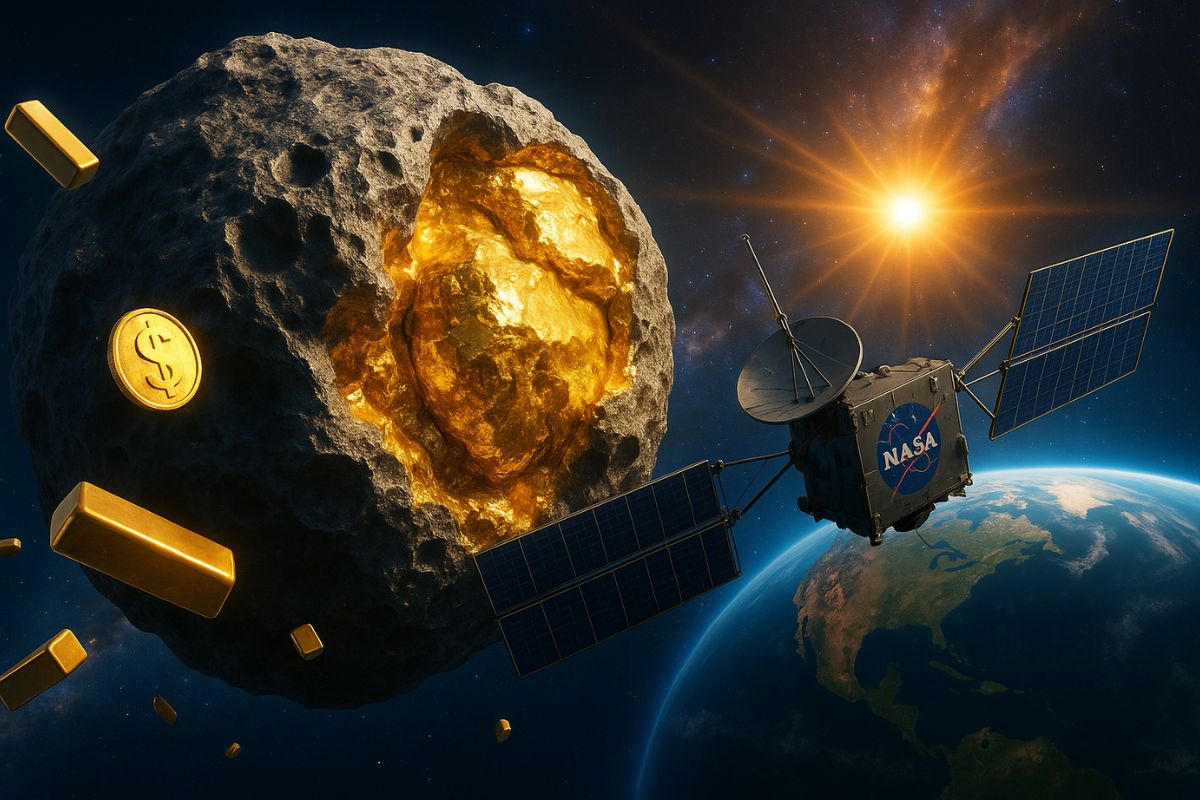


The Mission Dedicated to Asteroid 16 Psyche Transformed the Largest Reserve of Gold in the Solar System into a Natural Laboratory Where NASA Seeks to Understand Both the Economic Potential of Metals and the Clues That This Metallic Structure Holds About the Formation of Rocky Planets
NASA is focusing its scientific efforts on asteroid 16 Psyche, a celestial body located between Mars and Jupiter that may harbor the largest reserve of gold in the Solar System in potential, alongside large quantities of iron and nickel. More than attracting attention for its estimated trillion-dollar value, the object is treated as a unique opportunity to closely observe an exposed metallic core, something that is not accessible within rocky planets like Earth.
At the same time, the interest in Psyche goes beyond astronomy and reaches the field of economic projections, as such a large amount of precious metals could, in theory, profoundly alter the global commodities market. The combination of unusual composition, stable location in the asteroid belt, and estimated value of trillions of dollars causes the asteroid to be observed as a convergence point between planetary science, technological innovation, and discussions about the future of resource exploration in space.
What Makes Asteroid 16 Psyche Different
16 Psyche stands out because it has a rare metallic concentration compared to most asteroids, which are essentially composed of rocks, ice, or mixtures of both.
-
A gigantic dam project in the Himalayas could solve one crisis but silently create another for millions of people.

-
Nikola Tesla said that intelligent people tend to have fewer friends, and now science partially confirms this: a study with over 15,000 people showed that for the more intelligent, socializing too much can even reduce life satisfaction.

-
A superyacht worth US$ 17 million is delivered in impeccable condition, sets out to sail, and hits a bridge in the Bahamas just two hours later.

-
Residents of Australia woke up to a sky completely red like blood before the arrival of Cyclone Narelle, which hit the coast with winds of 250 km/h, tearing off roofs and lifting iron dust in a scene they described as apocalyptic.


Data collected from ground observations and space instruments indicate that Psyche has high density and a strong metallic signature, suggesting that its interior is dominated by alloys of iron, nickel, and traces of other heavy metals, possibly including large amounts of gold.
This configuration has led scientists to consider that Psyche may be the remnant of the core of an embryonic planet that had its outer layers removed by violent impacts in the early Solar System.
In this hypothesis, the asteroid would preserve internal characteristics that are now completely hidden in rocky planets.
Studying this metallic structure up close is, in practice, observing from the inside how the heart of a forming planet might be.
The Largest Reserve of Gold in the Solar System as a Scientific Hypothesis
When it is said that Psyche harbors the largest reserve of gold in the Solar System, the claim is associated with physical models and estimates based on density, albedo, and average composition of metallic asteroids, not direct measurements of gold deposits ready for extraction.
Scientifically, this is a hypothesis built from indirect data, which indicates the presence of heavy metals in quantities far exceeding those found in the Earth’s crust.
The mission dedicated to Psyche prioritizes refining this understanding by analyzing the gravitational field, internal structure, and surface composition of the asteroid.
As new data is obtained, it will be possible to check more accurately whether the scenario of a largest reserve of gold in the Solar System is compatible with the evidence or if current estimates need to be adjusted.
In all cases, the declared focus is scientific, not commercial, aimed at the origin and evolution of metallic bodies in space.
What Kind of Scientific Discovery Can Psyche Provide
From a planetary science perspective, Psyche offers a rare chance to directly study an object with characteristics similar to the cores of rocky planets.
By investigating its density, gravitational variations, and surface composition, researchers can reconstruct stages of internal evolution that, on Earth, can only be inferred through theoretical models, seismology, and computational simulations.
Among the expected developments are advances in understanding planetary differentiation, a process in which denser materials migrate inward and form metallic cores.
Analyzing Psyche’s structure helps validate or correct models that explain how iron, nickel, and other metals organized in the interiors of planets, including ours.
Moreover, studying the impacts recorded on its surface contributes to reconstructing the violent environment of the early Solar System, when high-energy collisions were decisive for the fate of many bodies in formation.
Potential Economic Impacts and Current Limits
The idea that Psyche concentrates the largest reserve of gold in the Solar System raises economic projections that extend beyond astronomy.
If it were possible to transport to Earth even a fraction of the metals present in the asteroid, the volume would be sufficient to alter the relationship between supply and demand, compressing prices and forcing a reorganization of entire production chains.
This scenario, however, remains in the realm of simulations and theoretical exercises.
In practice, there is currently no technological, logistical, or regulatory infrastructure capable of enabling large-scale space mining on such a distant object.
Any serious discussion about economic exploration needs to consider extremely high energy costs, operational risks, and the need for robust international agreements, as the introduction of large quantities of metals into the market could generate global financial instability.
Therefore, the official focus keeps the exploration of Psyche in the field of scientific research, not as an immediate resource extraction project.
Technological Challenges to Explore a Metallic Asteroid
Operating a mission on a metallic asteroid like Psyche poses specific challenges compared to rocky asteroids or comets.
The high density alters the local gravitational field, requiring precise planning of orbits and approach maneuvers.
The surface, possibly formed by metallic blocks, regolith, and irregular structures, may have thermal and mechanical properties different from those encountered by probes at other targets.
Additionally, the instruments used to investigate the composition and internal structure need to operate with high sensitivity, as reading residual magnetic fields and subtle gravitational variations is essential to understanding how this metallic core formed.
This set of requirements makes Psyche an important testbed for new technologies in navigation, communication, and remote sensing, which can be applied in future missions to other metallic bodies.
Why Psyche Became a Priority in Space Exploration
The interest in Psyche reflects a shift in focus in Solar System exploration, which now values not only worlds with atmospheres or water but also bodies that hold the memory of the oldest stages of planetary formation.
Instead of only looking at the surface of planets and moons, the scientific community seeks to understand what happens in their interiors, and a metallic asteroid like Psyche offers a rare shortcut for this type of investigation.
In this context, the combination of possible trillion-dollar value in metals and long-term scientific potential makes the asteroid a strategic target.
Even if mining never becomes viable, the detailed understanding of the largest reserve of gold in the Solar System in potential already represents a significant advance for physics, planetary geology, and the economy itself by allowing a real data assessment of the resource scenario available beyond Earth.
And Now: What to Expect from the Next Analyses on Psyche
As the mission dedicated to 16 Psyche progresses, new measurements should refine estimates of the asteroid’s mass, composition, and internal structure, confirming or adjusting the scenario that it harbors the largest reserve of gold in the Solar System.
Each set of data sent to Earth expands the understanding of how metallic cores form, fragment, and remain stable over billions of years.
The result is an object that, at the same time, feeds scientific curiosity and reignites discussions about the future of resource exploration in space, without losing sight that, at the
current stage, Psyche is primarily a natural laboratory to answer fundamental questions about the origin of rocky planets.
In light of this scenario, do you think humanity should maintain a focus on Psyche solely as a source of scientific knowledge or, in the long term, also consider more concretely the economic use of this potential reserve of gold beyond Earth?









Todo cuidado é pouco. Haverão ambições de todo jeito. O menos favorecidos ficarão a merecer dos que tem maior poder aquisitivo.
A última extinção dos dinossauros foi provocada por um asteroide que colidiu no local do Golfo da México há 66 milhões de anos.
Vão tentar trazer esse asteroide de ouro para a terra, ele vai colidir com o planeta e todos nós vamos morrer ricos.
Essa nasa e zoiuda vai passar mão no ouro