





 Portuguese
  English
  Spanish
  6 min of reading
  0 comments


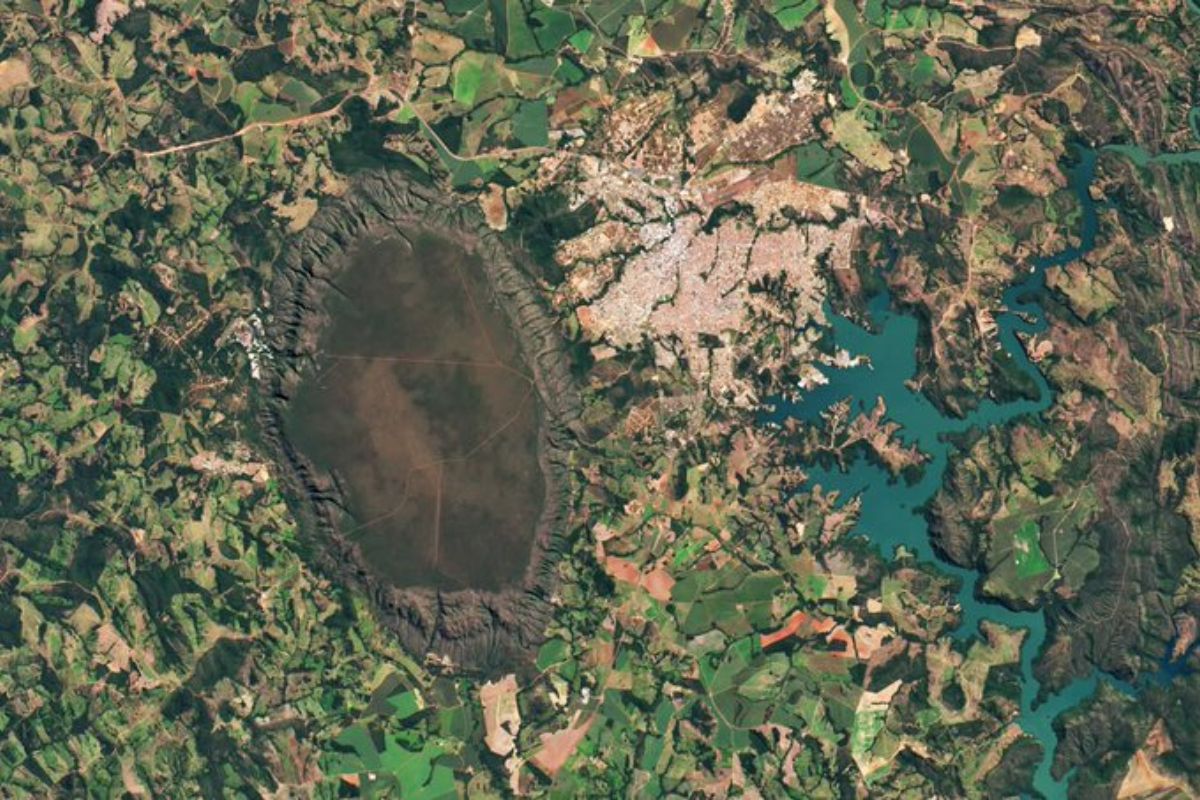
NASA published an image on Instagram from the Landsat 9 satellite showing a mountain range in the interior of Goiás with an oval shape and the caption “What’s that?”, and the photo surpassed 400 thousand likes because few knew that the Caldas Novas mountain range houses the largest hydrothermal spring in the world, where rainwater infiltrates more than a thousand meters deep and returns to the surface as hot water of up to 70 degrees
NASA published a photo taken from space with the question “What’s that?” and the world stopped to look at a mountain range in the interior of Goiás. The image, made by the Landsat 9 satellite at over 700 kilometers altitude, showed a dark oval covered with dense vegetation in contrast to the surrounding pastures. The post surpassed 400 thousand likes and generated thousands of comments from people who had no idea what they were seeing. The mountain range in the interior of Goiás that caught NASA’s attention is the Caldas Novas mountain range, and beneath it lies the largest hot water spring on the planet, with temperatures ranging from 43 to 70 degrees.
The Caldas Novas mountain range is an oval-shaped plateau that rises about 300 meters above the landscape of Central Brazil and acts as a massive aquifer recharge box. Rainwater infiltrates through the fractures of granite, descends to more than a thousand meters deep, and is heated by the Earth’s natural geothermal heat. It then returns to the surface due to pressure differences, feeding hundreds of thermal springs that sustain Caldas Novas and Rio Quente, the largest hydrothermal resorts on the planet. All of this in the middle of the Cerrado, 170 kilometers from Goiânia.
What NASA photographed and why the mountain range in the interior of Goiás caught the world’s attention

The image was taken on May 19, 2025, by the Landsat 9 satellite, which orbits the Earth at an altitude of 705 kilometers and travels at 26 thousand kilometers per hour. The resolution of the sensors allows for the identification of changes in vegetation, land use, and rock formations.
-
A thermal block costing only R$ 0.40 catches attention by reducing heat by up to 80% using recycled styrofoam, a common kitchen ingredient, and a manual technique capable of producing 50 blocks from a single bag of cement.

-
The item in the house that consumes the most water is not in the kitchen; it is in the smallest room of the house and can account for up to 30% of the expenditure on its own.

-
While Argentina relies on the USA to provide communications, data transmission, and electronic warfare for the F-16, Brazil is accelerating with the Gripen and integrating the Link-BR2, a national technology that strengthens air defense.

-
The daily shower that seems harmless now worries specialists: a shower uses 6 to 15 liters per minute and is at the center of the water crisis.


In the case of the mountain range in the interior of Goiás, what caught attention was the visual contrast: a dark and dense oval of preserved Cerrado surrounded by light areas of pasture and agriculture.
NASA explained in the caption that the dark oval was the Caldas mountain range, a plateau covered by Cerrado with species such as the seriema and the pequizeiro, established as a state park in 1970.
The impact was so great that the U.S. Embassy in Brazil had to intervene to clarify that the formation is 100% natural, with no uranium or military activity, as many internet users created conspiracy theories about what the mountain range in the interior of Goiás could be hiding. Geologist Valdir Silveira from the Geological Service of Brazil confirmed: it only has hot water.
How the mountain range in the interior of Goiás functions as a natural water heating machine
The mountain range in the interior of Goiás functions as a massive water recharge box. When it rains over the plateau, the water infiltrates through the cracks and fractures of the sedimentary rocks and granite that make up the formation. This water descends to depths that can exceed a thousand meters.
At this depth, the Earth’s natural geothermal heat warms the water, which then returns to the surface due to pressure differences through a system of geological faults created by the dome formation.
There is no volcano involved, although residents believed so for decades. The process is purely geothermal: the Earth’s crust naturally increases in temperature as one goes deeper.
The water that springs from the ground around the mountain range in the interior of Goiás reaches the surface with temperatures ranging from 43 to 70 degrees, feeding hundreds of thermal springs, natural pools, and the water parks that have transformed Caldas Novas and Rio Quente into the largest hydrothermal resorts in the world.
The history of the hot waters that began with a bandeirante in 1722
The thermal springs around the mountain range in the interior of Goiás were first discovered in 1722, when the bandeirante Bartolomeu Bueno da Silva, the son, found hot water springs at the foot of the mountain while searching for gold.
The springs were forgotten for decades until, in 1777, Martinho Coelho de Siqueira rediscovered them during a hunt. It is said that his dogs howled upon entering the Lagoa de Pirapitinga, whose waters were scalding.
The village grew around the springs and the gold. In 1911, the settlement emancipated from Morrinhos. Tourism gained momentum in the 1970s when hotels with thermal pools began to transform the region.
Today, more than 3 million people visit Caldas Novas annually, and the mountain range in the interior of Goiás that feeds the springs is protected by the Serra de Caldas Novas State Park (PESCaN), the first environmental conservation unit in the state, with 12,315 hectares of preserved Cerrado.
The park that protects the mountain range in the interior of Goiás and the Cerrado that covers it
PESCaN was created in 1970 and is managed by the Goiás Secretary of Environment and Sustainable Development (Semad). The park protects not only the top of the mountain range in the interior of Goiás but also its slopes, foothills, and spring areas that are essential for maintaining the hydrothermal aquifers.
Without the protection of the Cerrado that covers the mountain range, the water recharge capacity would decrease, and the thermal springs that sustain the entire economy of the region could dry up.
The mountain range in the interior of Goiás is also recognized as a geological site by the Brazilian Commission of Geological and Paleobiological Sites, linked to UNESCO’s Natural Heritage program. Its rocks are about a billion years old and hold records of an ancient marine environment.
The elevated plateau creates specific microclimates that allow for the existence of fauna and flora distinct from the neighboring plains, making the mountain range a refuge for species that depend on altitude and native Cerrado vegetation in a region surrounded by agricultural advancement.
A mountain range that NASA showed to the world and that Goiás has known for 300 years
The mountain range in the interior of Goiás that appeared in NASA’s photo was not discovered by the satellite. Bandeirantes found it in 1722, residents have been enjoying its hot waters for generations, and more than 3 million tourists visit it every year.
What NASA did was make visible to the entire world what the Goiás Cerrado already knew: that beneath that oval mountain range lies the largest hot water spring on the planet, with water that descends more than a thousand meters, is heated by the Earth, and returns to the surface at up to 70 degrees.
The image did not invent the importance of the mountain range in the interior of Goiás. It merely showed 400 thousand people at the same time what a photo taken from space can reveal about the ground we walk on.
Have you visited Caldas Novas or Rio Quente? Did you know that the mountain range in the interior of Goiás functions as a natural water heating machine? What did you think of the impact of NASA’s photo? Leave your comments and share this article with those who need to know this piece of the Cerrado that caught the world’s attention.









Seja o primeiro a reagir!