





 Portuguese
  English
  Spanish
  5 min of reading
  0 comments


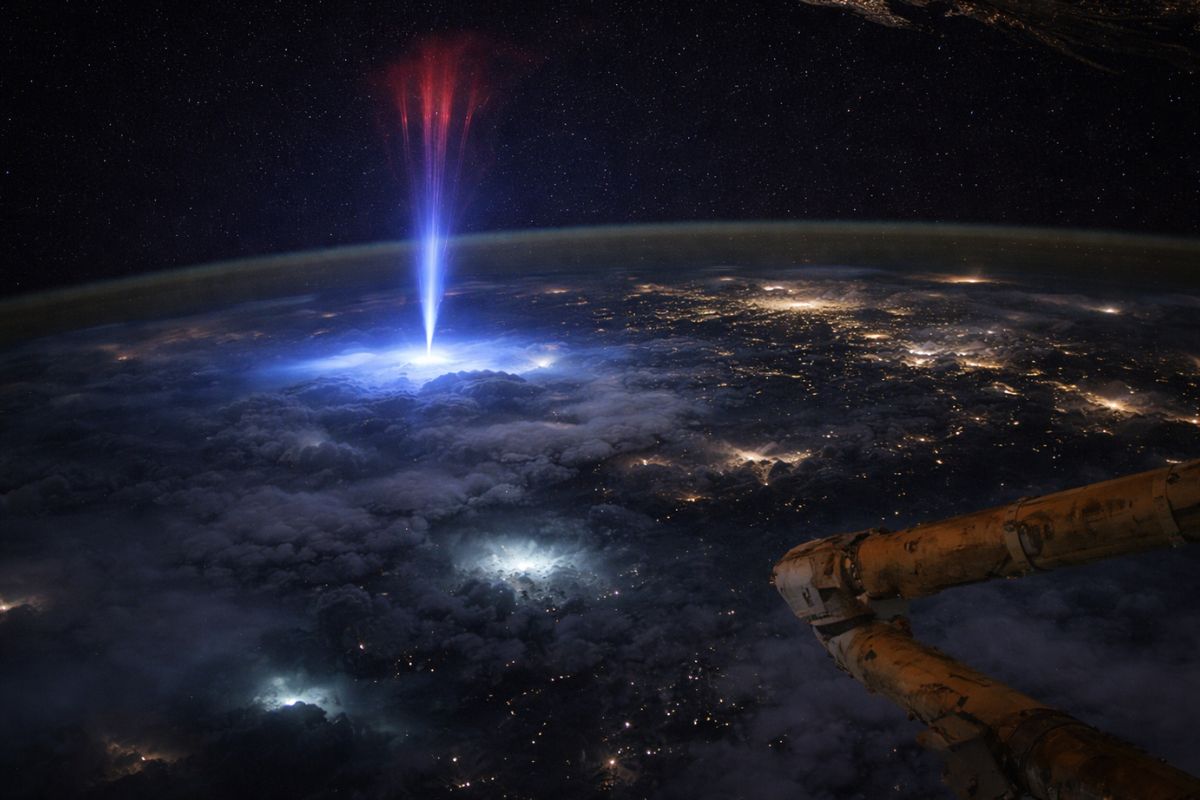
NASA highlighted an image captured from the International Space Station by astronaut Nichole Ayers that shows a gigantic jet, a rare lightning bolt shooting upwards from the top of a storm and reaching almost 100 kilometers in altitude towards space.
Most people know lightning as electrical discharges that fall from the sky to the ground. But NASA drew attention to an image that shows exactly the opposite: a lightning bolt shooting upwards from the top of a storm towards the edge of space. The photo was taken on July 3, 2025, by astronaut Nichole Ayers aboard the International Space Station, and shows what scientists classify as a “gigantic jet,” an electrical discharge so rare that few instruments on Earth can record it.
The phenomenon may seem like just a visual spectacle, but NASA is watching closely for practical reasons. Lightning at high altitudes can interact with the ionosphere, complicate aviation and spacecraft safety, and influence the chemistry of the upper atmosphere. The image published by NASA is not just beautiful. It is part of a scientific effort to understand events that connect atmospheric layers typically studied separately and that can affect communication systems, weather forecasts, and even climate models.
What is the gigantic jet that appears in the photo released by NASA

The lightning captured in the image belongs to a family of phenomena called transient luminous events, which includes red sprites, blue jets, and light rings known as ELVES.
-
Forget the idea that your brain stops developing at 25: a study with over 4,000 people proved that it continues to rebuild itself until 32 and goes through five phases throughout life.

-
Researchers from USP have discovered how to use Brazilian arnica to produce silver nanoparticles without generating toxic waste, and the innovation already has a patent application and practical application underway in the market.

-
A study published in one of the world’s most respected medical journals shows that just two tablespoons of olive oil per day can reduce the risk of heart attack by up to 30% and also silently protect the liver.

-
China surprises the world again with a human research program at the Tiangong station, which aims to create an unprecedented space atlas, with 387 projects submitted, 53 already completed, and a mission involving an astronaut spending over 1 year in orbit.
Pilots have reported strange flashes at the tops of storms for decades, but the first scientifically confirmed records only emerged in 1989, making this a surprisingly recent field of research for something so visually impactful.
Gigantic jets are scientifically important because they form what NASA describes as an electric bridge between the tops of storm clouds, at about 20 kilometers altitude, and the upper atmosphere, at about 100 kilometers.
This discharge deposits a significant amount of electrical charge along the way, connecting regions that typically do not interact directly. Astronaut Nichole Ayers initially thought she had captured a sprite, but NASA confirmed that the phenomenon was something even rarer.
Why the International Space Station is the best place to study these lightning bolts
From the ground, observing lightning shooting upwards is nearly impossible. We are looking through clouds at other clouds, which makes detection extremely difficult when the phenomenon occurs above the storm. From the International Space Station, the perspective is completely different.
The instruments can observe storms from above, and NASA notes that these observations can enhance atmospheric models used for weather and climate forecasts.
One of the key instruments is the Atmosphere-Space Interaction Monitor (ASIM), from the European Space Agency, installed on the exterior of the Columbus laboratory of the station since 2018.
The ASIM weighs 314 kilograms and records observations while the station travels at 28,800 kilometers per hour, allowing it to cover a vast area in a single nighttime pass. It is this type of orbital infrastructure that makes it possible to capture phenomena that last milliseconds and that ground observers almost never notice.
The cameras that capture lightning at 100 thousand images per second
Not all science about space lightning comes from external instruments of the station. The Thor Davis experiment, supported by NASA and the European Space Agency, uses a camera that detects contrast changes and can capture the equivalent of 100 thousand images per second while consuming only a few watts of power.
This speed is essential for recording processes that happen in fractions of a millisecond.
In one of the captures from the Thor Davis camera, astronaut Andreas Mogensen recorded a red sprite above a storm cloud, at an altitude between 40 and 80 kilometers.
Scientists estimated the size of the phenomenon at about 14 by 26 kilometers, and the project’s chief scientist, Olivier Chanrion, confirmed that the camera provides the temporal resolution necessary to capture the rapid processes of lightning. NASA and ESA are working together to continuously expand the observational capacity of these rare events.
The real impact that lightning to space can have on Earth
Some of these phenomena do more than produce spectacular images. NASA warns that transient luminous events can disrupt ground communication systems and pose a threat to aircraft and spacecraft, which is why creating a broad and well-timed database is not just an academic issue.
When electrical discharges inject energy into the ionosphere, they can affect the propagation of radio waves used in telecommunications and navigation.
Storms can also produce terrestrial gamma-ray flashes, brief bursts of high-energy radiation. NASA warns that these events can expose aircraft systems and passengers to excessive radiation levels under certain conditions.
From the perspective of atmospheric chemistry, a review published in the journal Atmospheric Research concluded that sprites, blue jets, and corona discharges can measurably contribute to gases like ozone and nitrous oxide, although there are still significant uncertainties about the scale of this effect.
What’s next in NASA’s research on lightning that shoots into space
The trend is clear, even though the details are still being defined. NASA notes that more compact sensors and small satellites can expand storm observation coverage, reducing costs and speeding up manufacturing compared to traditional approaches.
This means that in the future, the ability to monitor lightning at high altitudes may no longer rely solely on crewed space stations.
There is also an important deadline. NASA and partner countries have committed to operating the International Space Station until 2030, which means that today’s observations are helping to build the database for what comes next.
The image of a lightning bolt shooting into space, taken by Nichole Ayers in July 2025, is much more than a beautiful photo. It represents a growing field of research that connects storms, climate, communications, and aerospace safety in a single investigation network led by NASA.
Had you ever heard of lightning shooting upwards instead of falling to Earth? What did you think of the image released by NASA showing this electrical discharge reaching space? Leave your opinion in the comments. Phenomena like this show that we still know very little about what happens above our heads.






Seja o primeiro a reagir!