





 Portuguese
  English
  Spanish
  5 min of reading
  0 comments


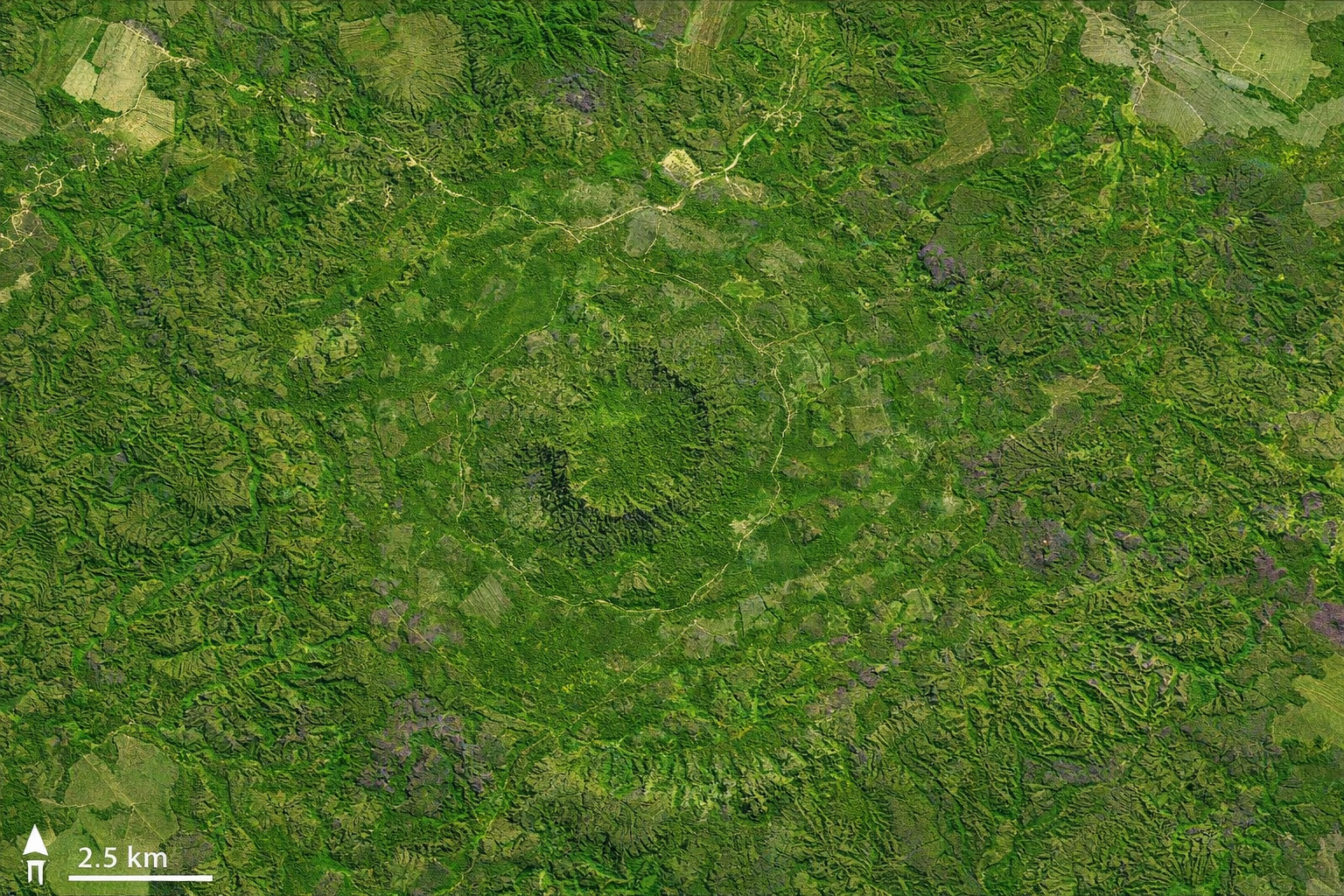
Serra da Cangalha, in Tocantins, is a 13 km meteorite crater formed 220 million years ago and is considered the best-preserved in Brazil.
In the middle of the Tocantins savanna, between soybean plantations and a flat landscape that stretches to the horizon, three concentric mountain ranges rise, forming an almost perfect arc. Viewed from the ground, the Serra da Cangalha, located in the municipality of Campos Lindos, may seem just another typical rock formation of the Brazilian interior. According to a report from Pesquisa FAPESP on geological studies conducted in the region, the set stands out precisely because it arises in the midst of a flat area of Tocantins, near the border with Maranhão, where the mountains reach about 400 meters in height and form a rare circular structure in Brazilian territory.
Viewed from space, however, the formation reveals a completely different structure: a circular crater approximately 13 kilometers in diameter, with concentric rings and an internal crown-shaped core about 3 kilometers in diameter, typical characteristics of a meteorite impact crater. According to analyses published by NASA’s Earth Observatory, the structure shows a series of clearly visible concentric rings in orbital images, with a diameter of about 13 kilometers, while scientific studies published in the Journal of South American Earth Sciences describe the Serra da Cangalha as a complex impact structure with an apparent diameter of 13.7 kilometers.
Located in the municipality of Campos Lindos, the Serra da Cangalha is considered by scientific studies and by NASA itself as the best-preserved impact crater in Brazil, although it is still little known by most of the population. The Earth Observatory publication states that, despite its estimated age of about 220 million years, the crater remains the most preserved Brazilian example of this type of structure, sitting on largely intact sediments of the Parnaíba Basin.
-
They spent up to 5 hours a day underwater, and their bodies changed because of it: discover how human populations developed impressive biological adaptations to survive in the most extreme environments on Earth.

-
The tallest wind turbine in the world is rising where there was coal: 360 meters in Schipkau, Germany, it ascends with a telescopic system, captures winds above 300 m, and aims to connect to the grid by 2026.
-
Shenzhen showcases high technology in China: deliveries by drones and autonomous robots, driverless taxis with sensors, smart hotel with AI, humanoid and surgical robots, automated café, and mega station “Shenzhen Eye.”

-
Cambridge University creates a solar reactor that transforms hard-to-recycle plastic and battery acid into clean hydrogen, operating for over 260 hours and paving the way to add industrial value to two waste materials that currently lead to disposal and environmental costs.

Meteorite impact 220 million years ago in the Triassic period shaped the Serra da Cangalha
About 220 million years ago, during the Triassic period, a meteorite about 1.4 km in diameter crossed the Earth’s atmosphere at an estimated speed of 43,200 km/h, equivalent to about 12 km per second.
The impact released an energy calculated at 2.74 × 10²⁰ joules, thousands of times greater than that of modern nuclear weapons.
In fractions of a second, rocks were pulverized, melted, and launched into the atmosphere. The shock wave generated geological structures known as shatter cones, formations that only occur under extreme pressures and are considered direct evidence of meteorite impacts.

The expelled material returned to the surface forming impact breccias, rocks composed of melted and compacted fragments after the shock.
The result was a complex crater, with multiple structural rings and a raised central core due to the rebound of the Earth’s crust after the impact.
Discovery of the Serra da Cangalha involved Petrobras, Radam Brasil, and scientific confirmation by Unicamp
The structure was initially identified in 1960 by geologists from Petrobras during prospecting activities in the Parnaíba Basin.
At the time, the formation was interpreted as a geological dome, unrelated to extraterrestrial impact.
In the 1970s, during the Radam Brasil project, the circular pattern drew attention again. By the 1980s, researcher John McHone suggested the possibility of a meteoritic origin, but without conclusive evidence.

The definitive confirmation occurred only in 2012, with the doctoral thesis of geologist Marcos Alberto Rodrigues Vasconcelos, developed at Unicamp under the guidance of Álvaro Penteado Crósta.
The study identified shatter cones and impact breccias at the site, confirming the nature of the structure as an astrobleme — a technical term for ancient craters formed by impacts and modified by erosion over millions of years.
NASA satellite images show concentric rings and elevated central core in the crater
The Serra da Cangalha is clearly visible in images from NASA’s Shuttle Radar Topography Mission (SRTM).
The data shows three distinct structural rings:
The outer ring, about 11 km in diameter, delineates the original crater. A second inner ring features gentle hills between 5 and 6 km. In the center, a raised core of approximately 3 km represents the point of greatest geological deformation.
The TO-226 highway crosses the region and passes within the structure, without most drivers realizing they are inside an impact crater.
Brazil has several meteorite craters, including the Araguainha Dome and other little-known structures
The Serra da Cangalha is part of a set of at least eight confirmed impact craters in Brazil.
The largest of them is the Araguainha Dome, about 40 km in diameter, located on the border between Goiás and Mato Grosso.
Another relevant structure is the Riachão Ring, in Maranhão, approximately 4.5 km in diameter, located about 45 km from the Serra da Cangalha.
The proximity between these formations raises hypotheses of multiple impacts, possibly caused by the fragmentation of a single celestial body. Despite their scientific relevance, many of these structures remain little known to the population.
The interior of the crater houses preserved forest, rivers, caves, and isolated biodiversity
The interior of the Serra da Cangalha presents unique ecological characteristics. The central region is covered by virtually intact native vegetation, protected by the elevated edges of the crater.
Rivers, such as the Manoel Alves Grande, cross the structure, forming waterfalls and areas suitable for activities like canoeing.
Caves identified in the inner rings feature rock formations associated with the pressures of the impact, making the site relevant for geological studies as well.
Proposal to create a state park aims to ensure the protection of the Serra da Cangalha
Despite its scientific and environmental importance, the area still lacks formal definitive protection. There is a proposal to create the Serra da Cangalha State Park, with an estimated area of 16,617 hectares.
Institutions such as Iphan, Unicamp, and UnB have already conducted studies at the site, and the crater is registered in international geological data bases, including specialized scientific publications.
Structures like the Serra da Cangalha function as natural archives that record extreme events in the history of the planet. Meteorite impacts can influence climate changes, geological alterations, and even mass extinction processes.
The study of these formations contributes to the understanding of Earth’s evolution and the dynamics of cosmic impacts over time.
Now we want to know: did you already know about this 13 km crater in Tocantins visible only from space?
The Serra da Cangalha remains one of the most impressive and least known geological formations in Brazil.
Even though it is visible from satellite and studied by researchers, it is still ignored by most of the population. Had you heard of this meteorite crater in Tocantins?








Seja o primeiro a reagir!