





 Portuguese
  English
  Spanish
  5 min of reading
  0 comments


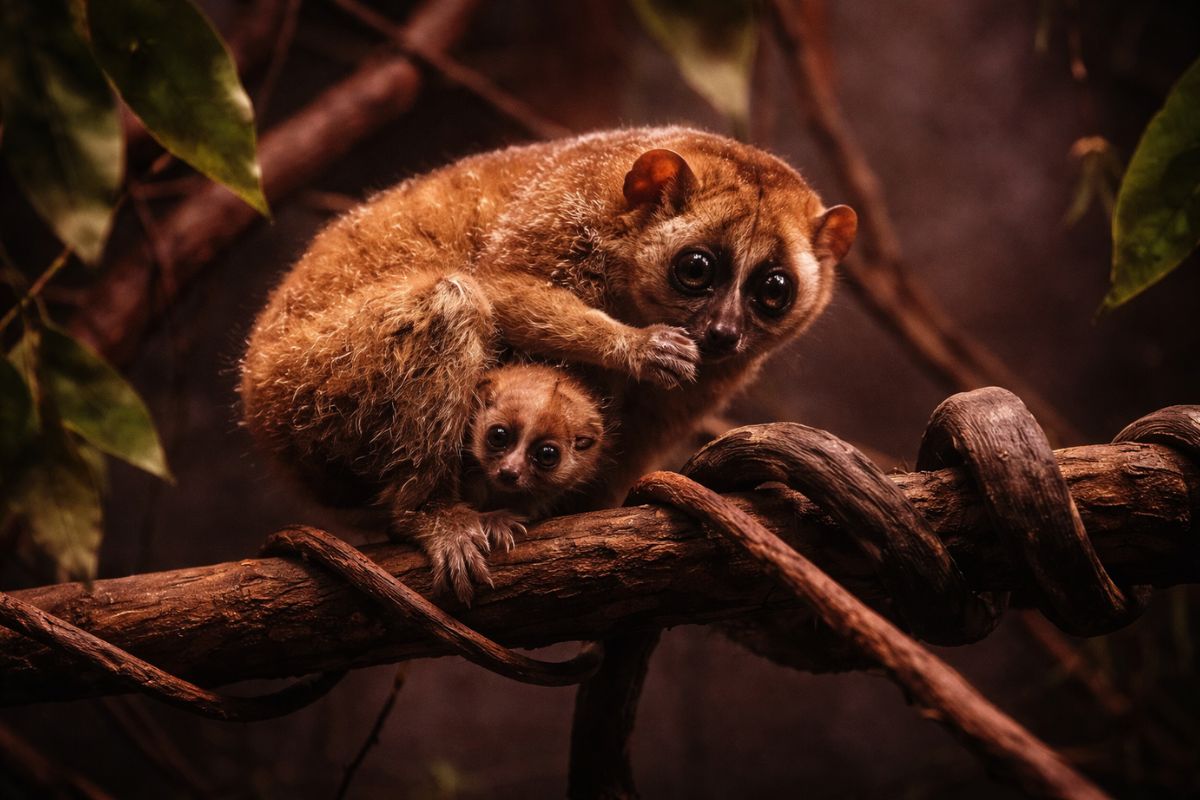
At The Bronx Zoo, The Birth Of The Only Known Venomous Primate Rekindles Warnings About An Endangered Species Targeted By Trafficking And Habitat Loss That Seems Harmless, But Produces Toxin With A Rare Mechanism Among Mammals And Primates.
In New York, a baby pygmy slow loris, the only venomous primate on the planet, was born with the face of a defenseless little creature, big eyes, and soft fur, but carries one of the most surprising defense systems in the animal kingdom.
The birth took place at the Bronx Zoo and is part of an international captive breeding program that seeks to maintain a genetically diverse and protected population, while the species faces a real risk of extinction in the wild.
A Tiny Baby, With A Gentle Appearance And Life Clinging To Its Mother

The baby weighs about 20 grams, a size so small that it impresses even those who are used to births in zoos.
-
In Mexico, a 3,000-year-old Maya site with the dimensions of an entire city may have been built as a colossal map of the cosmos, created to represent the order of the universe and reveal how this people organized space, time, and rituals.

-
Japan wants to build a solar ring of 10,900 kilometers on the Moon to continuously send energy to Earth.

-
Weighing almost 1 ton, with temperatures of up to 3,000°C, the ability to launch 10,000 fragments within a radius of 1 km, capable of penetrating concrete and melting steel, Turkey’s terrifying bomb emerges as one of the most destructive non-nuclear weapons ever presented.

-
After a submarine disappeared beneath the “Doomsday Glacier,” scientists announce a new monstrous machine capable of operating at 3,000 meters depth to return to the heart of the ice and investigate a threat that could raise sea levels worldwide.


The first impression is inevitable: it resembles a miniature Yoda, with a curious and delicate air that deceives anyone who is not familiar with the species.
Even with this tranquil appearance, the routine in the first months is intense and completely dependent on the mother.
The babies are born with fur and open eyes and spend three to six months hanging on their mother’s body, being carried practically all the time while they are nursed.
The separation only happens for brief moments when the mother needs to forage for food.
During this time, the diet includes tree gum, sap, and nectar, as well as fruits and insects, a combination that sustains the female’s energy and the baby’s development.
Where The Pygmy Slow Loris Comes From And Why It Entered The Risk Zone

The pygmy slow loris is native to the forests of Southeast Asia, an environment that serves as a shelter and food source for an animal adapted to live among branches, away from the ground and with discreet habits.
However, this lifestyle does not prevent the species from being threatened.
Habitat loss and international wildlife trafficking appear as the main threats, fueling an illegal market that seeks exotic animals to keep as “pets.”
The problem is that, often, these animals die quickly due to the stress of captivity.
And there is an even crueler detail related to the illegal trade: the removal of teeth, done to reduce the risk of bites, a procedure that compromises the well-being and survival of the animal.
The Only Venomous Primate And The Bite That Changes Everything

What makes the pygmy slow loris a unique case is the fact that it is the only known venomous primate.
And it is not “venom” in a figurative sense: there is a real, specific, and highly unusual mechanism among primates.
It produces an oil through a brachial gland located at the upper part of the arm.
When the animal lifts its arms and licks this area, the enzymes in its saliva mix with the oil and form a toxin.
This toxin is absorbed by the teeth and ready to be injected through a bite.
In humans, the substance can cause skin necrosis and anaphylactic shock, serious effects that help explain why an animal so “cute” can also be extremely dangerous when cornered.
What The Venom Is Really Used For In Nature
Despite the impact the word “venomous” has, the use of venom is generally not a hunting weapon aimed at taking down prey.
The observed behavior indicates that the loris mainly uses this strategy for defense.
An important point is that the toxic bite appears as a tool in territorial disputes among individuals of the same species.
In other words, the venom also serves as a brutal warning in internal confrontations, something that changes the dynamics of competition within the group itself.
Additionally, biologists observe that the venom plays a role in hygiene.
By “grooming” itself with this toxin, the animal can fend off parasites and, in turn, signal to predators that this body is not an easy target.
The Body Of The Adult Loris, Made For The Night And For The Branch

When adult, the pygmy slow loris weighs approximately 400 grams.
It is a nocturnal animal with excellent vision, which helps explain how it can move and remain active while most predators and prey change behavior.
The limbs are extremely strong, and the wrists and ankles are flexible, a combination that allows it to cling tightly to branches and stay there for hours, without the rush of animals that depend on jumps or runs.
This anatomy reinforces a curious image: it is not an “explosive” primate, it is a primate of control, precision, and persistence, compensating for slowness with grip strength and efficiency in movement among the treetops.
A Rare Group, Pressured From All Sides
There are eleven known species of loris in the world, including one recently described in 2023. And there is a frightening pattern: all are classified as endangered to some degree.
This means that the birth in New York is not just a “cute good news.”
It represents a breath for a species that is being pushed to the brink by two simultaneous engines: habitat loss and international trafficking, turning an animal adapted to the forest into a high-risk commodity in the illegal market.
Why A Birth In Captivity Becomes A Message To The World
When a zoo participates in an international captive breeding program, the goal is not just to increase numbers for the sake of it.
The central idea is to maintain a genetically diverse and safe population, something crucial when the species faces such strong pressure in the wild.
This type of birth also helps to draw attention to a point that many people ignore: “small” and discreet species can have unique biological roles, and when they disappear, they take with them rare evolutionary traits, like the case of the only known venomous primate.
And now, with this baby growing under monitoring, the story gains a new symbol: a tiny animal with huge eyes that seems harmless, but reminds us that nature holds surprising defenses and that extinction often arrives without warning.
Do you think that trafficking and habitat destruction will continue pushing rare species toward extinction, or can cases like this still turn the tide of real protection?









-

-

-

5 pessoas reagiram a isso.