





 Portuguese
  English
  Spanish
  4 min of reading
  1 comment




Historical Ship of 111 Years That Has Traveled 360 Thousand Nautical Miles and Has Had Five Different Names Transformed into Luxury Hotel After US$ 18 Million Investment in Tourist Island of Indonesia
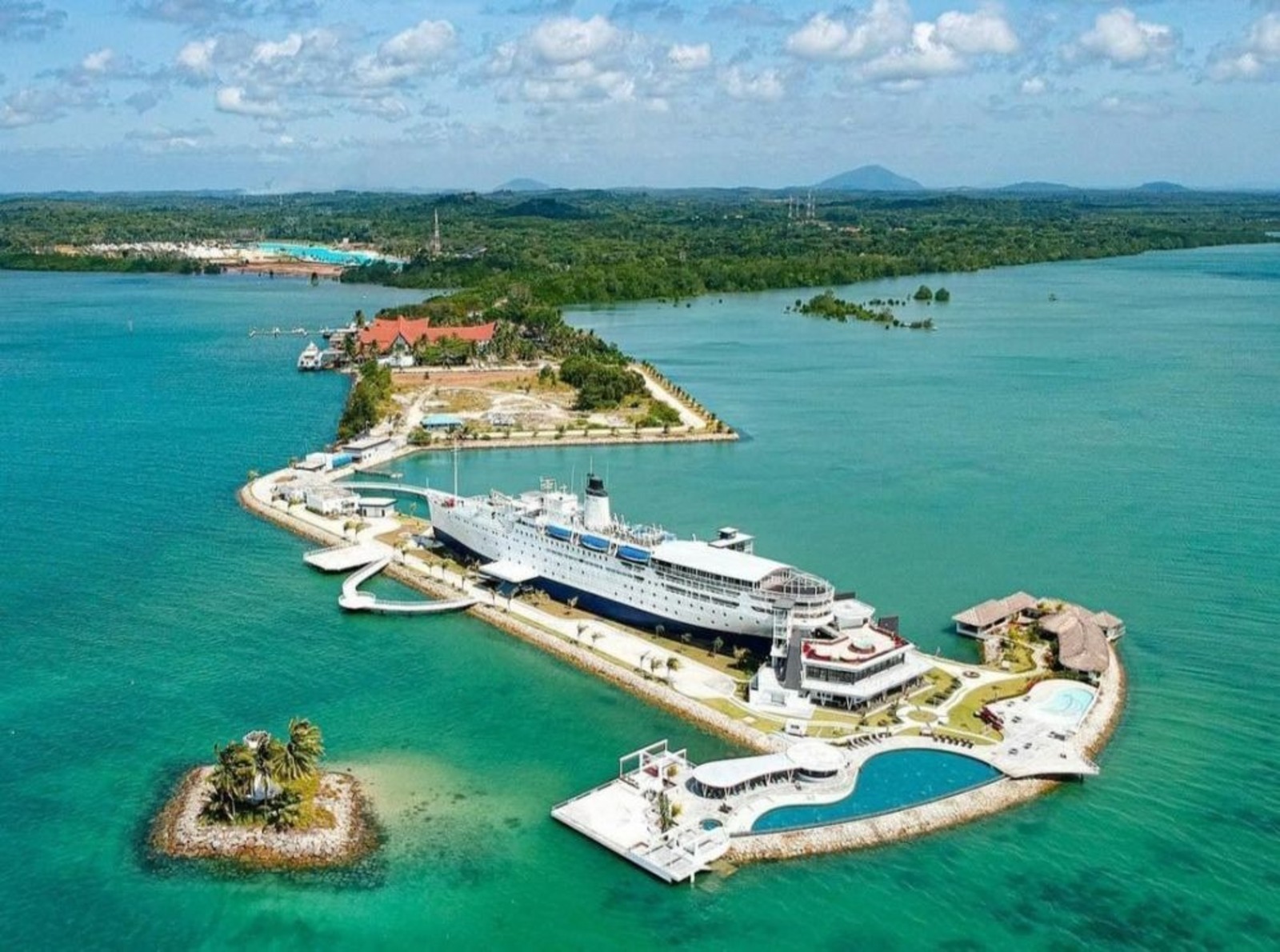
The Doulos Phos, 111 years old, has been transformed into a hotel after a US$ 18 million investment and 15 years of renovations on the island of Bintan, Indonesia. The conversion preserves the history of the vessel and creates a new tourist attraction linked to the legacy of the former historical ship.
Origin of the Historical Ship and First Transformations
Built in 1914 at the Newport News Shipbuilding in Virginia, United States, the SS Medina steamship entered service two years after the Titanic began its maiden voyage. The vessel started its career transporting onions and other commercial goods.
During World War II, the ship was called upon to assist the United States with logistical operations. Years later, it underwent conversion for passenger transport and was renamed the SS Roma.
-
With 1,066 acrylic panels, the building known as the friendly alien is supported by a steel skeleton, has a façade that functions as a giant screen, and impresses the world without any internal columns.
-
Scientists warn that a comet about 1 km in size that has started to release gases may actually change direction in space. It was spotted by NASA and surprises with potential impacts near Earth.

-
These living root bridges and ladders are over 700 years old and help indigenous people survive in one of the rainiest regions in the world.

-
From sertanejo star to international investor: Ana Castela invests millions in a mansion in the USA, creates a themed accommodation in Orlando, and shows that the “boiadeira” also wants to grow away from the stage.


The transformation continued when it received a diesel engine and began operating as a cruise ship under the name MS Franca C.
These changes marked new stages in the trajectory of the historical ship, which remained active in different roles over the decades.
In 1977, the vessel was purchased by a Christian organization and was renamed MV Doulos. During this period, it began to function as a missionary ship and floating library.

World Travels and Episode in the Philippines
For about three decades, the MV Doulos traveled over 360 thousand nautical miles and visited more than 100 countries. The missionary project brought books and religious activities to various regions of the world.
In 1991, the ship was targeted by a grenade attack in the Philippines carried out by Muslim separatists. The attack left two evangelists dead.
Even after this incident, the vessel continued to operate for several years. Throughout this period, it established itself as the historical ship with the longest active passenger service.
Transformation into Hotel After Purchase in 2010
The future of the ship seemed uncertain in 2010. The MV Doulos was no longer considered safe for navigation, and meeting new maritime safety standards would require millions in investments.
Singaporean entrepreneur Eric Saw presented the winning proposal to buy the vessel for 900 thousand euros, about R$ 5.7 million.
Even after the purchase, costs continued to rise. For over three years, Saw paid docking and maintenance fees while searching for a permanent location for the project.
After failing to obtain permits in Singapore, he found support on the Indonesian island of Bintan, where a tourist complex had been created in the 1990s in partnership between Indonesia and Singapore.
Construction of the Artificial Peninsula and Installation of the Ship
The solution found was to install the historical ship on solid ground. A developer offered to recover more than 12 thousand square meters of coastal area on the northern coast of Bintan.
The land was designed in the shape of an anchor, as requested by the entrepreneur. Construction began in 2014.
Before the final installation, the ship was towed to Batam, where it underwent structural renovations. In October 2015, the vessel made its last journey from Batam to Bintan.
To position the ship, engineers dug the seafloor next to the artificial peninsula and created a basin. The 6,800-ton hull was then dragged over 170 meters to its final platform.
The move utilized air bags as rollers and mechanical winches. The process took seven weeks, more than three times the initially planned time.
Hotel Structure Preserves Original Elements
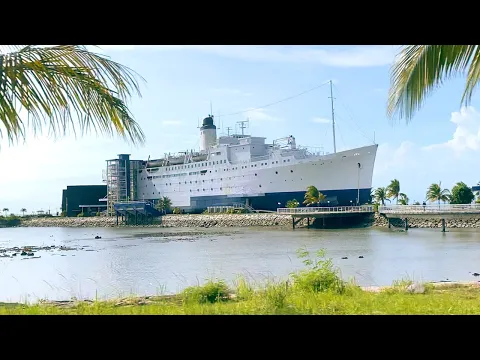
Today, the historical ship is installed on a concrete platform measuring 130 by 16 meters, supported by piles that go more than 40 meters deep into the ground.
The hull measures 130 meters and was built with steel plates joined by rivets, a technique common before the popularization of welding in shipbuilding in the 1930s.
The hotel currently has 93 cabins distributed throughout the internal compartments. Some preserve original round portholes and metal doors.
During the renovation, fuel tanks and internal divisions were removed to expand the spaces. Modern plumbing, electricity systems, elevators, and escape routes were also installed.
The rates vary between 1.7 million and 3.8 million Indonesian rupiah, equivalent to approximately R$ 572 and R$ 1,278.
Among the preserved elements are the propeller shaft, six original lifeboats, and the old engine room, which remains open for visitation.
Some compartments have been kept as “experience cabins,” allowing visitors to see what the original accommodations were like.
Project Took 15 Years and Million-Dollar Investment
Eric Saw claims to have invested around 23 million Singapore dollars, approximately US$ 18 million or R$ 97.7 million, over 15 years to complete the project.
According to him, he receives only a symbolic salary of US$ 1 per year, dedicating the hotel profits to Christian causes.
Although it is now on solid ground, the entrepreneur states that all changes are reversible. If a future owner desires, the historical ship could return to the sea.
Saw also asserts that the original structure of the vessel can last another 111 years. Still, he highlights that rust remains the main maintenance challenge.
For him, preserving the vessel goes beyond a business project. The main goal is to keep alive the history of what he calls the “great lady of the seas.”
With information from CNN.





Ne lê o que a IA escreve. Passa pelo menos o corretor ortográfico. REPOLSA é sacanagem.