





 Portuguese
  English
  Spanish
  3 min of reading
  0 comments


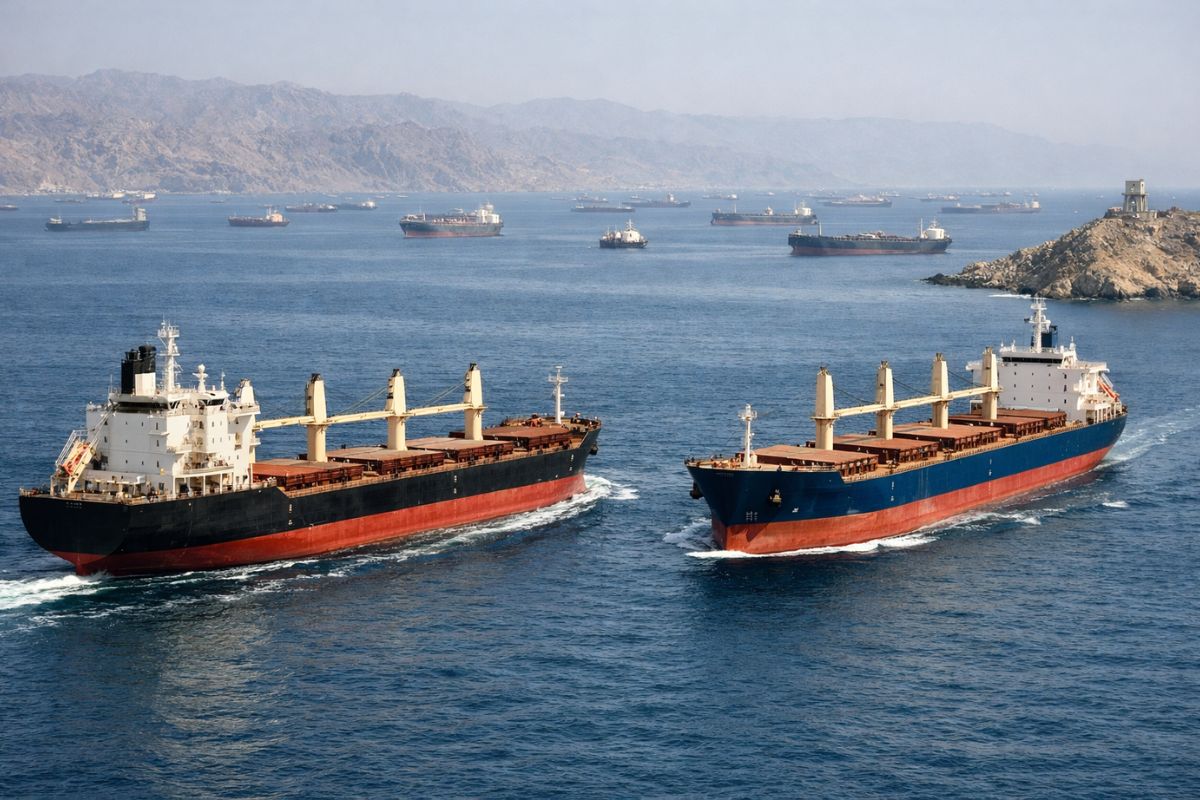
In Ormuz, two grain carriers transited safely according to MarineTraffic, while 426 tankers and other vessels remain detained, maintaining uncertainty about the normalization of the oil corridor
Ormuz has recorded ship crossings again following the announcement of a ceasefire between Iran, the United States, and Israel. At least two vessels crossed the strait safely, according to the latest data from the MarineTraffic monitoring platform.
Nonetheless, the movement in Ormuz still remained well below the standard. Hundreds of ships remained in the Persian Gulf region, suggesting that the resumption should be gradual and cautious on the part of the maritime sector.
Two grain carriers cross Ormuz after the ceasefire
On Wednesday morning (8), the NJ Earth, a Greek-owned grain carrier, crossed Ormuz, according to tracking data. About two hours earlier, the Daytona Beach, another grain carrier flagged in Liberia, had arrived in the Gulf of Oman, also according to MarineTraffic.
-
Brazil’s exports to the U.S. plunge for the eighth consecutive time, while China expands its leadership, and this is changing the landscape of foreign trade in 2026.

-
The Federal Government wants to curb family indebtedness and is considering releasing FGTS with a renegotiation that could cut up to 80% of debts for families and individual micro-entrepreneurs (MEIs).

-
‘Theory of the Madman’ is the strategy that explains why Trump threatened to end Iran and hours later offered a two-week truce as if nothing had happened.

-
Oil secures a larger drop, exports advance in March, and Brazil ends the month with a surplus of $6.4 billion despite the strong rise in imports.

The number of crossings is still small, but the record of these passages has already signaled an initial reactivation of circulation in the strait.
Hundreds of vessels remain detained in the Persian Gulf
Despite the crossings, MarineTraffic reported that hundreds of vessels remained in the area. The group included 426 tankers, as well as 34 liquefied petroleum gas carriers and 19 liquefied natural gas carriers.
This accumulation reinforced the view that, even with the ceasefire, the release of traffic in Ormuz does not happen immediately.
Route used in Ormuz passed through a control area
All indications were that the two vessels followed a route that passes by Larak Island, Iran. Previous information from Lloyd’s List Intelligence indicated the area as a checkpoint used by the Islamic Revolutionary Guard to control access to Ormuz.
The detail of the route helps explain the caution and sensitivity surrounding the corridor, especially in the post-conflict scenario.
Why is Ormuz so strategic for oil
Ormuz is a crucial point for global maritime transport. Transport experts have expressed uncertainty about a rapid resumption of circulation in this stretch, where about 20% of the world’s oil supply typically passes.
Before the war began, about 130 vessels transited the waterway daily, according to UNCTAD (United Nations Conference on Trade and Development), highlighting the contrast with the still low flow observed now.
Oil falls, but the pace in Ormuz remains in doubt
Following the announcement of the ceasefire, oil prices plummeted, but the market and the maritime sector were still monitoring concrete signs of normalization in Ormuz.
In parallel, indications emerged that Iran and Oman are expected to charge fees for ships passing through the strait, and Iran stated that a reopening for two weeks “is possible,” elements that kept the topic on the radar.
In the short term, the picture is one of slow resumption, with few ships crossing and many still waiting in the Persian Gulf.
And you: do you think Ormuz will return to normal flow in the coming days, or will this queue of ships still take time to move?








Seja o primeiro a reagir!