





 Portuguese
  English
  Spanish
  4 min of reading
  0 comments


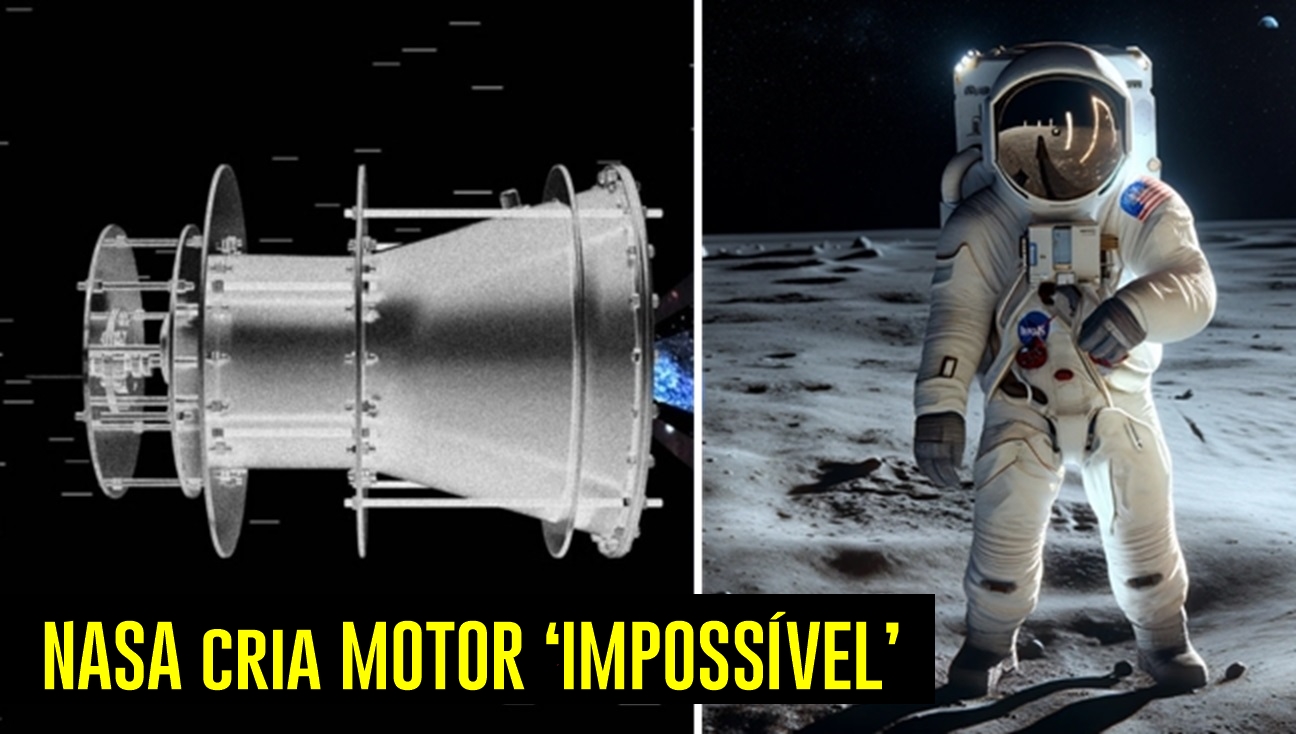
NASA Unveils Innovative Engine Without Moving Parts And Combustion That Challenges Current Technology And Opens New Possibilities In Space Exploration
The search for new propulsion methods for space exploration is one of the biggest challenges faced by agencies and scientists around the world. NASA scientists are at the center of a scientific controversy with the development of the EmDrive, an engine that supposedly generates thrust without the need for fuel or moving parts — something which, according to the known laws of physics, would be “impossible.”
The Challenge of Conventional Engines in Space Missions
One of the main obstacles in space exploration is the need to overcome Earth’s gravity and reach a speed capable of placing objects into orbit.
This process consumes an abundance of fuel, and the heavier the equipment or payload, the greater the fuel needs, resulting in a surge in weight and costs. Conventional combustion or electric engines face severe limitations in this regard.
-
Something is happening around the Earth: Inside the huge explosion of fireballs in 2026

-
A hot air bubble coming from Argentina expands over Brazil, causing thermometers to exceed 38 degrees with a thermal sensation of 40 degrees in late March, affecting 6 states at once.

-
The radish leaf that almost everyone throws away has more polyphenols, flavonoids, and fiber than the consumed root, and a 2025 study showed that the leaf contains compounds that protect the intestine, combat inflammation, and may inhibit the growth of cancer cells.

-
A planet that seemed to defy the laws of physics has intrigued scientists for decades, until the James Webb revealed what is really affecting Saturn’s rotation.

Combustion engines, for instance, rely on propellants that significantly increase the vehicle’s weight.
Electric engines, no matter how efficient, require bulky and heavy batteries to operate, complicating the feasibility of long space missions even further.
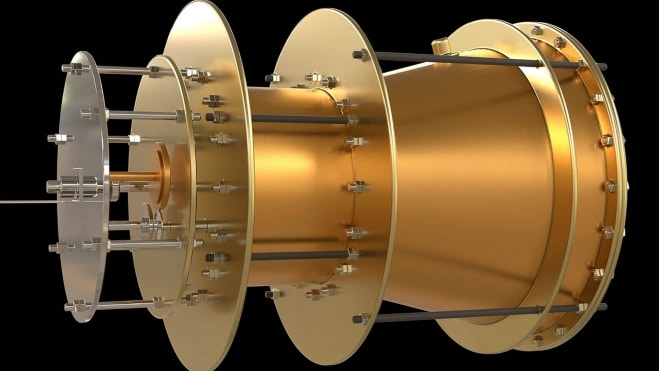
EmDrive: The “Impossible” Engine That Generates Thrust Without Fuel
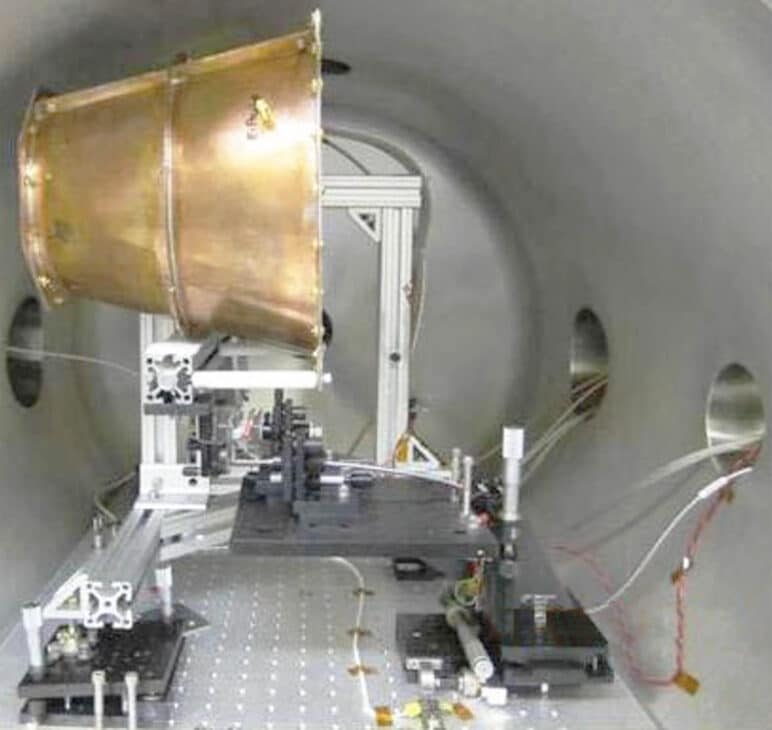
It was in light of these challenges that NASA began studying the EmDrive, a concept introduced in 2001 by British engineer Roger Shawyer. The EmDrive is an electromagnetic engine that promises to generate thrust through the reflection of microwaves in a closed conical cavity. The goal is to create an internal force capable of moving the device without expelling any type of matter, which drastically differentiates it from conventional engines that eject propellant to generate movement.
The concept contradicts the Law of Conservation of Linear Momentum, one of the pillars of classical physics, as there is no mass ejection for the force to be created. This proposal divides the scientific community, generating intense debates about the feasibility of the idea.
Tests and Controversies: The EmDrive Under Examination for Space Exploration
In 2016, scientists at NASA’s Eagleworks laboratory conducted tests with the EmDrive and obtained thrust measurements. Although the generated thrust was extremely small, these results were enough to fuel hope for a possible revolution in space propulsion. However, the nature of the results raised questions about the accuracy of the tests.
Scientists from various parts of the world began conducting independent tests to verify NASA’s data. A group led by researcher Martin Tajmar from the Technical University of Dresden in Germany built a prototype of the EmDrive to investigate the claims.
They conducted experiments in a controlled vacuum chamber, where sensors monitored vibrations, thermal variations, and resonances that could influence the thrust generated.
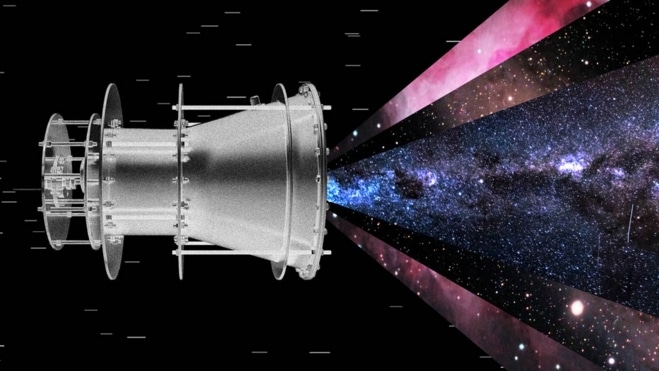
Preliminary Results Indicate External Interference
The study led by the Dresden team indicated that the observed thrust could be related to external factors, such as Earth’s magnetic field interfering with the electrical cables connected to the device. When researchers turned off the propulsion system, the EmDrive continued to generate a minimal thrust, something that, if the concept were correct, should not happen.
At a conference on space propulsion, Tajmar and his team suggested that the generated thrust could be explained by electromagnetic interaction with Earth’s magnetic field. This effect raises the possibility that the observed thrust in the EmDrive is not, in fact, a result of a new form of propulsion, but of known electromagnetic forces.
The Role of Mu-Metal in the Next Phase of Testing
Despite the criticism and skepticism, there is still no definitive verdict on the EmDrive. Experts like Jim Woodward from California State University, who developed his own thruster — the Mach Effect Thruster — advocate that new experiments should be conducted with mu-metal shielding, a material with high magnetic permeability that would insulate the engine from external magnetic influences, such as Earth’s magnetic field.
Woodward explains that using this shielding could eliminate any external interference and make the tests more reliable. Additionally, he suggests that tests with higher energy levels should be conducted, as the real signals from the EmDrive could be obscured by interferences.
The Impact of Possible Validation of the EmDrive
If the EmDrive is proven to be a viable form of propulsion, it has the potential to revolutionize space exploration.
Without the need for fuel, long-duration missions and interplanetary exploration would become significantly cheaper and less complex. However, if tests continue to point to external interference as the cause of the thrust, the scientific community will likely dismiss the concept as viable for propulsion.
At this time, the possibility that the thrust results from unintentional effects, such as magnetic interactions, has not been completely ruled out.







-

Uma pessoa reagiu a isso.