





 Portuguese
  English
  Spanish
  4 min of reading
  0 comments


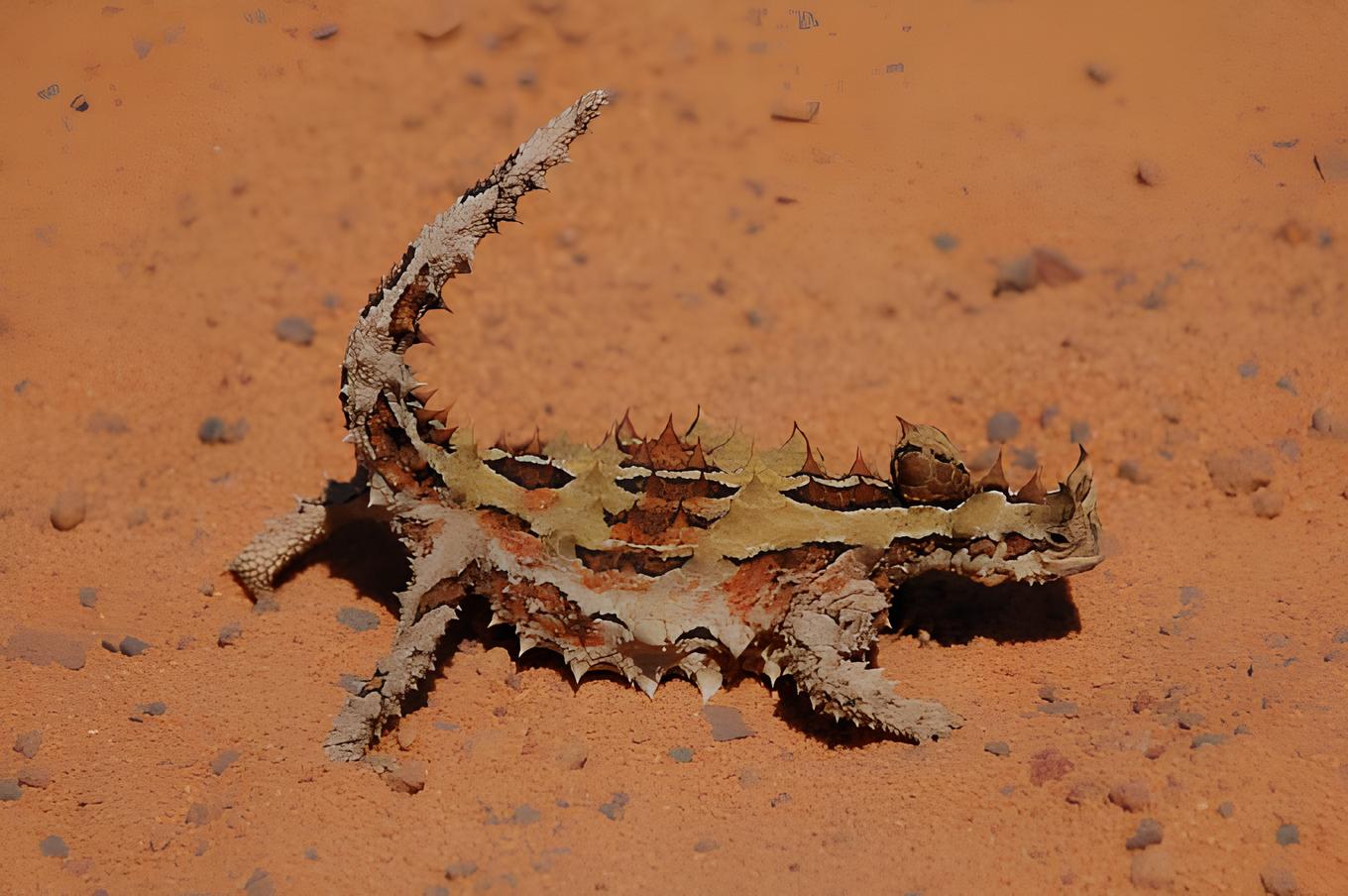
The Spiny Devil (Moloch horridus) Uses Microchannels In Its Skin To Capture Water From The Soil And Transport It To Its Mouth, Surviving In The Australian Desert With Natural Hydraulics.
Few people imagine that a reptile could “drink” without touching its mouth to water, simply using its body as a natural hydraulic system. But the Australian desert holds this rare and profoundly technical biological phenomenon: the Spiny Devil, species Moloch horridus, a spiny lizard that lives in arid regions with rainfall of less than 250 mm per year and temperatures that can exceed 45 °C. Science has been studying this creature for decades because it solved an extreme problem: how to obtain water in an environment where there are almost no puddles, rivers, dews, or reservoirs?
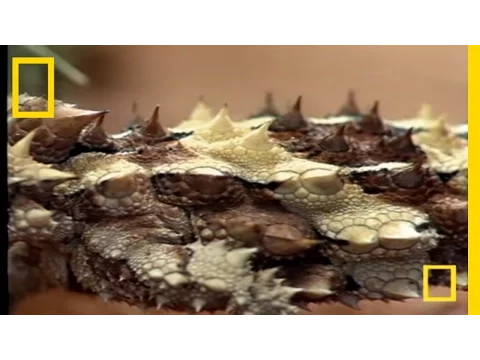
The fascination starts at the skin. The surface of the Spiny Devil is made up of microstructures that form interconnected hydrophilic channels, a network resembling tiny tunnels that conduct liquids by capillarity.
When water touches these channels, whether from dew, rain, moisture from the sand, or even condensation between soil grains, it is pulled by surface tension gradients and moves towards the animal’s mouth. Studies published in the Journal of Experimental Biology describe this cutaneous microhydraulics and quantify the flow, showing that transportation can be continuous and efficient even with minimal volumes.
-
With a cost per shot close to zero, the DragonFire laser could change naval warfare in 2027 and provide British ships with nearly unlimited defense against drones.

-
A British startup creates tires that generate electricity in electric vehicles when passing over potholes, speed bumps, and cracks.

-
Scientists have created robots made with living cells that have their own nervous system, swim on their own, explore the environment, and self-organize without any genetic engineering, and now they want to do the same with human cells.

-
Students create a solar-powered ambulance that operates without a plug, without fuel, and still keeps medical equipment running in remote areas.


The Natural Hydraulics Of Moloch Horridus
The mechanism works thanks to the simple and relentless physics of capillarity. Between scales and spines, there are microchannels on the order of tens to hundreds of micrometers.


These channels are connected in such a way that when wet, they create a continuous flow path to the commissure of the mouth. At this point, the lizard performs the final movement: it lightly sucks, as if drinking through a sealed straw, completing the ingestion.
This phenomenon has been observed in the laboratory using dyes and high-resolution cameras. Researchers from the CSIRO (Commonwealth Scientific and Industrial Research Organisation) have also investigated the effect of moist sandy substrates, demonstrating that even without visible water, the lizard can collect small volumes sufficient to maintain hydration.
Under experimental conditions, droplets applied to the tail traveled through the body to the mouth without the reptile needing to move.
Surviving In The Desert, An Evolutionary Engineering
The habitat of Moloch horridus includes arid areas of central and western Australia, where water availability is highly seasonal. Rainfall is low, the soil is poor in retention, and surface water sources evaporate quickly.
In this scenario, natural selection has favored radical adaptations: a specialized diet of ants (thousands per day), efficient metabolism, cryptic behavior, and the unusual ability to capture water from the environment.
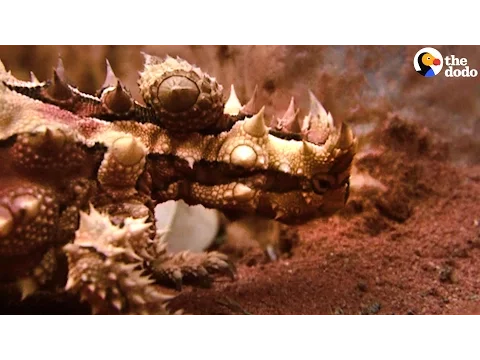
The accumulation of water occurs not only from rain but also from the “washing” of the soil itself. Some studies report that when the lizard finds a moist substrate, it flattens its body and takes advantage of the ascending moisture to wet its skin, activating the capillary network. It’s as if the animal transforms the sand into an invisible reservoir.
Biomimetics And Scientific Interest
The interest in the Spiny Devil goes beyond zoology. Materials researchers have studied the pattern of microchannels and the hydrophilic surface to replicate structures with potential uses in:
– Passive water collection in the desert
– Hydrophilic surfaces for environmental engineering
– Materials for fog harvesting
– Passive desalination devices
Laboratories involved in biomimetic research cite Moloch horridus as inspiration similar to the Namib desert beetle and the xerophytic plants that condense water on their surfaces.
The Paradox Of A Spiny Lizard
Although its appearance is aggressive, the Spiny Devil is slow, small (around 10–16 cm in length) and harmless to humans. Its spines serve to defend against predators like birds of prey and monitors, and not to store water.
The spiny architecture, however, helps increase the contact area with droplets and dew — more contact, more capillarity.
This combination makes Moloch horridus a meeting point between physics, ecology, and evolutionary engineering. It not only survives in one of the driest environments on the planet but does so using a method that until recently seemed like science fiction: absorbing water through its skin and transporting it through microchannels as if it were piping.
What Does This Species Teach Us?
In the end, the Spiny Devil exposes a simple and powerful truth: nature solves extreme problems with extreme solutions. Water, which for us requires expensive infrastructure pumps, plumbing, and reservoirs, can be captured by a skin system just micrometers wide, activated only by physics and instinct.
In a world seeking sustainable technologies for arid regions, it’s worth asking: how many solutions already exist in nature waiting to be copied?








-

-

-

-

6 pessoas reagiram a isso.