





 Portuguese
  English
  Spanish
  5 min of reading
  0 comments


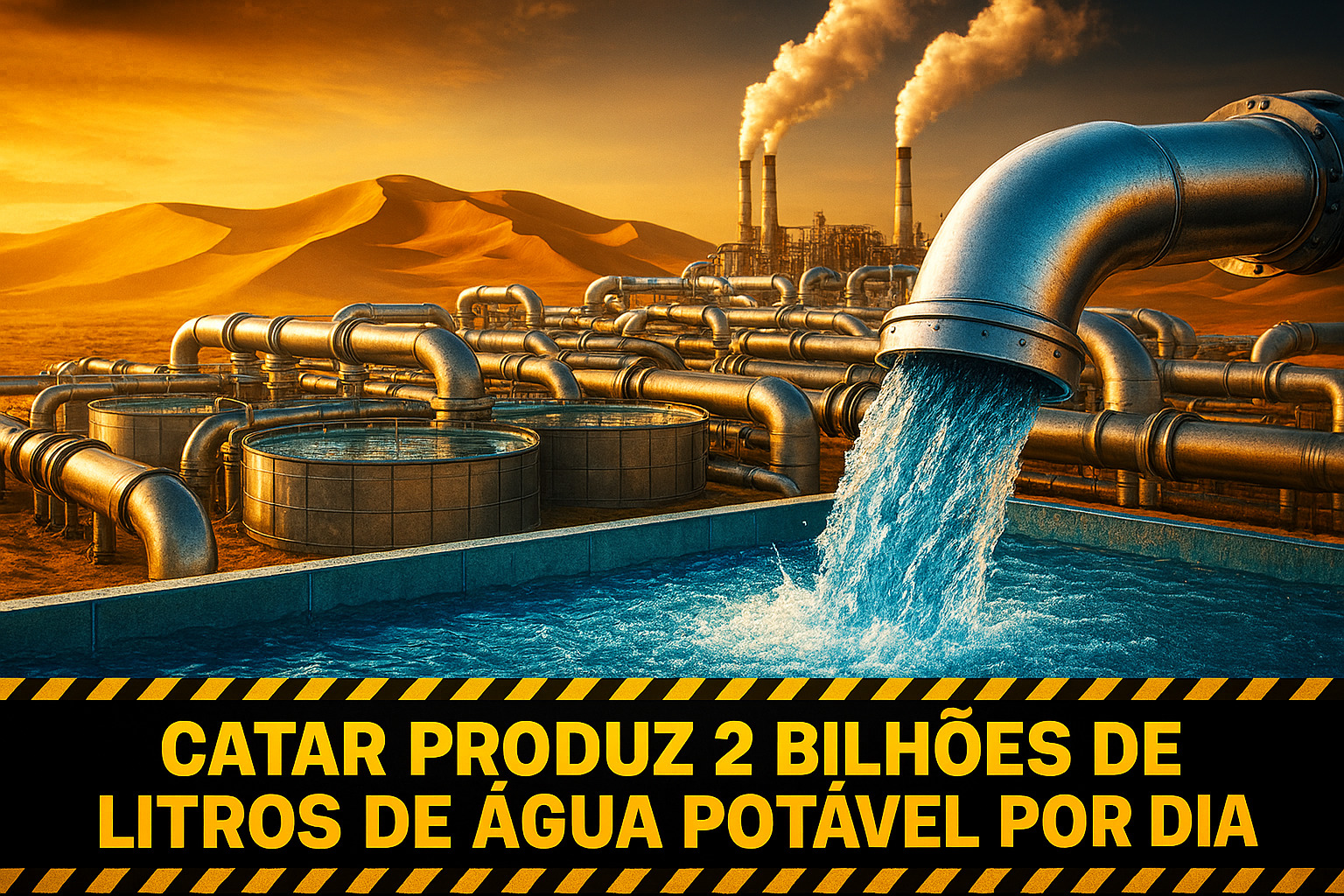
In Qatar, Natural Gas-Powered Plants Produce 2 Billion Liters of Water Per Day, Ensuring About 75% of Drinking Water for the Population in the Desert.
Qatar is a small country in territory but gigantic in technological ambition. Located in the Arabian Peninsula, one of the driest regions on the planet, it has an existential challenge: there are no rivers, lakes, or significant underground reserves of fresh water. Yet, amid temperatures exceeding 45 °C in summer and a complete absence of regular rainfall, more than 2.7 million inhabitants depend daily on drinking water.
The response found by the country was bold: to transform natural gas — of which Qatar has one of the largest reserves in the world — into energy to power colossal desalination plants. Today, these facilities provide almost 75 to 80% of the drinking water consumed in the country, on a scale that impresses engineers, environmentalists, and geopolitical analysts.
The Power of Desalination Plants
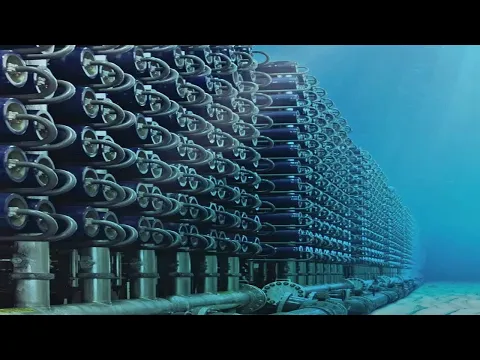
In Qatar, most of the drinking water comes from two main complexes: Ras Abu Fontas and Ras Laffan. Together, these plants utilize the process of thermal desalination through multi-stage distillation (MSF and MED), in which seawater is heated until it evaporates, separating from the salt and other impurities.
-
It took just two days of walking in the jungles of New Guinea to find the plane that historians had been searching for for 80 years: the legendary Marge still had its original red paint and the face of the woman who named the most feared fighter of World War II.

-
On a rocky stretch of just 40 meters in South Africa, scientists found dozens of footprints that are 132 million years old hidden beneath the tide, revealing the youngest record ever identified in the southern part of the African continent.

-
Artemis 2 makes history by bringing astronauts in a ‘fireball’ at over 40,000 km/h and 2,700 °C in an impressive reentry that challenges human limits.

-
At over 2,000 meters above sea level, archaeologists have found a medieval city spanning 120 hectares with four citadels hidden in the mountains of Uzbekistan. This discovery dismantles the idea that the Silk Road was merely a passage and reveals a colossal urban center where no one imagined.

Numbers That Impress:
- Combined daily production: over 2 billion liters of drinking water (equivalent to 800 Olympic swimming pools per day).
- Installed capacity: about 2.4 million m³ per day, according to the Qatar Electricity & Water Company (QEWC).
- Energy integration: the plants operate in synergy with gas-fired thermal power plants that simultaneously produce electricity and steam for desalination.
This model — called cogeneration — allows Qatar to be extremely efficient in leveraging its primary natural resource, gas, transforming it not only into energy for export but into something even more valuable: drinking water.
Total Dependence on Desalination
While countries like Brazil, Canada, and Norway have abundant rivers, Qatar faces the extreme opposite. Practically 100% of the water consumed in the country is produced artificially from desalination.
This means that:
- Every glass of water, every shower, and every irrigation in the luxurious gardens of Doha actually comes from the sea transformed into fresh water.
- The energy and financial cost is extremely high, but the country manages to sustain the system thanks to its wealth in liquefied natural gas (LNG), of which it is the world’s largest exporter.
- Desalination also ensures controlled irrigation of agricultural greenhouses and urban green areas, essential for the “sustainable modernization” project that the government promoted before the 2022 World Cup.
Environmental Impact and Energy Paradox
The Qatari model raises debates in the sustainability world. On one hand, it’s a brilliant technological solution to a vital problem. On the other, there are criticisms:
- High energy consumption: thermal desalination is one of the most energy-intensive processes ever developed.
- Dependence on gas: while exporting LNG to the world, Qatar consumes vast volumes internally to keep its water plants running.
- Saline waste: the process generates concentrated brine, which is discharged back into the sea, potentially affecting coastal ecosystems.
Despite this, the Qatari government claims it has invested in more efficient technologies, including plants that utilize reverse osmosis desalination and pilot projects with solar energy.
Global Comparisons
To understand the magnitude of the Qatari achievement, it’s worth comparing with other desalination giants:
Saudi Arabia: world leader, produces about 5 billion liters per day, but in a territory nearly 20 times larger than Qatar.
Israel: a reference in reverse osmosis technology, meets more than 80% of the country’s drinking water demand.
Qatar: although smaller, it is one of the most water-dependent countries in the world, being an extreme case of a society that only exists thanks to desalination.
In population proportion, no other country on the planet depends on this technology as much as Qatar.
The Strategic Role of Natural Gas
The choice for the cogeneration model was only possible because Qatar sits atop the third largest natural gas reserve in the world, shared with Iran in the giant North Dome/South Pars field.
This resource guarantees not only billion-dollar LNG exports to Europe and Asia but also abundant internal energy to power plants like Ras Laffan. In other words:
The same gas that heats homes in Germany and powers industries in China is used to transform water from the Persian Gulf into drinking water for Qataris.
This balance between export and domestic use is part of the strategy that has made Qatar one of the richest economies in the world in terms of GDP per capita.
Technology and Future
Even with such dependence, Qatar has already realized that it cannot base its future solely on gas. The country invests in research to make desalination more sustainable:
- Hybrid solar projects: pilot plants utilize solar energy to reduce part of the gas consumption.
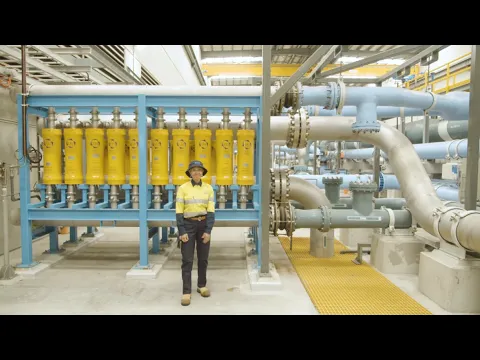
- Advancements in reverse osmosis: more efficient, can reduce energy consumption by up to 50% per liter produced.
- International partnerships: collaboration with Japanese and South Korean companies to develop more durable membranes and processes that are less harmful to the sea.
The goal is to reduce the carbon footprint without compromising water security, something vital in a region projected to face rising temperatures and increased climate scarcity in the coming decades.
The Daily Miracle of Survival
For any visitor in Doha, drinking a simple glass of water in a luxury hotel or even watering plants in urban gardens may seem trivial. But in practice, each liter consumed is the result of a gigantic engineering process, driven by the country’s energy wealth.
Without the plants, there would be no way to sustain modern life in Qatar. The country, which hosted millions of tourists during the 2022 World Cup, was able to offer global standard infrastructure only because it built cities in the desert supplied with artificially created water.
The example of Qatar serves as a warning to the world. According to the UN, one-third of the global population will live in water-scarce areas by 2050. In many places, desalination may stop being the exception to become the rule.
If today Qatar uses its gas to survive in the desert, in the future countries on all continents may have to adopt similar solutions. And the question remains: who will have enough resources and energy to transform the sea into fresh water on a massive scale?






Seja o primeiro a reagir!